Limenandra barnosii Carmona, Pola, Gosliner & Cervera, 2014
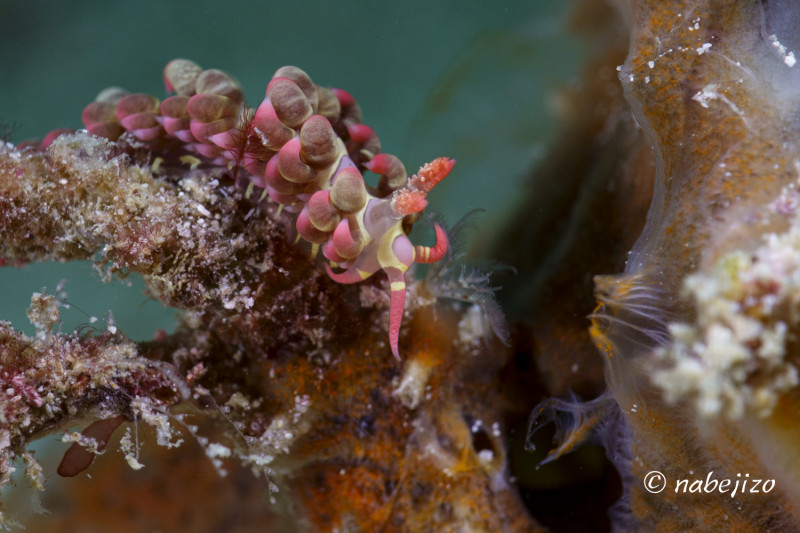
- Location
- Thailand
- Date
- 2021/03/28
- Length
- 10mm
- Depth
- 10.0m
- Water temperature
- 29.0℃
Description
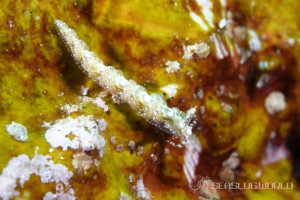
Body elongate and slender, tapering close to the tail. Anterior foot margin rounded; tentaculiform foot corners with a deep groove across the width. Body colour pale pink with lime-green pigment all over the dorsum. From head to tail the dorsal surface bears a series of concentric circles, bright lemon yellow outside and pinkish-purple inside. The number of circles varies with body size, up to fifteen. The edge of the foot alternates transverse translucent and lime-green bands from head to tail. Bases of the pink rhinophores very close. Rhinophores densely papillate on the posterior side, presenting orange colouration on the papillae; papillae elongate, not uniform in size and occasionally bifurcated. Oral tentacles pinkish, elongate and longer than rhinophores. Foot corners same colour as the body, with two lime-green rings (one just below the pink tip and one at the midpoint). Cerata moderately long, fusiform and rounded; tips slightly recurved inwards. Cerata dark olive green with lime-green pigments scattered all over their surface; distal part pink with translucent tips. Cerata arranged in up to twenty-five rows, very close together every two rows; some rows join over the dorsum forming a side-to-side arch with the opposite row.Distribution
Known from the Philippines, Indonesia and New Caledonia (Gosliner et al. 2008; present study). Type locality: Matotonngil Point, Balayan Bay, Batangas Province, Luzon Island, Philippines. Feeds on the anemone Alicia sansibarensis.Etymology
Verbatim from the original description (Carmona et al. 2014, Helgol Mar Res 68: 43):This species is dedicated to Mohamed Barnosi, grandfather of the first author of this paper.
Remarks
Described as a new species in Carmona, Lei, Pola, Gosliner, Valdés & a 2014 revision Helgoland Marine Research 68: 37-48. The author noted:Limenandra barnosii is easily distinguishable from other Limenandra species by its bright colours. It also differs from L. nodosa, L. confusa and L. fusiformis in the ornamentation, colouration and size of the cerata, the number of salivary glands and the reproductive system. While L. barnosii has smooth cerata, those of L. nodosa and L. confusa are often papillate. L. fusiformis also has smooth cerata, but some of them are significantly longer than the cerata of L. barnosii. Moreover, only L. barnosii has two pairs of salivary glands and a long oviduct leading from its junction with the vas deferens to the receptaculum seminis(p.43).
References
A Kindle field guide by the site author
Kimoto N. (2026). Sea Slugs of Japan & the Indo-Pacific, 2nd Edition.
Kindle Edition
View on Amazon PR (Amazon Associates)Seasonality
Shooting Locations
Loading shooting locations...
Photos of Limenandra barnosii

Same Genus Nudibranchs

Academic Database
Sea slug observation data is available in international marine biodiversity databases.