Limenandra rosanae Carmona, Pola, Gosliner & Cervera, 2014
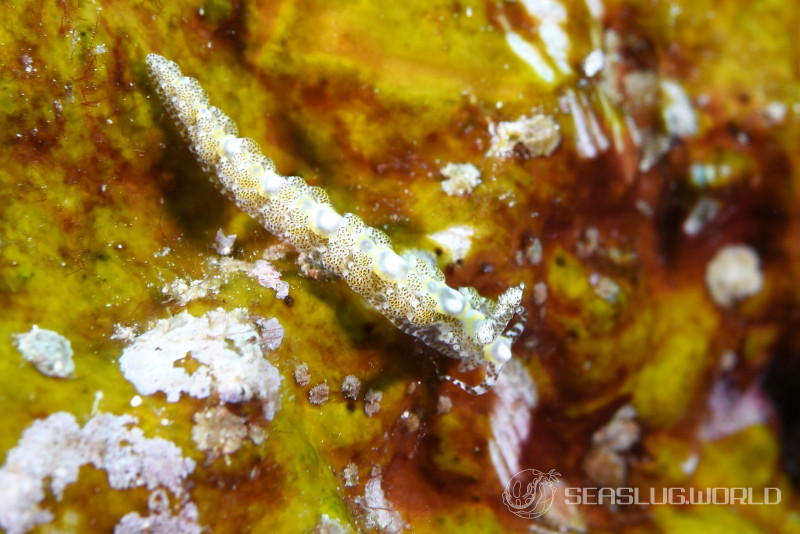
- Location
- Maibara W Reef, Ishigaki and Yaeyama, Okinawa, Japan
- Date
- 2018/05/24
- Length
- 10mm
- Depth
- 10.0m
- Water temperature
- 29.0℃
Description
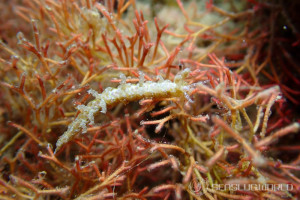
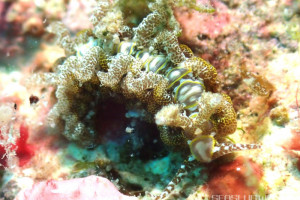
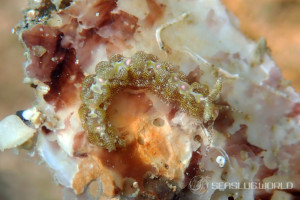
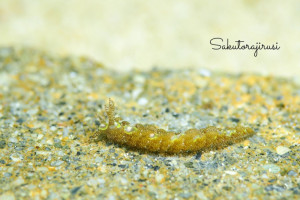
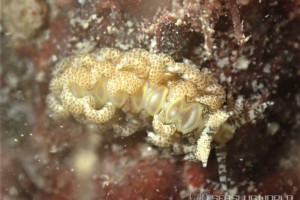
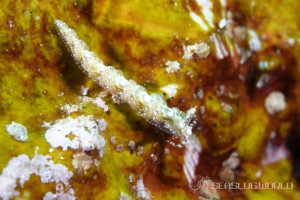
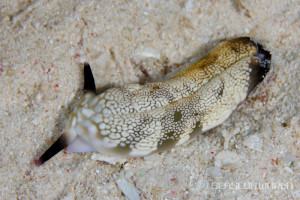
Body elongate and slender, tapering posteriorly. Anterior foot margin rounded; foot corners tentaculiform with a deep groove across the width. Ground colour pearly white. From head to tail, the dorsal surface bears a series of concentric circles in bright lemon yellow (sometimes absent), bright grey, and pearly white to pink. The number of circles depends on body size and may reach fifteen. Small ochre, dark-green or black spots together with bright yellow patches form a continuous band along each side. The rhinophores have closely spaced bases and are pearly white with the same small dark spots; they bear elongate, non-uniform, sometimes bifurcated papillae densely on the posterior side. Oral tentacles longer than the rhinophores. Cerata moderately short, fusiform, with tips slightly recurved towards the tail; pearly white overlaid with the ochre / dark-green / black spots.Distribution
Marshall Islands (type locality: Kwajalein Atoll), Hawaii, Samoa, the Philippines, the Kerama Islands (Japan), and the Red Sea.Etymology
Verbatim from the original description (Carmona et al. 2014, Helgol Mar Res 68: 46):This species is dedicated to Rosana Carvalho Schroedl, wife of Michael Schroedl who kindly gave us the first specimen of this species.
Remarks
Described as a new species in Carmona, Lei, Pola, Gosliner, Valdés & a 2014 revision Helgoland Marine Research 68: 37-48. The author noted:Limenandra rosanae is clearly distinguishable from other members of the genus because of its external colouration and its pyriform receptaculum seminis. Furthermore, this species differs from L. nodosa and L. confusa in having two salivary glands and in lacking long cerata or papillae on any cerata. L. barnosii also has a pair of salivary glands but differs in colouration(p.47).
References
- ノードサ, 小野篤司. (1999). ウミウシガイドブック. TBSブリタニカ.
- クサリミノウミウシ(新称), 小野篤司. (2000). ウミウシガイドブック. 第2版. TBSブリタニカ.
- クサリミノウミウシ, 小野篤司. (2004). 沖縄のウミウシ. ラトルズ.
- クサリミノウミウシ, 小野篤司 & 加藤昌一. (2009). ウミウシ. 誠文堂新光社.
- Carmona L., Pola M., Gosliner T.M. & Cervera J.L. 2014. The end of a long controversy: systematics of the genus Limenandra (Mollusca: Nudibranchia: Aeolidiidae). Helgoland Marine Research, 68: 37-48. [Published online 7 August 2013; Code-compliant paper version published March 2014 page(s): 42, 44-47
- ジャノメミノウミウシ, 奥谷喬司. (2015). 日本近海産貝類図鑑. 第二版. 東海大学出版部.
- Limenandra rosanae, Terrence Gosliner, Ángel Valdés and David Behrens. (2015). Nudibranch and Sea Slug Identification Indo-Pacific. New World Pubns Inc.
Featured in this book
Terrence Gosliner, Ángel Valdés and David Behrens. (2018). Nudibranch and Sea Slug Identification Indo-Pacific 2nd Edition. New World Pubns Inc.
New World Publications
This species, Limenandra rosanae, is included in the book.
View on Amazon PR (Amazon Associates)Seasonality
Shooting Locations
Loading shooting locations...
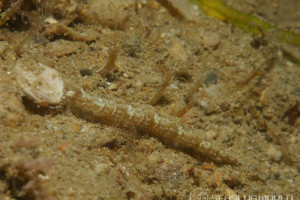
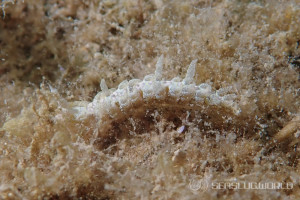
Photos of Limenandra rosanae







Same Genus Nudibranchs

Similar Colors Nudibranchs
Academic Database
Sea slug observation data is available in international marine biodiversity databases.