Myja longicornis Bergh, 1896
- Location
- Agung, Tulamben, Pulau Bali, Indonesia
- Date
- 2018/01/13
- Length
- 15mm
- Depth
- 16.0m
- Water temperature
- 28.0℃
Description
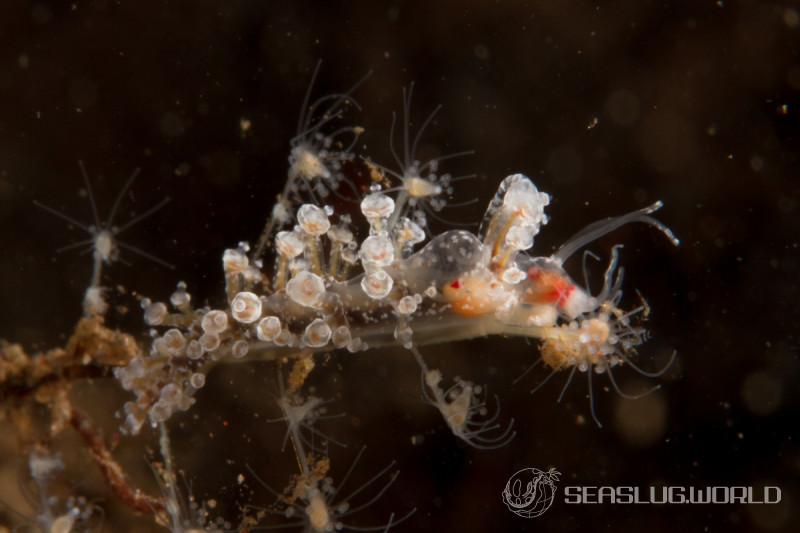
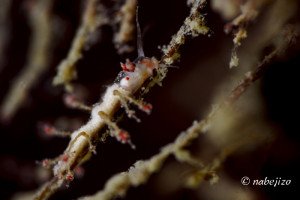
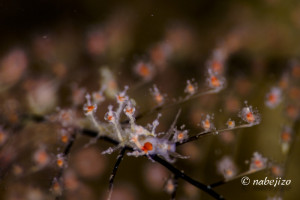
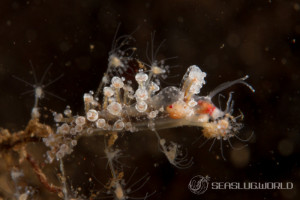
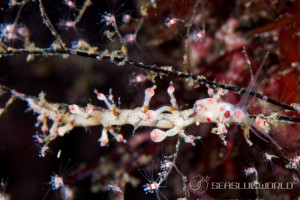
A small slender aeolid; living animals about 15 mm in length, with a translucent body. Cerata are arranged in seven pairs of small groups along the dorsal margin, with approximately equal spacing between groups. The first two groups contain three cerata each, the following three groups two each, and the last two groups only one ceras each, the number decreasing posteriorly. Each ceras is slender, with an inflated apex tipped by a fine point. The oral tentacles and rhinophores are both simple and elongate, the rhinophores being longer than the oral tentacles. In life the white reproductive lobes and green hepatic ducts show through the translucent body; a chocolate-brown spot lies at the base of the first ceratal cluster on the right, a red spot is present at the base of the oral tentacles, and fine red lines run along the body sides. The hepatic core of each ceras is green, and the apex around the cnidosac is suffused with brown pigment.Distribution
Type locality: vicinity of Ambon Island, Indonesia (Mer des Indes, Amboine). At the time of the original description the species was only known from Ambon, where it was collected on the hydroid Pennaria. It probably ranges across the Indo-West Pacific in habitats dominated by hydroids.Etymology
The specific epithet longicornis combines Latin longus ("long") with cornu ("horn"), meaning "long-horned", in reference to the conspicuously elongate oral tentacles and rhinophores of the species.Remarks
The type species of the monotypic genus Myja Bergh, 1896. The genus name honours the ancient Greek poetess Myia (Myja), as noted in the original description ("Nom d'une poète grecque"). The original description is based on three specimens collected on hydroids of Pennaria on 6 August 1890, during the Malay Archipelago expedition of Maurice Bedot and Camille Pictet, with Bergh contributing the eolid section "Eolidiens d'Amboine"; Learchis indica and Ennoia briareus were described as new genera and species in the same paper. Myja longicornis is presumed to feed on its hydroid host.References
A Kindle field guide by the site author
Kimoto N. (2026). Sea Slugs of Japan & the Indo-Pacific, 2nd Edition.
Kindle Edition
View on Amazon PR (Amazon Associates)Seasonality
Shooting Locations
Loading shooting locations...
Photos of Myja longicornis




Same Genus Nudibranchs
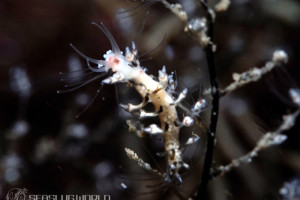
Similar Colors Nudibranchs
Academic Database
Sea slug observation data is available in international marine biodiversity databases.