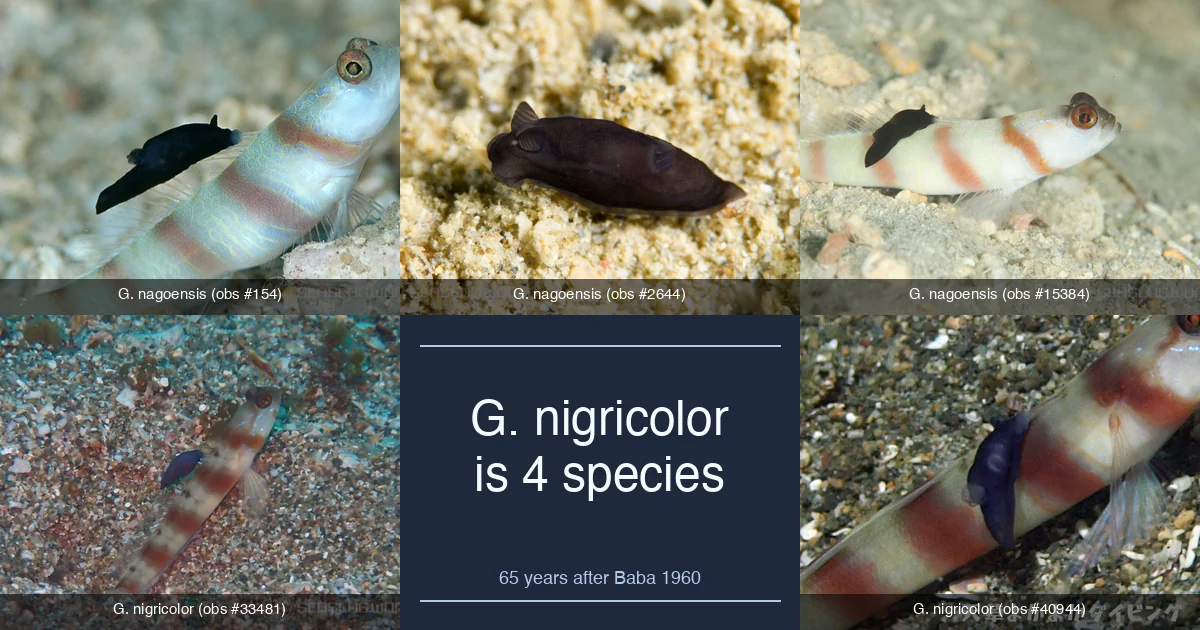
Gymnodoris nigricolor is a four-species complex: 65 years after Baba's 4 mm holotype
The black nudibranch that clings to gobies and bites at the soft tissue between the fin rays — Gymnodoris nigricolor, long familiar to divers as the goby-fin parasite — has been split. De Souza-Canal et al. (2025) show it is a complex of at least four species. The anchor for the entire group is a single specimen, 4 mm long, that Kikutarô Baba pulled out of muddy substrate at 2 m depth in Misaki, Sagami Bay, Japan, in 1960. Sixty-five years later, what was inside "G. nigricolor" is finally being unpacked.
Paper
Baba 1960: a single 4 mm specimen from Misaki
Gymnodoris nigricolor Baba, 1960 was described from a single 4 mm specimen collected on muddy bottom at 2 m depth in Misaki, on the Miura Peninsula, Sagami Bay, central Japan.
Baba's diagnosis can be summarised as:
- Smooth body, no tubercles
- Dorsum and sole uniformly bluish black
- Gill of 9 plumes arranged in a semicircle
- Radula with 7–8 lateral teeth per side; innermost tooth tricuspidate (one central cusp, two lateral flat cusps)
The species epithet nigricolor comes from Latin niger (black) + color. The Japanese vernacular name "sumizome" (墨染, "ink-dyed") matches the same idea — a body uniformly black.
For 65 years, no additional specimen from Misaki was formally recorded. The entire concept of "Gymnodoris nigricolor" rested on Baba's single illustration and that 4 mm individual.
The goby-fin parasite story
What made this species memorable to divers was not its colour but its diet. Several authors reported individuals clinging to gobiid fishes that share burrows with snapping shrimp:
- Mulliner 1991 — first record of contact association with the Datehaze goby
- Osumi & Yamasu 1994, 2000 — feeding behaviour (rasping soft tissue between fin rays) and early development
The goby is not killed, and several individuals of G. nigricolor may attach to the same fish simultaneously — a near-parasitic relationship. Other species in Gymnodoris (e.g. G. inornata, G. okinawae) feed on other sea slugs or their egg masses; the goby-fin habit was treated as unique to this one species.
Records accumulated from the Indian Ocean and the Red Sea (Bidgrain 2014), and the genus-wide treatment was that any uniformly velvet-black Gymnodoris across the Indo-Pacific was simply G. nigricolor.
Trouble had already surfaced, though: Knutson & Gosliner (2022) sequenced a "G. cf. nigricolor" from Kwajalein Atoll, Marshall Islands, and recovered it well separated from the nominal species in their tree.
The 2025 resolution
The present paper sampled 14 specimens from New Caledonia (Koumac, Poum) and Japan (Okinawa, Amami Ōshima), sequenced COI, 16S rRNA and Histone H3, and applied two species-delimitation methods (ASAP and bPTP) to count lineages.
The result: G. nigricolor sensu lato corresponds to at least four lineages. Two are described as new species in this paper. One is being treated by another group. One is anchored to the original description from Misaki.
The four species
Gymnodoris nigricolor sensu stricto — Baba's species
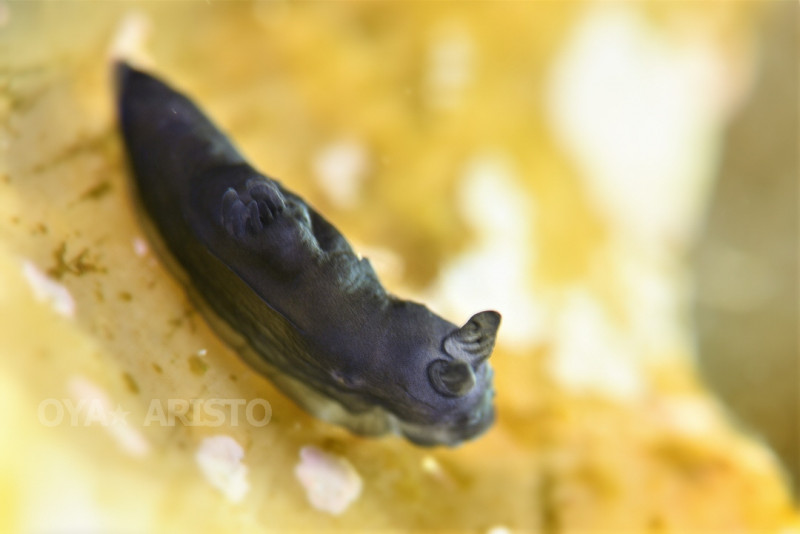
Distribution: Misaki (type locality) and Koumac (New Caledonia). The diagnostic external feature is that the rhinophores are fused at the base. The radula matches Baba's drawing: short innermost teeth with a central cusp flanked by two flat cusps.
The authors did not have material from the type locality. Their assignment of the New Caledonian specimens to G. nigricolor sensu stricto rests on morphological match with Baba's 1960 figure — an indirect anchor. The species concept of G. nigricolor now effectively rides on the New Caledonian material. Re-collection of topotypes from Misaki, with DNA, remains an open task.
Gymnodoris boussionae Souza-Canal, Nakano & Valdés, 2025 — New Caledonia
Ten specimens from Koumac and Poum, New Caledonia. Externally indistinguishable from G. nigricolor at first glance — the same velvet black body — but the rhinophores are separate at the base, not fused. The innermost radular teeth are strongly curved, very elongate, lacking denticles. Penial spines are short with curved tips, and the prostate is broad and flattened.
The epithet honours Magali Boussion, a New Caledonian diver and underwater videographer who participated in several of the collecting expeditions. Feeding behaviour was not observed.
Gymnodoris nagoensis Souza-Canal, Nakano & Valdés, 2025 — Okinawa & Amami
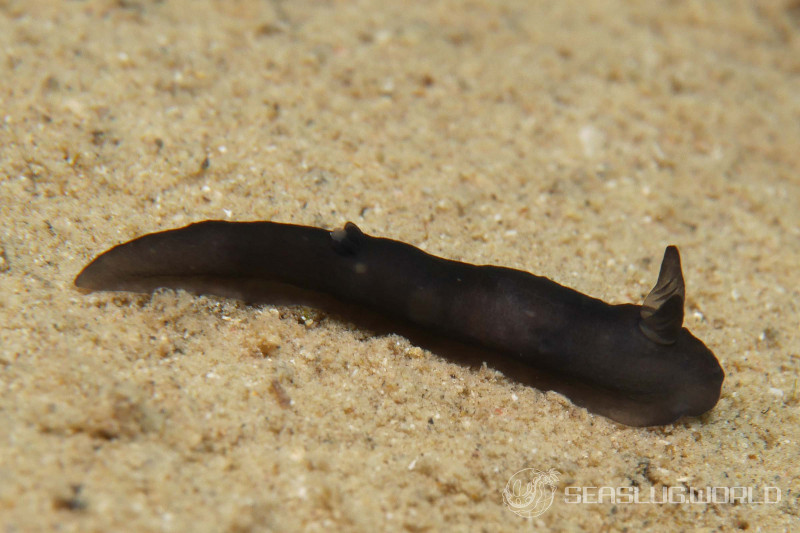
Holotype from Nago, Okinawa Prefecture (10 m depth); additional material from Sunabe (Ginowan, Okinawa) and Tebiro Beach (Amami Ōshima, Kagoshima). The epithet refers to the city of Nago.
Externally, the rhinophores are proportionally longer than in the other species and separate at the base. The gill consists of only 10 simple branchial leaves, fewer than in the other three lineages. Crucially, the authors observed G. nagoensis entering goby burrows and feeding on the fins, sometimes with several individuals on the same fish. Among the four species, this is the only one for which the goby-fin feeding habit has been directly confirmed in this study.
Phylogenetically, G. nagoensis is sister to G. nigricolor sensu stricto (PP 1, MLB 100) — genetically very close to it. Its radula, however, resembles that of the more distant G. boussionae, which the authors interpret as possible convergence driven by similar diet.
A fourth, undescribed Marshall Islands species
The Kwajalein "G. cf. nigricolor" of Knutson & Gosliner (2022) is clearly distinct from all three species above in the tree, and is being described by another team (Gosliner, pers. comm.). The discussion also flags a Thai specimen (Mehrotra et al. 2021, Koh Tao) with a white gill as a probable further lineage. The "four species" figure is a floor, not a ceiling — additional, undescribed lineages likely exist around the Red Sea, Thailand, and the Philippines.
Four months after this paper, in October 2025, the same group (De Souza-Canal & Valdés, without Nakano) released a 73-page Zootaxa monograph on the New Caledonian Gymnodoris, formally describing eleven further new species: knutsonae, fleuroti, mariefranceae, lebouteillerorum, deniseae, bricei, wanaporum, fassioae, feyae, bernardae and boiteuxi (Souza-Canal & Valdés 2025, Zootaxa 5710(1):1-73). New Caledonia alone has driven a dramatic expansion of the genus, and the "60-70 candidate species, most undescribed" picture from Knutson & Gosliner (2022) is being burned through rapidly.
What this means for divers
"Black Gymnodoris on a goby = G. nigricolor" no longer holds
Goby-fin parasitism observations recorded from southern Japan over the past 30 years are now plausibly attributable to G. nagoensis, not G. nigricolor. The authors are explicit that they did not observe feeding in the other three species, and they caution that not every member of the complex necessarily feeds on goby fins. The published identifications attached to the goby-fin literature need to be revisited, at least for material from Okinawa and Amami.
But the photographs of goby-fin predation can rarely be re-identified
This is the practical bottleneck. The external diagnostic separating the four species is whether the rhinophores are fused at the base — fused in G. nigricolor sensu stricto, separate in G. boussionae and G. nagoensis. Gill leaf count helps as a secondary character (10–11 vs. 16–19 vs. 10).
In dive photographs of goby-fin predation, however, the slug is almost always shown either as a whole-body shot wrapped around the goby's fin, or as a side / oblique view of the body.
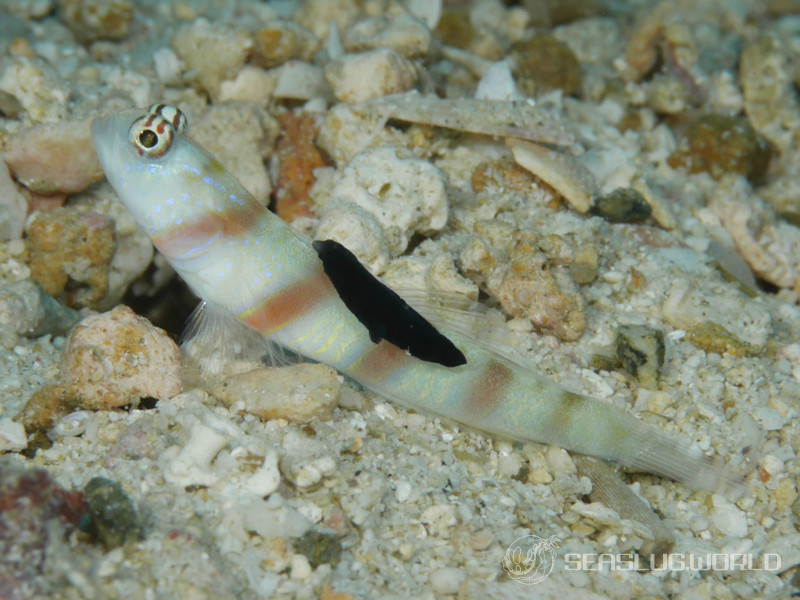
The rhinophore bases — left-right separated or not — are rarely visible at the angle they would need to be. The gill leaves are similarly hard to count when the animal is contorted around the host fin.
So: an existing image of "a black Gymnodoris on a goby" usually cannot be pushed to any of the four candidates with confidence. The information that would allow re-identification is simply not in the frame.
Re-collection of Misaki topotypes is the next step
No new specimens have been recorded from the type locality (Misaki, Miura Peninsula) since Baba 1960. The 2025 paper's assignment of G. nigricolor sensu stricto to New Caledonian material is an indirect call via morphological match with Baba's 1960 plate. If Misaki specimens are eventually collected and yield DNA, it remains possible that the Misaki lineage will fall outside the current sensu stricto clade, requiring renaming. (And of course, DNA recovery from the original 4 mm holotype may or may not be feasible.)
Misaki's muddy 2 m floor is accessible to divers. If you encounter a solitary black Gymnodoris there — not on a goby — please try to get a clean top-down shot of the rhinophore bases and the gill.
What we changed on the site
- Gymnodoris nigricolor species page updated with the four-way breakdown
- Gymnodoris boussionae (New Caledonia, endemic) added as a new species page
- Gymnodoris nagoensis (Okinawa & Amami) added as a new species page
Photographic review records from Okinawa and Amami that show goby-fin feeding will, in principle, be reassigned to G. nagoensis. In practice, the reassignment is only possible for images where the rhinophore bases are visible. Photos where that diagnostic is hidden by the host fish will remain on G. nigricolor sensu lato for now.
Closing
Sixty-five years after Baba's single 4 mm specimen, "the black Gymnodoris that bites goby fins" turns out to be a label for at least four lineages. What moves next, in priority order, is re-collection of topotypes from Misaki and formal description of the undescribed Marshall Islands and likely Indian Ocean / Thai lineages.
For shooters: if you find one of these animals off a goby — moving freely on the substrate — a top-down shot of the rhinophores and gill is the highest-value frame, well above the parasitism portrait. Such records will become useful identifiable material once more topotype data accumulates. Submissions via the photo upload form are welcome.
Enjoyed this post? You can tip the author directly —
Tip this post