Gymnodoris nigricolor Baba, 1960
Description
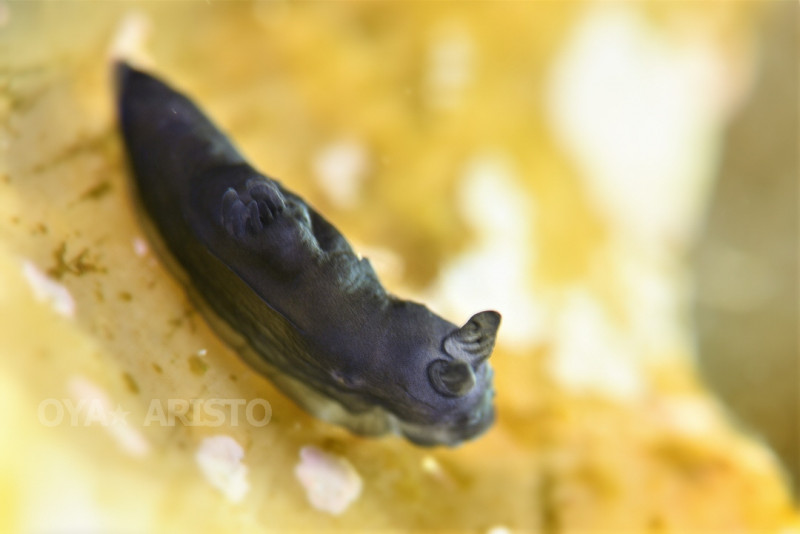
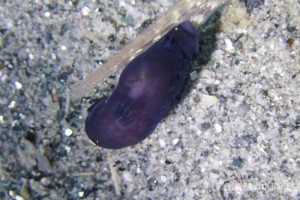
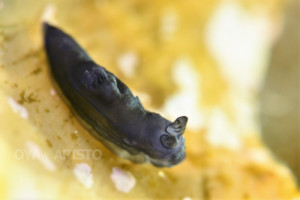
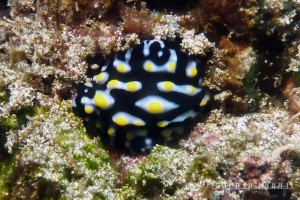
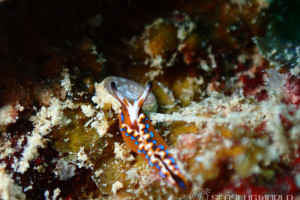
Body elongate, smooth, lacking tubercles. Body color a uniform velvet black; the dorsum and sole alike are bluish black. Under certain light some individuals show blurry neon-blue lines along the mantle margin. Rhinophores short, conical, fused together at the base; the entire visible length of each rhinophore bears six transverse lamellae. Gill composed of 10-11 simple leaves arranged in a circle, the leaves themselves bearing fine secondary lamellae along their edges. Rachidian teeth absent; innermost lateral teeth hook-shaped with an elongate cusp and 3-4 denticles. The holotype is a single 4 mm specimen, and a 1960 study noted that the uniformly black coloration is "somewhat unusual in the genus Gymnodoris".Distribution
Type locality: Misaki, Sagami Bay, Japan, on a 2 m muddy bottom; based on a single specimen collected in November 1956 by the Biological Laboratory of the Imperial Household. Originally reported broadly across the Western Pacific, the Indian Ocean and the Red Sea, but Souza-Canal et al. 2025 showed that those records represent a species complex; in its current strict sense the species is confirmed only from Japan (Sagami Bay) and New Caledonia (Koumac).Etymology
The specific epithet combines the Latin niger ("black") and color, referring to the uniformly black body. The Japanese vernacular name "Sumizome" ("ink-dyed") was coined by a 1960 study and likewise alludes to the uniformly black coloration, mirroring the Latin epithet.Remarks
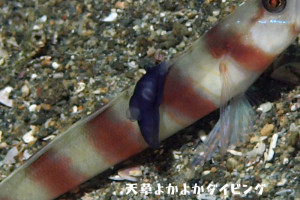
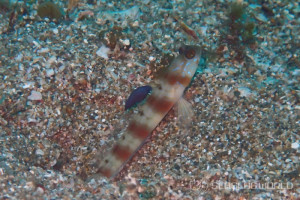
The species clings to the fins of gobies that themselves form a symbiosis with snapping shrimps and feeds on the soft skin between the fin rays. Because the goby itself is not consumed entirely, the relationship is regarded as parasitic rather than predatory; multiple individuals can be found feeding on the same host fish. Following Souza-Canal et al. 2025, the New Caledonia population previously assigned to G. nigricolor is now separated as Gymnodoris boussionae, the Okinawa population as Gymnodoris nagoensis, and a Marshall Islands specimen represents a further undescribed species. G. nigricolor is distinguished from G. nagoensis by its shorter rhinophores (6 vs 5 lamellae) and by the secondary lamellae on the gill leaves, and from G. boussionae by rhinophores fused at the base and a lower gill leaf count (10-11 vs 16-19).References
- Gymnodoris nigricolor BABA, n. sp. Sumizome-kinuhada-umiushi (n.n.), Baba K. (1960). THE GENERA GYMNODORIS AND NEMBROTHA FROM JAPAN (NUDIBRANCHIA-POLYCERIDAE). Publications of the Seto Marine Biological Laboratory. 8(1): 71-74. https://doi.org/10.5134/174700
- Gymnodoris nigricolor Baba, 1960, DE SOUZA-CANAL J., NAKANO R. & VALDÉS Á. (2025). Gymnodoris nigricolor Baba, 1960 (Mollusca, Nudibranchia, Polyceridae) is a species complex. Zoosystema. 47(17): 315-326. https://doi.org/10.5252/zoosystema2025v47a17
A Kindle field guide by the site author
Kimoto N. (2026). Sea Slugs of Japan & the Indo-Pacific, 2nd Edition.
Kindle Edition
View on Amazon PR (Amazon Associates)Seasonality
Shooting Locations
Loading shooting locations...
Photos of Gymnodoris nigricolor




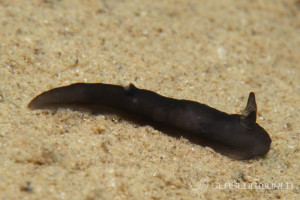
Same Genus Nudibranchs

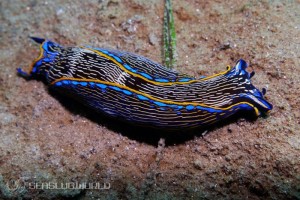
Similar Colors Nudibranchs
Academic Database
Sea slug observation data is available in international marine biodiversity databases.