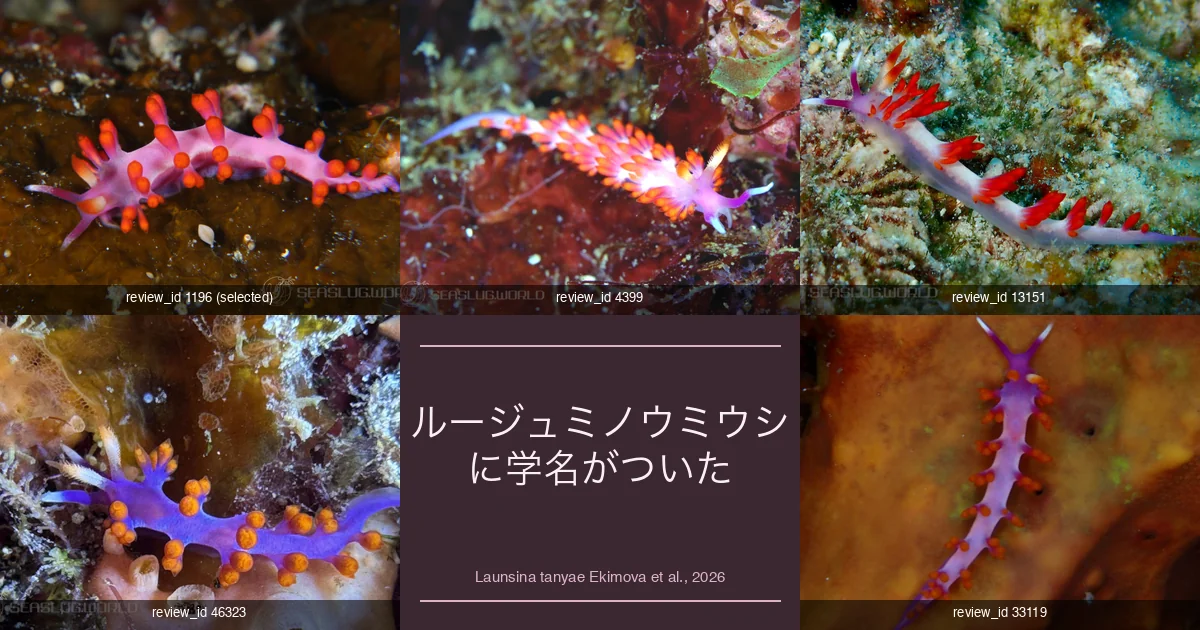
Japan's "Rouge Mino" Finally Has a Name — Launsina tanyae After 20 Years
The small purple flabellinid that Japanese divers have long photographed as the "rouge mino" (ルージュミノウミウシ) finally has a scientific name. Ekimova et al. (2026) describe it as Launsina tanyae, a new species (in a new genus) based on material from Nha Trang, Vietnam. Most Japanese specimens previously identified as Flabellina rubropurpurata or Samla rubropurpurata appear referable to this newly described species, based on colour similarity.
Paper
The new genus Launsina — the lineage of the rouge mino
The genus name Launsina derives from Laun-Sina, a goddess of the eastern skies, stars and seas in Visayan oral traditions of the Philippines, said to bring sunlight and cool winds during the dry season and to protect against strong typhoons.
The genus currently contains two species:
- Launsina tanyae Ekimova et al., 2026 — type locality in the South China Sea off Vietnam. The focus of this article
- Launsina rubropurpurata (Gosliner & Willan, 1991) — type locality in Papua New Guinea; New Caledonian specimens match the original description
The authors designate L. tanyae, not L. rubropurpurata, as the type species of the genus. Because the original description of rubropurpurata was based on geographically distant material (Papua New Guinea and South Africa) and may represent a species complex, the authors avoid anchoring the genus on it and instead designate L. tanyae, which is described from a single, unambiguous holotype.
The "rouge mino" is Launsina tanyae
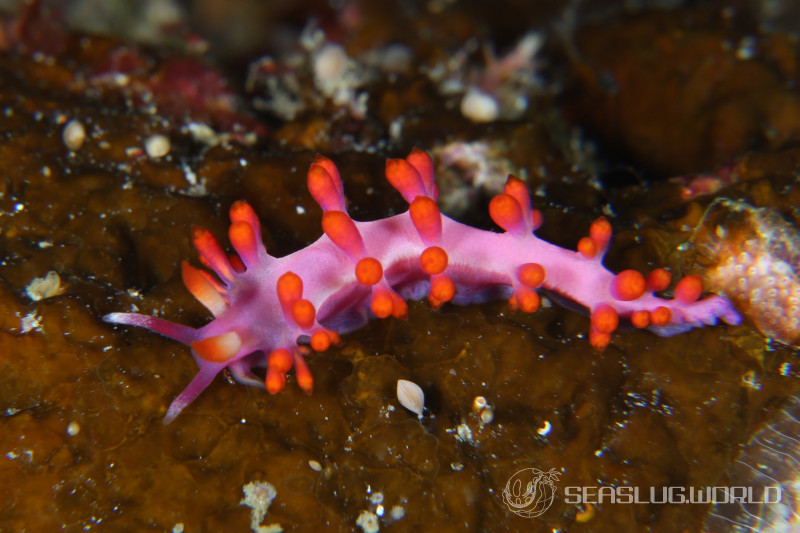
In Japan, the vernacular name ルージュミノウミウシ ("rouge mino") was coined in 1999 by Masuda in Marine Life Guidebook, under the scientific name Flabellina rubropurpurata Gosliner & Willan, 1991. The original description listed records from Papua New Guinea, South Africa and the Marshall Islands, so Japanese specimens were treated as part of a broadly distributed species.
Combining a four-marker phylogeny (COI, 16S, H3, 28S) with morphology, Ekimova et al. (2026) found that specimens from Nha Trang (Vietnam) form a distinct clade from New Caledonian "rubropurpurata". The two clades differ by 12.1 % in COI, well within the typical inter-specific range for nudibranchs.
Externally, Launsina tanyae is diagnosed by:
- A uniformly pink-purple background colour
- Very sparse opaque white speckles confined to the notal margin and the posterior dorsum
- Tricolour rhinophores: white at the base, yellow in the middle, orange at the tip
- Bright orange cerata with red cnidosacs
These features broadly match Japanese photographs of the "rouge mino", but the paper figures only one specimen of L. tanyae (the holotype) and does not directly compare Japanese material or provide molecular data for Japanese specimens. The strongest claim that can be made is that Japanese records are "likely referable" to this species; the possibility of a separate, still-undescribed lineage in Japan cannot be excluded.
The specific epithet honours Tatiana Antokhina (nickname "Tanya"), a Russian marine biologist who collected the type material and contributed extensively to nudibranch sampling across tropical and boreal seas.
The "real" Launsina rubropurpurata — a potential first record for Japan
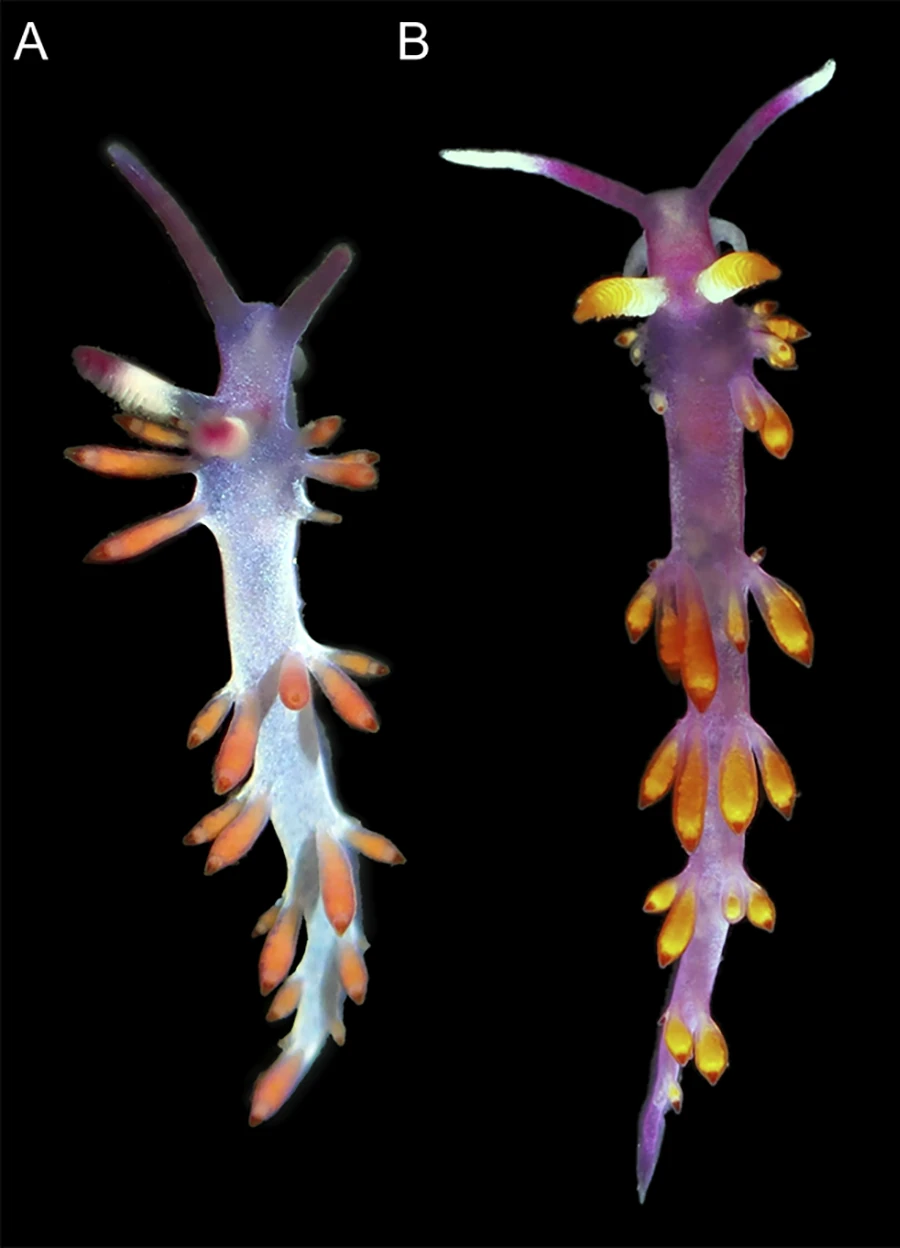
So what about L. rubropurpurata itself? Ekimova et al. (2026) confirm that New Caledonian specimens match the Gosliner & Willan (1991) original description, and the name is retained on this lineage as Launsina rubropurpurata.
It contrasts with L. tanyae by:
- A deep purple background colour
- Dense opaque white speckles covering the entire dorsum
- Bicolour rhinophores: white at the base, orange at the tip (no yellow middle band)
Of the original distribution, only the New Caledonia specimens and the type locality (Madang, Papua New Guinea) are reliably referable to this species. The status of the South African and Marshall Islands populations awaits further morphological and molecular study, and the authors explicitly note that L. rubropurpurata may itself be a species complex.
If you photograph a purple flabellinid in Japan with deep purple background, dense dorsal speckles, and rhinophores that lack the yellow middle band (white base + orange tip only), you may be looking at the true L. rubropurpurata — which would be a first record for Japan.
What to check in the field
When you encounter a purple flabellinid:
- Density of white speckles — dense across the whole dorsum = L. rubropurpurata; sparse on the notal margin and posterior only = L. tanyae
- Rhinophore middle band — absent (white base + orange tip, 2 colours) = L. rubropurpurata; present yellow middle band (white + yellow + orange, 3 colours) = L. tanyae
- Background shade — deep purple = L. rubropurpurata; pink-leaning purple = L. tanyae
- Neither fits cleanly — the individual may represent an undescribed lineage or a yet-unrecorded close relative, and the observation itself is valuable data
Submitting a photo directly improves our understanding of the distribution of these species in the region.
Site updates
- Launsina tanyae renamed from the previous Samla rubropurpurata
- Launsina rubropurpurata added as a separate species page
- The genus Launsina added under family Flabellinidae
This paper is in fact a 43-page global revision of Flabellinidae with additional genus consolidations and reassignments beyond Launsina. Those will be covered in a separate post.
Enjoyed this post? You can tip the author directly —
Tip this post