Heart Regeneration in Sea Slugs — Interview with Sayaka Mitoh
On March 9, 2021, a piece of news took the world by surprise: autotomy and regeneration in sea slugs. Many of you may have seen the video of a sea slug — reduced to nothing but a head — crawling around perfectly alive. Unlike the familiar case of a lizard shedding its tail, here a sea slug had lost most of its body, heart included, and then fully regrew it in a matter of weeks. This astonishing discovery was made by a young researcher in Japan. We sat down with her — Sayaka Mitoh — to hear the story in her own words.
Sayaka Mitoh — a second-year doctoral student in the Graduate School of Humanities and Sciences at Nara Women's University. Under Professor Yoichi Yusa, she studies sacoglossan sea slugs, including Elysia marginata (konoha-midori-gai).
Encountering Sea Slugs and Rearing Them Across Generations
—— Could you tell us how you first came to work with sea slugs?
My first encounter with sacoglossan sea slugs was in my fourth year of undergraduate studies.
Sacoglossans are a group of sea slugs characterized by a sac (the radular sac) that stores used teeth. Most feed on algae, and some species are even able to take up chloroplasts from their food and carry out photosynthesis (kleptoplasty).
At Nara Women's University, fourth-year students are assigned to a lab for their graduation research. I chose the Yusa Lab because I wanted to study ecology. When it came time to pick a research subject from the animals the lab works with, I was drawn to the curious behavior and charming appearance of photosynthetic sea slugs, and decided to study them.
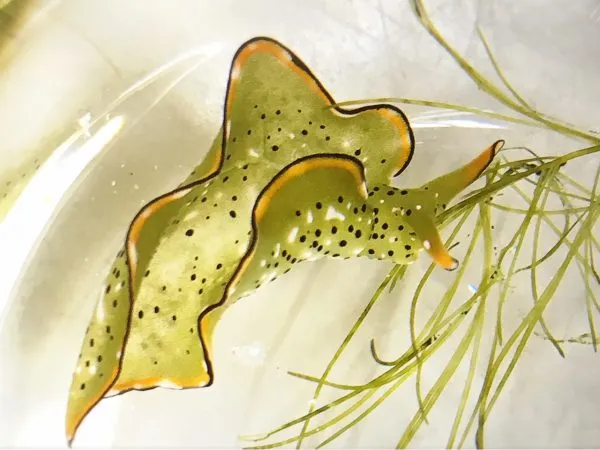
Elysia marginata (konoha-midori-gai)
—— What kind of environment were sea slugs being kept in at the lab at that point?
Before I joined the lab, no serious rearing was being done. Experiments had been conducted using sea slugs collected from the wild — studies on the ecological significance of photosynthesis and on phototaxis — but the approach was basically to keep the collected slugs in a tank with their food, and occasionally try to raise the larvae when they laid eggs. For most species, the larvae just wouldn't grow.
—— Rearing sea slugs really doesn't sound easy. What was the theme of your graduation research?
It was to unravel the life history of sacoglossan sea slugs. The first goal was to close the life cycle — to rear them successfully across generations, from eggs all the way to the next generation's eggs.
—— Did the research go smoothly?
At first, closing the life cycle really wouldn't work. For about the first six months, it was one failure after another. The larvae would hardly grow before dying — that kept happening over and over. Whenever I got discouraged by a failed attempt, I'd find my motivation again in how adorable the slugs were. That was pretty much my daily routine.
Most sea slugs, after hatching, spend some time as free-swimming larvae in the plankton, and once they've grown enough, they settle on the substrate and metamorphose into the form we recognize.
While I was going along like that, in the autumn of that year, Professor Yusa brought in some Elysia marginata (konoha-midori-gai) he had collected. That became the first species in which we successfully closed the life cycle.
—— Six months! That must have been tough. How did you feel when you first succeeded at complete rearing?
Honestly, it was a mix of relief — "now my graduation research can actually come together" — and sheer joy at finally having succeeded. And the fact that Elysia marginata metamorphosed on the very first try made me feel a bit of destiny about it (laughs).
A successfully reared Elysia marginata (konoha-midori-gai)
I didn't think much of it at the time, but Elysia marginata grows to a relatively large adult size, so it develops quickly. Its food — the green alga Bryopsis (hanemo) — is also easy to cultivate, which makes it an especially well-suited species for rearing. I've been feeling a touch of destiny about that too.
—— You must have been relieved after working at it so earnestly for so long. What was your impression the first time you saw Elysia marginata metamorphose?
Peering through the microscope, I couldn't help grinning and going, "Oh, how cute."
—— Your love for sea slugs really comes through! Did the research wrap up successfully? And did you keep rearing sea slugs after that?
With the successful rearing of Elysia marginata, and with Elysia hirugilla (hirugi-midori-gai) — which didn't reach metamorphosis, but still showed clear differences between rearing conditions — my graduation research came together nicely.
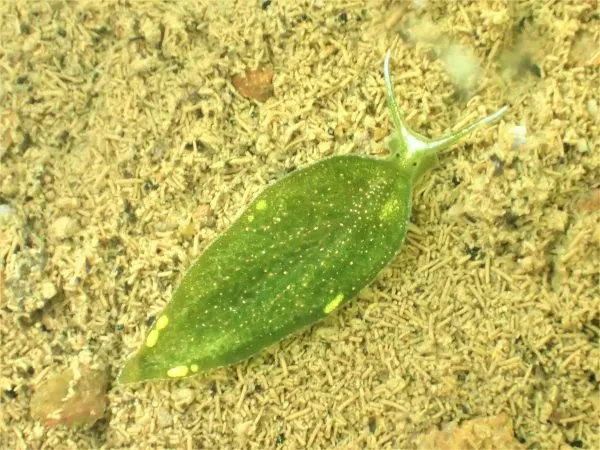
Elysia hirugilla (hirugi-midori-gai), a mangrove-dwelling species
After that, we've always kept Elysia marginata in the lab. Right now we maintain both a Kagoshima strain and an Oki strain.
We also succeeded in rearing Elysia hirugilla, and now we have over 100 individuals in the lab. This species is quite long-lived, so their numbers keep growing.
—— Sustaining multi-generational rearing of sea slugs — something considered difficult even by global standards — is truly impressive. Before the discovery of autotomy and regeneration, you were also studying the relationship between sea slugs and their parasites, right?
Yes. I started working on the relationship with parasites during my master's research.
For my master's, I studied the relationship between Elysia atroviridis (kuro-midori-gai) and its parasite (a species of copepod).
Copepods are tiny crustaceans. Most live as plankton, but some species are parasites on hosts such as sea slugs.
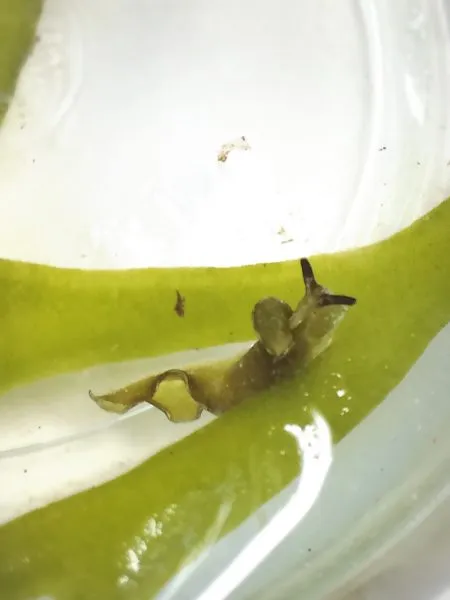
Elysia atroviridis (kuro-midori-gai)
—— What got you started on that?
There simply hadn't been any previous studies on the relationship between sacoglossans and the organisms that feed on them — predators and parasites. Another trigger was that in my fourth undergraduate year, when I collected Elysia atroviridis at Mukaishima in the Seto Inland Sea — an area where they occur in large numbers — the parasitism rate was remarkably high, and I became curious about what kind of relationship was going on.
—— Now that you mention it, that really is intriguing. As the research progressed, how did this host-parasite relationship look to you?
Even when parasitized, the sea slug isn't just a passive victim — at this stage, I think the countermeasure it has evolved may well be the autotomy we've now discovered.
Large-Scale Autotomy and Regeneration in Elysia marginata
—— Now that autotomy has come up, let us first summarize your research so far in chronological order.
Spring 2017: Began research on sacoglossan sea slugs
Autumn 2017: Observed larval metamorphosis
January 2018: Successfully closed the life cycle of Elysia marginata
April 2018: Began research on the relationship between Elysia atroviridis and its parasite
August 2018: Discovered autotomy in Elysia marginata
Observed autotomy events every 1–2 months thereafter
June–August 2019: Discovered autotomy in Elysia atroviridis
August 2020: Conducted autotomy induction experiments
September 2020: Presented at the Japanese Association of Benthology meeting
March 2021: Paper published in Current Biology
—— That sums it up nicely. So, could you tell us about the moment you first discovered autotomy in Elysia marginata?
One day, I noticed that one of the Elysia marginata individuals I was maintaining as part of our multi-generational rearing had come apart into a head and a neck-down body. At that point, to prevent weakening from egg-laying, I was keeping each individual isolated, so the tank contained only that one sea slug and its food — nothing that could attack it. Given the circumstances, I concluded it had to be autotomy.
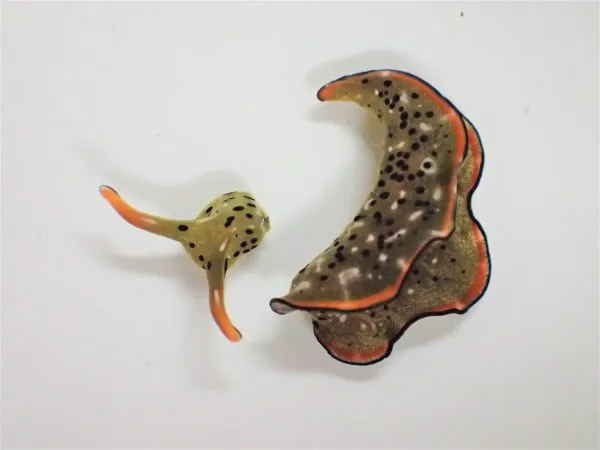
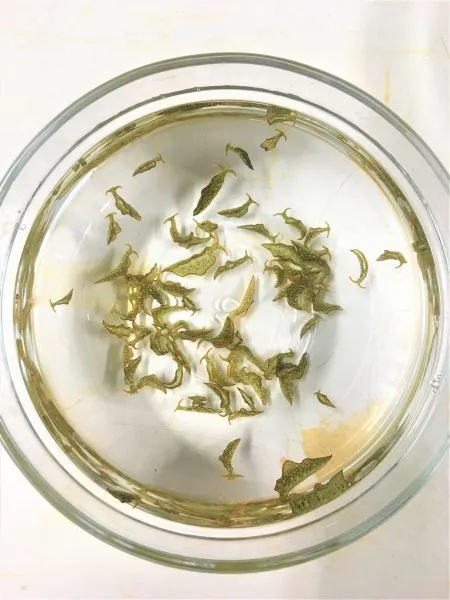
An Elysia marginata after autotomy
Even though there had been earlier reports of autotomy in sea slugs, the only autotomy I had ever seen with my own eyes was the familiar lizard's tail. My mental image of autotomy was the lizard's: something you do "to escape from a predator," and something that involves "cutting off just the tip of the body."
Seeing a sea slug suddenly shed most of its body — heart and all — inside a perfectly safe tank with no enemies and no threats, I was genuinely shocked, and pretty bewildered.
—— That must have been a real shock. Did you tell the people around you (Professor Yusa and others) right away?
I told Professor Yusa and the senior lab members who happened to be there immediately. Their reaction, as I recall, was something like, "Ewww — that's gross!"
—— I see. No one had any idea at that point that it would lead to such a major discovery, had they?
Right. I don't think anyone — myself included — thought that it would regenerate at that point.
—— What did you do after that?
I decided to just keep rearing it normally and see what happened. Sea slugs typically dissolve quickly after they die, but neither the detached head nor the body showed any sign of that — they were both moving actively. The head was even eating, and amazingly, I could still see the heart, which had remained with the body side, beating away.
—— Right from the moment of discovery, the situation looked very different from an ordinary sea slug death. How many days later did you realize it was regenerating?
Seven days after the decapitation. As I continued to rear it, I had a vague feeling that "the head side seems to be getting longer," and since the sea slug looked lively, I casually started a video recording on my phone to "at least keep a record." When I zoomed in — thinking "maybe I should get a close-up of just the head" — I saw a heartbeat in the head, even though the heart should have been lost along with most of the body during autotomy. That's when I realized: "It's regenerating!"
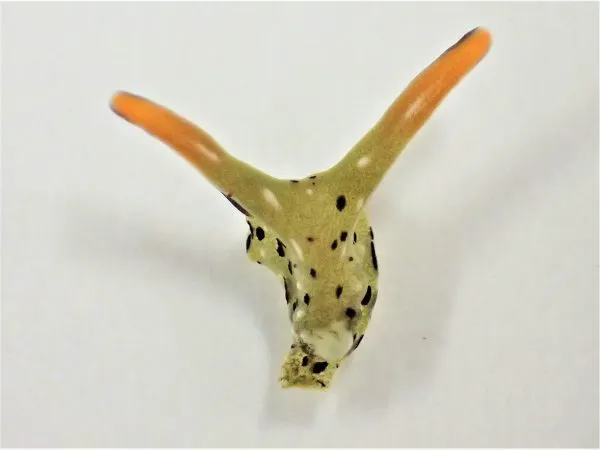
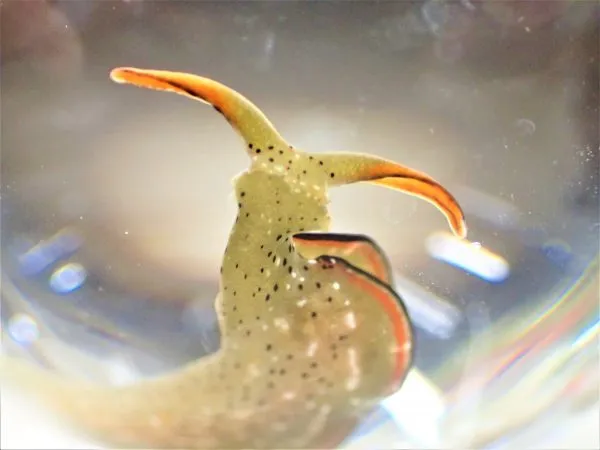
An Elysia marginata immediately after autotomy
—— What went through your mind at the moment of discovery?
I was just stunned. Not only in sea slugs, but in any animal, I had never heard of one that sheds a vital organ like the heart and then regenerates it. It felt unbelievable — and yet, right in front of my eyes, the heart really was beating. I had a growing sense that something extraordinary was happening.
—— At that point you were still maintaining the multi-generational rearing of Elysia marginata and working on parasitism in Elysia atroviridis. Did you feel moved to take on autotomy and regeneration as a new research topic?
Right after discovering autotomy, I wasn't thinking of launching into a new study straight away. It might have been something that just happened to that one individual, so I decided to watch and wait for a while.
But autotomy kept happening every one to two months — eventually in six Elysia marginata individuals (33% of the ones I was rearing), and the following year in three Elysia atroviridis (2% of the total). Once we had that much, I figured it was time to write it up as a paper, and last year I ran additional experiments and pulled the whole thing together.
—— Autotomy starting about seven months after you first closed the life cycle, and then recurring every one or two months — it really feels as if the success of the multi-generational rearing is what made this discovery possible. As you observed more autotomy events, did your feelings, or the reactions of those around you, change?
At first, I was terrified the sea slug might die, but as I watched it happen again and again, I grew used to it and came to think, "Oh, they'll probably be fine even if they cut themselves." Though older individuals didn't regenerate after autotomy. Professor Yusa was all for it, saying, "Hey, why don't we try cutting their necks ourselves?" (laughs).
—— He was really into it (laughs). At first, I imagine it was just observation, but when did you start thinking about concrete experiments and studies?
Around August of last year. We decided to present at the Japanese Association of Benthology meeting in September and to formally submit a paper, and since I wanted exact times for the autotomy process and clean photographs of it, I quickly got to work on the autotomy-induction experiments.
—— Could I ask you to walk us through the experiments in more detail?
We performed two experiments on Elysia marginata: a neck-constriction test and a simulated-predation test.
First, for the neck-constriction test, we used fishing line to apply a physical stimulus, to see whether it would induce autotomy. If this happens in nature, it would probably correspond to a situation where Elysia marginata becomes entangled at the neck by the alga Bryopsis (hanemo) while feeding on it. Even in the lab, I've seen individuals that couldn't free themselves after getting tangled in their food. In Elysia atroviridis, though, its food alga Codium (miru) is quite thick relative to the slug, so natural neck-constriction almost never happens.
For the simulated-predation experiment, we used tweezers and the like to reproduce what it might feel like to be attacked by a predator.
The results: in the neck-constriction test, all six individuals shed most of their body — heart included — and regenerated the body, heart and all, in about a week. In the simulated-predation test, autotomy did not occur.
—— Before the experiments, were you confident you could trigger autotomy?
Yes. For the neck-constriction experiment, I figured it would most likely lead to autotomy.
From my observations, sacoglossan sea slugs have a groove-like structure around the neck, and every individual that had autotomized had broken off at exactly that spot. Also, many animals that autotomize are known to have a pre-formed break plane (an autotomy plane) that detaches easily. I suspected that was the autotomy plane in these sea slugs, and that applying a stimulus there would cause them to break.
For the predation experiment, I predicted autotomy wouldn't occur. Taking more than ten hours to slowly shed the entire body hardly seems like a way to escape a predator. And in everyday handling, I've sometimes nicked them accidentally with tweezers or sucked them up slightly roughly with a pipette, and autotomy never happened from that sort of thing.
—— How did you feel when you succeeded in inducing autotomy and regeneration with the neck-constriction experiment?
"Yes!" — something like that (laughs). I had a feeling it would work, but actually confirming that we could induce it experimentally was a relief, and I was really happy thinking about all the ways we'd be able to make use of it going forward.
—— What did the sea slugs look like after regeneration was complete?
For these experiments, we watched over them without dissecting either the head or the body, so we don't really know the internal details — how much of the organs aside from the heart were lost, and how much was regenerated. From the outside, though, all the standard body parts are back in place. That said, even with regeneration "complete," the body tends to be slightly smaller and often a bit misshapen compared with the original.
—— Earlier, you raised the possibility that one function of autotomy and regeneration might be "getting rid of parasites." Could you say more about that?
Actually, in Elysia atroviridis, autotomy was observed only in parasitized individuals — it didn't occur at all in non-parasitized ones. That led Professor Yusa and me to gradually come around to the idea that parasite removal might well be the function, though we talked it through carefully. We haven't obtained statistical significance yet, so we don't have a definitive answer.
—— You mentioned that Elysia atroviridis has its egg-laying suppressed by the parasite. Were you able to confirm egg-laying after regeneration?
Not yet. Sea slugs are hermaphrodites, but they can't self-fertilize, so egg-laying requires two individuals. Once they've mated, they can store sperm for a while and lay eggs whenever they choose.
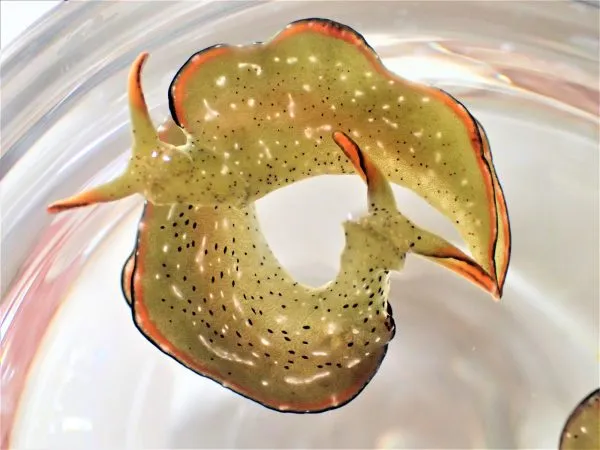
Elysia marginata (konoha-midori-gai)
In the case of Elysia marginata, we keep each individual isolated, so there was no mating partner available. Some individuals had mated before autotomy, but because of its location, the seminal receptacle was apparently lost along with the rest of the body during autotomy.
For Elysia atroviridis, they were being kept in pairs during the experiment, but by the time an individual had autotomized and regenerated, the partner had often already died, or the partner was alive but parasitized — mating conditions were not great.
So whether they can lay eggs after autotomy is something we'd like to clarify in the future.
—— I see — that's something to look forward to. Your discovery became a huge news story. How did that feel?
Professor Yusa and I had said to each other, "This autotomy is interesting stuff, and it'll probably land well with a general audience," but neither of us expected it to take off the way it did. The article went live late at night, and by the time I woke up it was already going viral on Twitter. Friends and acquaintances kept getting in touch with me. I was just flabbergasted (laughs).
Even before the paper was published, I received a flood of interview requests, mostly from overseas, and had some very busy days. Domestically, too, it was picked up by various media outlets, and I received an award from the university. I could really feel the attention.
Some of it was tough, but having my own research get this much attention is the kind of thing that makes being a researcher worthwhile — I really am grateful. I hope to use this opportunity to properly convey how fascinating and charming sea slugs are.
—— To be honest, I was very surprised at first. Sea slug surveys and research are certainly still a recent endeavor, but it's remarkable that such a major discovery was made by a young Japanese researcher, still in her twenties. There are countless sea slug enthusiasts out there, yet no one had spotted this or confirmed it. Listening to you, I got the sense that you treat sea slugs with real affection — that you rear and observe them carefully and conscientiously — and that's probably what made the difference. What do you think was the key factor?
I really do think that successfully closing the life cycle was the biggest factor. Among sacoglossans, few species can be reared, and there probably isn't an established model species. That's why I took on multi-generational rearing for my graduation research — and the fact that I was a student with relatively plenty of time, able to learn from the basics, was likely part of what made the rearing work. It was also coincidental, but keeping each individual isolated turned out to be a crucial factor in the discovery. Being able to rear and observe each slug on its own, over a long period, is probably what made it possible.
Also — on a personal note — I'm confident my love for sea slugs is second to none (laughs). I think being good at fine manual work and careful close observation helped too. In Professor Yusa's words, I'm "tenacious."
—— Yes — succeeding in closing the life cycle really was huge. The autotomy and regeneration are amazing in themselves, but preparing the stage for it feels like the real prelude to this discovery, and it makes me look forward to further surprising findings in the future.
By the Way, Here's How Professor Yusa Sees Sayaka Mitoh…
She normally comes to the university from around noon to evening, and heads home from late night into the morning. This isn't for the sea slugs' sake — it's because her body clock is just off. The rest of us in the lab, and the sea slugs, are rather inconvenienced by it (laughs). She normally comes to the university from around noon to evening, and heads home from late night into the morning. This isn't for the sea slugs' sake — it's because her body clock is just off. The rest of us in the lab, and the sea slugs, are rather inconvenienced by it (laughs). That said, when it comes to cherishing sea slugs, caring for them attentively, and watching over them tirelessly, I think she stands head and shoulders above other sea slug researchers. The fact that she discovered a form of large-scale autotomy that probably no one had ever seen before, and was able to follow the regeneration process step by step, really comes down to her love for sea slugs. She normally comes to the university from around noon to evening, and heads home from late night into the morning. This isn't for the sea slugs' sake — it's because her body clock is just off. The rest of us in the lab, and the sea slugs, are rather inconvenienced by it (laughs). That said, when it comes to cherishing sea slugs, caring for them attentively, and watching over them tirelessly, I think she stands head and shoulders above other sea slug researchers. The fact that she discovered a form of large-scale autotomy that probably no one had ever seen before, and was able to follow the regeneration process step by step, really comes down to her love for sea slugs. Also, the foundation of this research was her success in closing the life cycle of Elysia marginata — rearing it all the way from egg to adult. That, too, is a testament to her own hard work.
Future Work and a Message
—— Are there any topics you'd like to research from now on?
I'd like to look into autotomy and regeneration in sea slugs in a bit more detail. For example:
- What other species do this? Are there any non-sacoglossans that do it too?
- What conditions are necessary for autotomy and regeneration? (Food, how much photosynthesis is required?)
- Culturing and transplanting the stem cells, which presumably sit around the neck region
That's roughly where I'd like to start.
—— We'll have to keep a close eye on your work! By the way, divers and researchers sometimes say they've seen sea slugs reduced to just a head after being preyed on. Do you think regeneration happens outside of autotomy too? And would you like to study that?
Experimentally, it would come down to cutting off the head directly. We're considering such experiments, but to be honest, I hesitate a little. Since we don't know whether they'll regenerate, I'd feel terrible if one died because of it.
—— If regeneration were also confirmed after large-scale "heterotomy" (being cut by something else), would that change how we interpret this discovery of autotomy?
I'm not entirely sure. If that were the case, it would mean that a high regenerative capacity is the underlying premise, and they use it both to autotomize and to survive heterotomy. Even so, the meaning of autotomy itself might not change that much. There's still so much we'd like to investigate.
—— Do you plan to continue your life as a researcher from here on?
I'd like to continue research after I graduate, but there aren't many academic positions, so at this point I'm not sure how things will turn out. Professor Yusa seems a bit worried too (laughs). At the very least, my aspiration is to become a researcher.
—— Please do your very best! Finally, could we ask you for a message — first for divers and other sea slug enthusiasts, and then for anyone interested in sea slug biology and research, or anyone else you'd like to reach? Feel free to speak to whomever you wish.
Alright — first, a word for those who go swimming in wetsuits or observe animals in the tidal zone.
I'm a beginner collector myself, so I'm hardly in a position to say this, but — when you find a sea slug, please take your time and really observe it. You might end up discovering food items that weren't known before, or catch sight of some interesting behavior.
To those interested in sea slug biology and research:
If you search tide pools at low tide, you'll find sea slugs in surprisingly many places. Please start by just looking carefully and watching them. Sea slugs are soft and easy to tear, and even human body heat can burn them. Please try not to touch them, and leave them as undisturbed as possible. And if at all possible, please don't try to decapitate them. They don't necessarily regenerate, and whatever the outcome, a slug reduced to just a head is in a very weak state out in the field. I think the best approach is to get to know each other without harming the animals or their environment. That said, as researchers we'd like to investigate which species of sacoglossans possess the ability to autotomize, using the minimum number of individuals necessary. For that, we need a variety of sacoglossans and their algal food plants. If you'd be willing to help with our research, please contact the Aquatic Ecology Laboratory at Nara Women's University.
Lastly — the Yusa Lab is always looking for members who'd like to study sea slugs together. If you're interested, why not come visit Nara Women's University? You may well end up finding some surprising phenomenon that no one had ever anticipated.
—— Thank you so much!
Pouring so much time and love into sea slug research — carefully, earnestly facing them day after day — that's Sayaka Mitoh. She said she felt a sense of destiny, and it really does feel as if the Elysia marginata chose her to reveal to the world this miracle of life: autotomy and regeneration. We can't wait to see what comes next.
Interview cooperation: Sayaka Mitoh and Professor Yoichi Yusa
Interview and editing: Mayu Kawazoe
Provided by: SEASLUG.WORLD
Reference paper: "Extreme autotomy and whole-body regeneration in photosynthetic sea slugs"
Research summary: "Large-scale autotomy and regeneration discovered in photosynthetic sea slugs — They can live without a heart. The astonishing capability of sea slugs"
Enjoyed this post? You can tip the author directly —
Tip this post