Austrodoris kerguelenensis (Bergh, 1884)
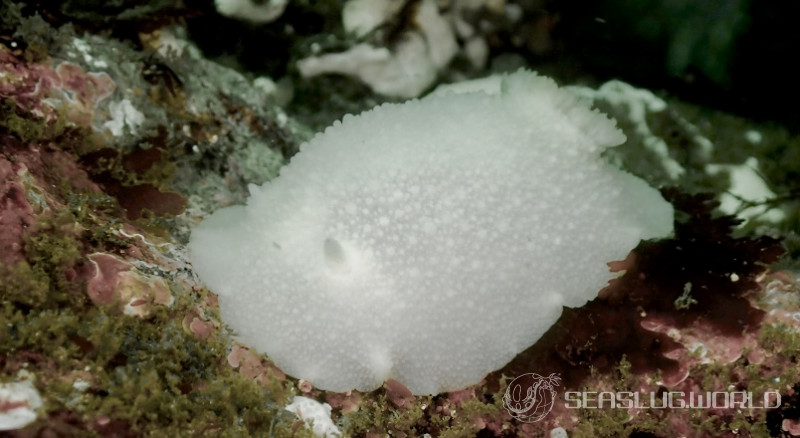
- Location
- Antarctic
- Date
- 2025/02/04
- Length
- 20mm
- Depth
- 7.0m
- Water temperature
- -1.0℃
Description
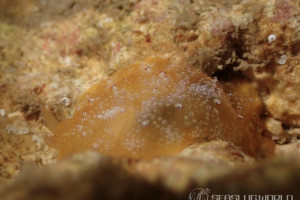
A medium-sized dorid reaching about 4.5 cm in body length. The ground colour in life is variable, ranging from white to bright yellow. The dorsum is densely covered all over with tubercles of various sizes, with the smallest tubercles concentrated along the mantle margin. The rhinophores are powerful, with 30–40 broad leaves on the club and a small terminal papilla. The gill consists of seven tripinnate leaves arranged in a horseshoe. Bergh's alcohol-preserved type measured 4.5 cm long, 1.8 cm wide and 1.2 cm high, with a 4.5 mm wide mantle margin, 12 mm wide foot, 5 mm tail, transversely oval branchial opening 8 mm in diameter, retracted rhinophores 4 mm high, retracted gill nearly 5 mm high, tentacles 3 mm long and the largest dorsal tubercles 1.3 mm in diameter. The ground colour was yellowish throughout, ochre-yellow on the front and lateral parts of the back, paler on the upper sides of the foot margin, and yellowish-white on the rhinophores and gill. The body is elongate-oval, with a not very broad but powerful mantle margin; the back is slightly convex and tubercular all over, the smallest tubercles concentrated on the mantle edge. The rhinophore openings lie well forward, are roundish and bear small tubercles on their slightly raised margin; the transversely oval branchial opening has a slightly scalloped, slightly raised margin also bearing small tubercles. The anal papilla (2.5 mm high) sits in the opening of the gill horseshoe, with a slightly scalloped margin; the slit-shaped renal pore opens at the base of the anal papilla on its right. The foot is powerful, projecting only slightly (~2.5 mm) from the body sides and somewhat more anteriorly (~4.5 mm); the anterior end is rounded with a marginal furrow.Distribution
Circum-Antarctic and sub-Antarctic. Type locality: Royal Sound, Kerguelen Islands (sub-Antarctic Indian Ocean), 49°40′ S, 70°20′ E, at 25 fathoms (≈ 46 m), based on a single specimen dredged by HMS Challenger on 17 January 1874. Subsequently recorded around the Antarctic Peninsula, the South Shetland Islands, South Georgia, the South Sandwich Islands, the Falkland Islands and other sub-Antarctic islands.Etymology
The specific epithet kerguelenensis is a Latinised geographical adjective meaning "of Kerguelen", in reference to the Kerguelen Islands type locality.Remarks
Originally placed by Bergh in Archidoris. In the same Challenger report Bergh also described Archidoris australis as a new species; both, together with several other names from the wider Southern Ocean, are now treated as junior synonyms of this species. The species was later transferred to Austrodoris; the parentheses in the author citation reflect this generic transfer. Some recent treatments place it back in Doris. The species feeds on ascidians, bryozoans and sponges, and is known to sequester terpenoid defence compounds.References
A Kindle field guide by the site author
Kimoto N. (2026). Sea Slugs of Japan & the Indo-Pacific, 2nd Edition.
Kindle Edition
View on Amazon PR (Amazon Associates)Seasonality
Shooting Locations
Loading shooting locations...
Photos of Austrodoris kerguelenensis
Similar Colors Nudibranchs
Academic Database
Sea slug observation data is available in international marine biodiversity databases.