Cymbulia sibogae Tesch, 1903
Description
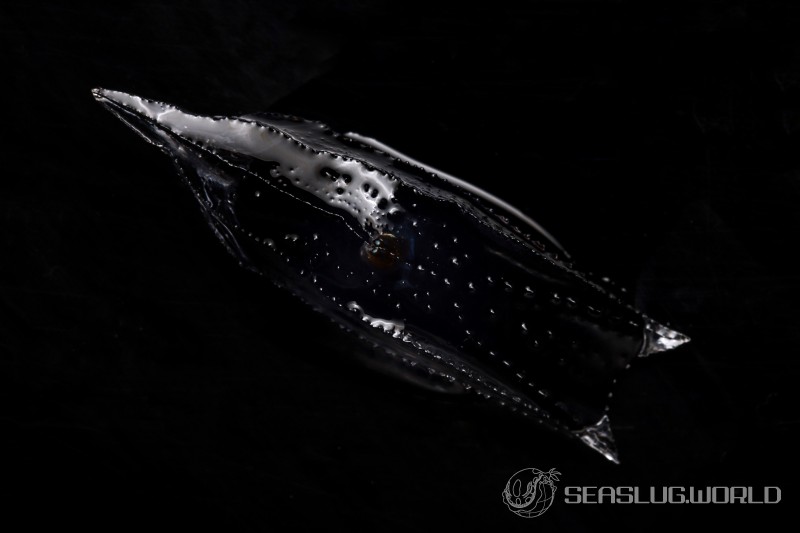
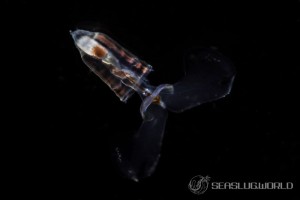
A pelagic pteropod ("sea butterfly") that lacks an ordinary calcified shell and instead carries a transparent, elastic, cartilage-like pseudoconch. The pseudoconch is boat-shaped with several rows of spines, and one end tapers to a point, giving it an arrowhead-like outline. This is a relatively large pteropod, with the pseudoconch reaching up to 65 mm in length. The left and right wing-feet are fused into a single subrhombic swimming plate with a constriction at the lateral margin, and a distinctive long whip-like filament extends from its posterior end — a useful field mark for this species. The visceral mass shows through the transparent pseudoconch as a dark nucleus.Distribution
Centred on the South Atlantic and Indian Oceans, and in the Pacific most frequently encountered in the Kuroshio Current region off Japan. The type locality is in the Banda Sea, Indonesia, at Siboga expedition station 189a (2°22'S, 126°46'E).Etymology
The specific epithet sibogae is the Latin genitive form of "Siboga" and commemorates HNLMS Siboga, the Dutch naval vessel that carried the Siboga Expedition (1899-1900). The ship itself was named after Sibolga, a port town on the west coast of Sumatra, and the expedition — led by the zoologist Max Weber — carried out the first large-scale marine survey of what was then the Dutch East Indies (present-day Indonesia), where the type specimens of this species were collected.Remarks
Protandric hermaphrodite. Feeds as a phytophage, spreading a mucous web to trap microplankton. An oceanic species that is rarely seen near shore. Among the Japanese members of Cymbuliidae, it is distinguished by its boat-shaped pseudoconch with a pointed apex, whereas Corolla ovata and Corolla spectabilis both have a slipper-shaped pseudoconch. The type material (lectotype and 12 paralectotypes) is held in the Zoological Museum of Amsterdam (ZMAN), now part of Naturalis Biodiversity Center.References
- Cymbulia sibogae n.sp., Tesch J.J. (1903). Vorläufige Mitteilung über die Thecosomata und Gymnosomata der Siboga-Expedition. Tijdschrift der Nederlandsche Dierkundige Vereeniging, ser. 2, 8(2): 111-117.
- ヤジリカンテンカメガイ Cymbulia sibogae Tesch, 1903, 奥谷喬司. (2016). わが国近海に見られる浮遊性巻貝類―VI. 有殻翼足類・ミジンウキマイマイ科及び擬有殻翼足類. うみうし通信, 93, 4–5.
A Kindle field guide by the site author
Kimoto N. (2026). Sea Slugs of Japan & the Indo-Pacific, 2nd Edition.
Kindle Edition
View on Amazon PR (Amazon Associates)Seasonality
Shooting Locations
Loading shooting locations...
Photos of Cymbulia sibogae

Similar Colors Nudibranchs
Color:
Transparent
Academic Database
Sea slug observation data is available in international marine biodiversity databases.