Hamineobulla kawamurai Habe, 1950
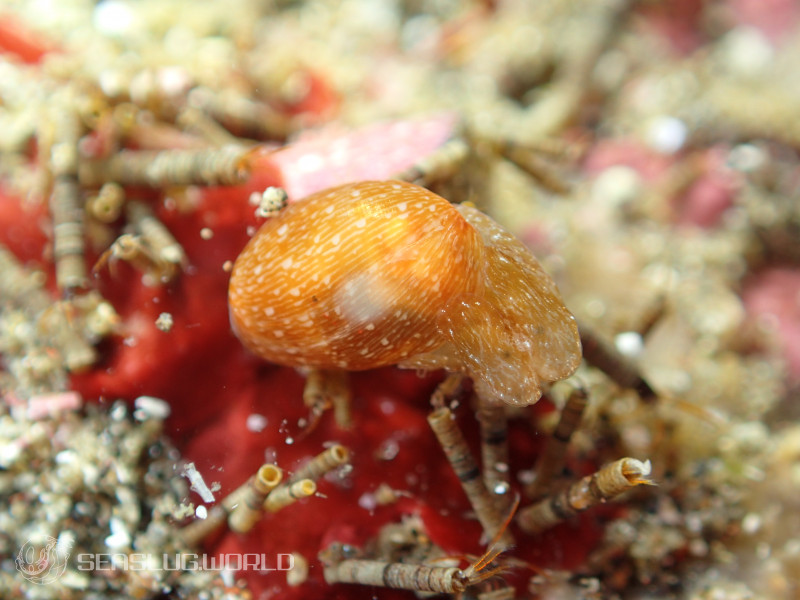
- Location
- Otchogahama, Hachijo Island, Tokyo, Japan
- Date
- 2016/07/05
- Length
- 10mm
- Depth
- 12.0m
- Water temperature
- 17.0℃
Description
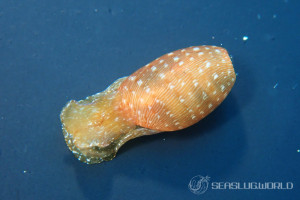
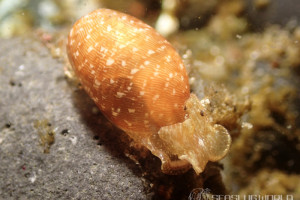
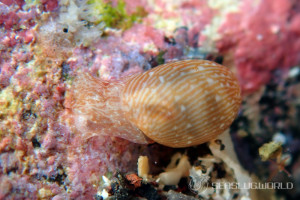
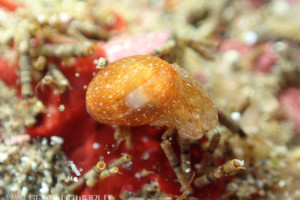
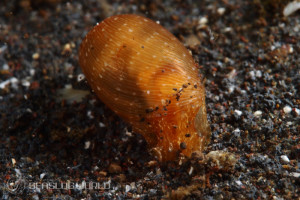
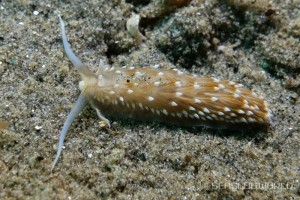
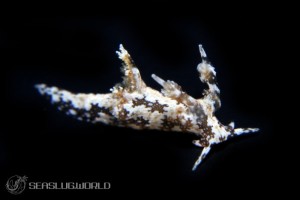
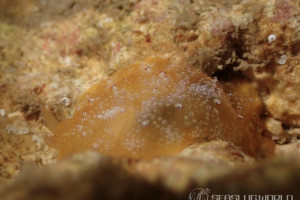
A small cephalaspidean reaching about 8 mm in shell length. The shell is thin, semi-translucent and brownish, sculptured all over with fine spiral grooves and scattered with paler brown markings. The apex bears a distinct opening. The body is semi-translucent brown with darker brown longitudinal lines. It burrows in sandy bottoms in shallow water.Distribution
The type locality is Okinawa Main Island, Ryukyu Group, Japan. Recorded from Japan (Ryukyus and the western coast of Kyushu), the Philippines and Midway Atoll across the shallow sandy bottoms of the Indo-West Pacific.Etymology
The specific epithet kawamurai honours Mr. Ryosuke Kawamura, as stated in the original description (Habe, 1950).Remarks
A 1950 paper erected the genus and species on a single empty shell from Okinawa, provisionally placing it in the family Bullidae because of the distinct apical opening. Kitao & Habe 1982 later examined the radula and gizzard plates of a specimen from Tomioka, Amakusa (western Kyushu): the radula lacks a central tooth and bears one horn-shaped lateral tooth on each side, prompting transfer to the family Atyidae. In current systematics (WoRMS / MolluscaBase) Atyidae has been merged into Haminoeidae, and Hamineobulla kawamurai itself is placed in Eoscaphandridae (Cephalaspidea: Cylichnoidea).References
- Hamineobulla kawamurai n.sp., Habe T. (1950). Hydatinidae, Bullidae and Akeridae in Japan. In: Kuroda T. (ed.) Illustrated Catalogue of Japanese Shells, 1(3): 17-24, pl. 3.
- Hamineobulla kawamurai Habe, 1950 スジナツメガイ, 北尾耕二・波部忠重. (1982). 後鰓類スジナツメガイとニヨリキセワタガイの分類学上の位置. ヴヰナス. 41(1): 61-63.
A Kindle field guide by the site author
Kimoto N. (2026). Sea Slugs of Japan & the Indo-Pacific, 2nd Edition.
Kindle Edition
View on Amazon PR (Amazon Associates)Seasonality
Shooting Locations
Loading shooting locations...
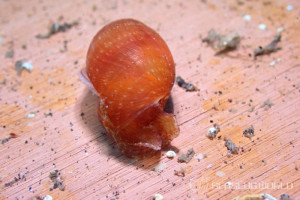
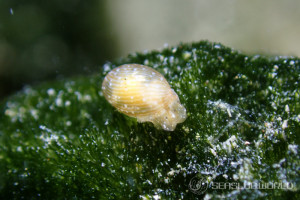
Photos of Hamineobulla kawamurai




Similar Colors Nudibranchs

Academic Database
Sea slug observation data is available in international marine biodiversity databases.