Kynaria cynara (Ev. Marcus & Er. Marcus, 1967)
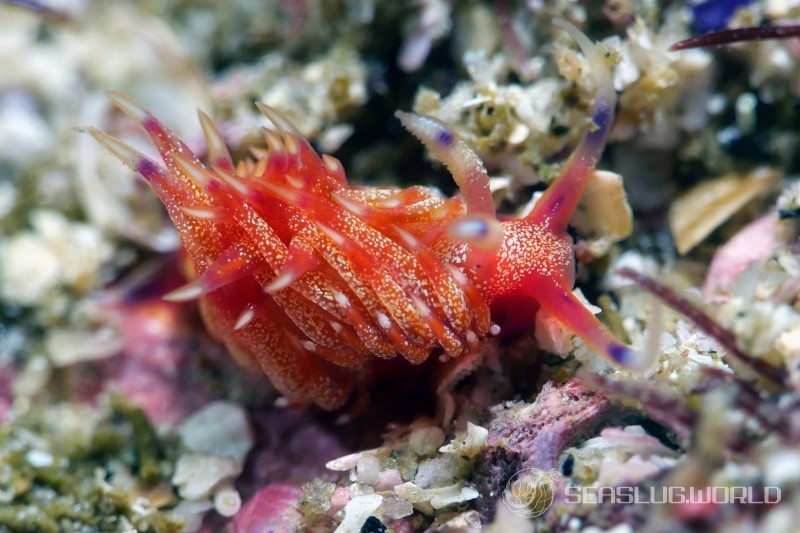
What is the swimming cynara?
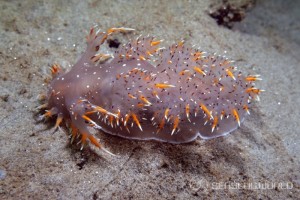
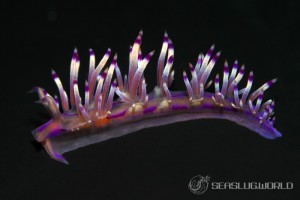
The swimming cynara (Kynaria cynara) is a deep pink aeolid nudibranch of the tropical eastern Pacific, easily known by its unusually long, whip-like cerata — and it is one of the few sea slugs that swims strongly enough to stay up in the water column for three quarters of an hour at a time.Description
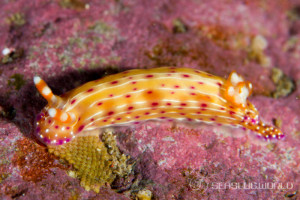
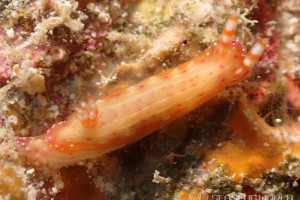
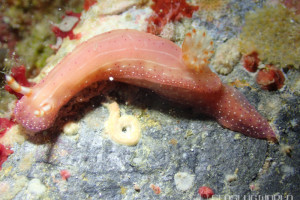
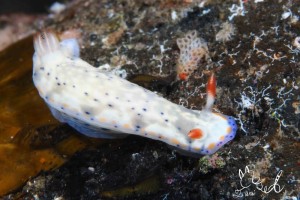
The body is deep pink to salmon-pink; some animals are finely spotted with white, others carry no spots at all. The cerata are long and slender, translucent salmon-orange speckled with white, with a purple ring near the tip and a creamy white point beyond it. A rich purple line runs along the border of the foot, and the oral tentacles carry a purple blotch towards their tips. The rhinophores are perfoliate with up to 29 leaves; the lower half is pinkish and the upper half creamy white with a purple band below the tip. The cerata taper to a point and sit in several groups on slightly raised bases; those in the middle of the back are longer than the animal itself and are held erect in the water. The oral tentacles are longer than the rhinophores. Living animals are about 25 mm long, with reports of 40-50 mm.Distribution
Tropical eastern Pacific, recorded from the Gulf of California south to Panama. The type locality is Puerto Peñasco, Sonora, Mexico. For a long time the species was known only from the northern Gulf of California; it has since been found further south along the Pacific coast of Mexico, including Bahía de Banderas. It occurs at depths of 4 m and greater, in small numbers throughout the year.Etymology
The specific epithet cynara is the Latin and Greek word for the artichoke.Remarks
This is one of the swimming aeolids. The long cerata are swept forward together in a bowed, loosely coordinated movement, pause, and are then whipped backwards in a single power stroke; that rearward flip provides the thrust, running as a wave from the hindmost cerata forward until the tips come to rest under the foot. The animal is a strong swimmer and has been watched staying in the water column for more than 45 minutes without any obvious rest. Swimming was already noted in the original description. Flabellinopsis iodinea, now placed in the same family, also swims.It feeds on hydroids and is not tied to a single prey species; in captivity one animal was seen eating Hermissenda crassicornis. The spawn mass is white.
Bajaeolis bertschi is the species it is most often confused with. The digestive gland inside the cerata is only a thin tube in K. cynara, whereas in Bajaeolis bertschi it is nearly as thick as the ceras itself. The rhinophore clubs also differ: elongate with relatively sparse leaves and a purple band below the tip in K. cynara, shorter and fatter with numerous closely packed leaves and a purple patch at the very tip in Bajaeolis bertschi.
The generic name Kynaria comes from the same Greek word for "artichoke", taken from the specific epithet of this species, which is the type species of the genus.
References
- Coryphella cynara spec. nov., Marcus Er. & Marcus Ev. (1967). American Opisthobranch Mollusks. Studies in Tropical Oceanography, Miami. 6: 1-256.
- Coryphella cynara, Farmer W.M. (1970). Swimming gastropods (Opisthobranchia and Prosobranchia). The Veliger. 13(1): 73-89.
- Flabellina cynara, Gosliner T.M. & Kuzirian A.M. (1990). Two new species of Flabellinidae (Opisthobranchia: Aeolidacea) from Baja California. Proceedings of the California Academy of Sciences, Series 4. 47(1): 1-15.
- Flabellina cynara (Hermosillo 2002), Rudman W.B. (1998-2010). Sea Slug Forum. Australian Museum, Sydney. http://www.seaslugforum.net/
- Flabellina cynara, Millen S.V. & Hermosillo A. (2007). The genus Flabellina Voight, 1834 (Mollusca: Opisthobranchia) from Bahía de Banderas (Pacific coast of Mexico) with ecological observations, the description of a new species, and the redescription of Flabellina cynara. Proceedings of the California Academy of Sciences, Series 4. 58(26): 543-559.
- Kynaria cynara comb. n., Korshunova T., Martynov A., Bakken T., Evertsen J., Fletcher K., Mudianta I.W., Saito H., Lundin K., Schrödl M. & Picton B. (2017). Polyphyly of the traditional family Flabellinidae affects a major group of Nudibranchia: aeolidacean taxonomic reassessment with descriptions of several new families, genera, and species (Mollusca, Gastropoda). ZooKeys. 717: 1-139. https://doi.org/10.3897/zookeys.717.21885
- Kynaria cynara, Behrens D.W., Hermosillo A., Fletcher K. & Jensen G.C. (2022). Nudibranchs & Sea Slugs of the Eastern Pacific. Molamarine.
- Kynaria cynara, Ekimova, I., Carmona, L., Mikhlina, A. L., Grishina, D., Stanovova, M. V., Schepetov, D. M., Hoover, C., de Souza-Canal, J., Kuznetsov, K. O., & Valdés, Á. (2026). Neither "lumpers" nor "splitters": A global revision of Flabellinidae s.l. nudibranchs (Gastropoda: Heterobranchia: Nudibranchia). PLoS One. 21(5): e0347759. https://doi.org/10.1371/journal.pone.0347759
Featured in this book
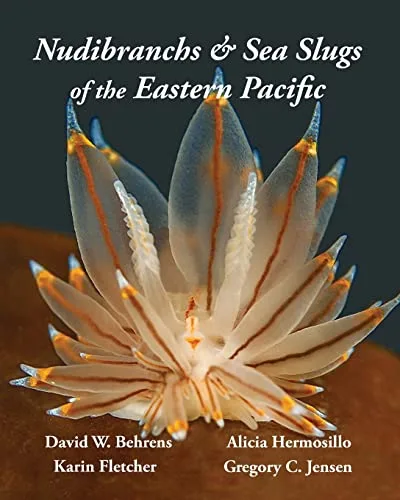
Behrens D.W., Hermosillo A., Fletcher K. & Jensen G.C. (2022). Nudibranchs & Sea Slugs of the Eastern Pacific. Molamarine.
Molamarine
This species, Kynaria cynara, is included in the book.
View on Amazon PR (Amazon Associates)Seasonality
Shooting Locations
Loading shooting locations...
Photos of Kynaria cynara

Similar Colors Nudibranchs
Academic Database
Sea slug observation data is available in international marine biodiversity databases.