Hermissenda crassicornis (Eschscholtz, 1831)
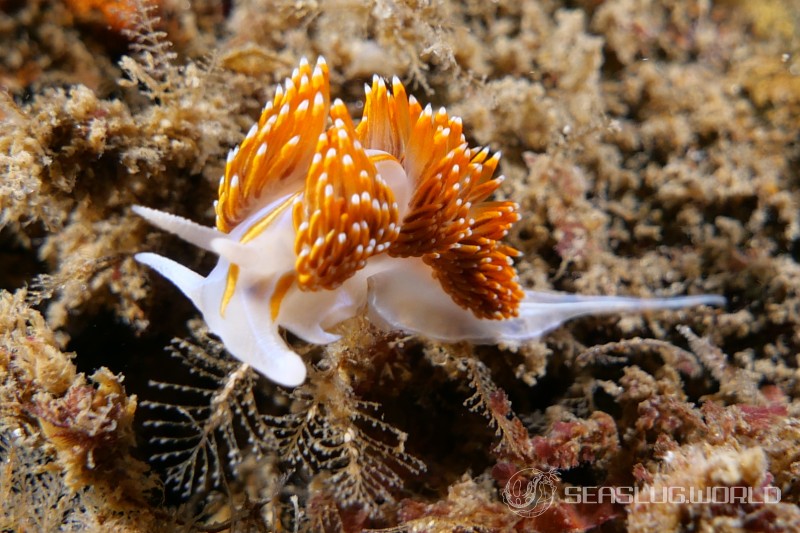
- Location
- Ruby E, San Diego, California, United States
- Date
- 2019/10/31
- Length
- ??mm
- Depth
- ??m
- Water temperature
- ??℃
Description
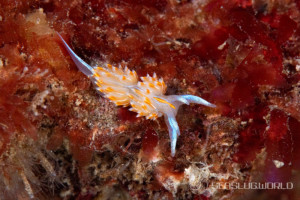
A very colourful aeolid with a translucent grey-white body. An orange to yellow band runs along the dorsal midline, flanked on each side by an iridescent blue line and a white line. Numerous orange-brown cerata are clustered along the back, their tips tinged white or blue. It grows to about 5 cm. It is well known as a long-standing model organism in the neuroscience of learning and memory.Distribution
Northeastern Pacific, along the west coast of North America from Alaska to California. It occurs in a wide range of habitats — rocky reefs, sandy bottoms and eelgrass beds — from the intertidal zone to the shallow subtidal. The species was originally described from Alaska.Etymology
The specific epithet crassicornis is Latin for “thick-horned” (crassus, thick + cornu, horn), after the stout tentacles.Remarks
A voracious predator that eats hydroids and also small anemones, other sea slugs, carrion, and even members of its own species. It was long treated as a single wide-ranging North Pacific species, so that Japanese animals were also called Hermissenda crassicornis; a 2016 study showed that western Pacific (including Japanese) populations belong to a separate species, Hermissenda emurai. The two look very similar and are reliably separated only by molecular data.References
- Cavolina crassicornis n.sp., Eschscholtz F. (1831). Zoologischer Atlas, enthaltend Abbildungen und Beschreibungen neuer Thierarten, während des Flottcapitains von Kotzebue zweiter Reise um die Welt. Heft 4: 1-19. G. Reimer, Berlin.
- Hermissenda crassicornis, Lindsay T. & Valdés Á. (2016). The Model Organism Hermissenda crassicornis (Gastropoda: Heterobranchia) Is a Species Complex. PLOS ONE. 11(4): e0154265. https://doi.org/10.1371/journal.pone.0154265
- Hermissenda crassicornis, Behrens D.W., Hermosillo A., Fletcher K. & Jensen G.C. (2022). Nudibranchs & Sea Slugs of the Eastern Pacific. Molamarine.
Featured in this book
Behrens D.W., Hermosillo A., Fletcher K. & Jensen G.C. (2022). Nudibranchs & Sea Slugs of the Eastern Pacific. Molamarine.
Molamarine
This species, Hermissenda crassicornis, is included in the book.
View on Amazon PR (Amazon Associates)Seasonality
Shooting Locations
Loading shooting locations...
Photos of Hermissenda crassicornis

Same Genus Nudibranchs
Similar Colors Nudibranchs

Academic Database
Sea slug observation data is available in international marine biodiversity databases.