Hermissenda emurai (Baba, 1937)
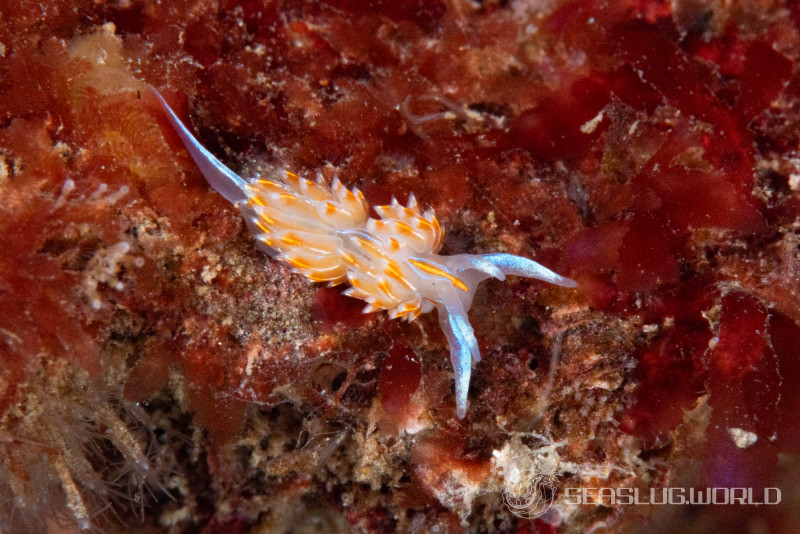
- Location
- Hennoshima, Etchumiyazaki, Toyama, Japan
- Date
- 2015/12/31
- Length
- 15mm
- Depth
- 6.0m
- Water temperature
- 11.0℃
Description
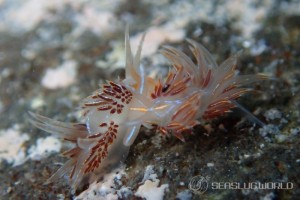
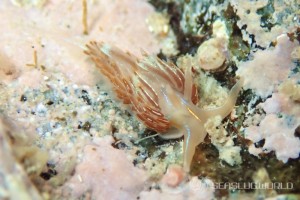
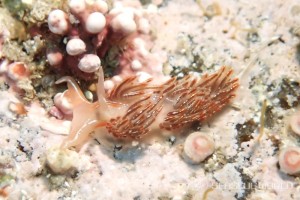
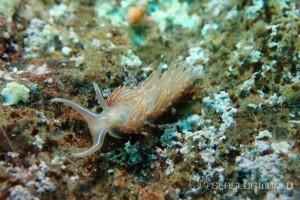
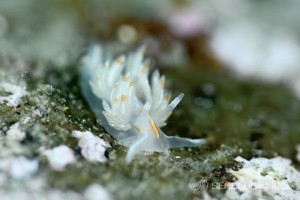
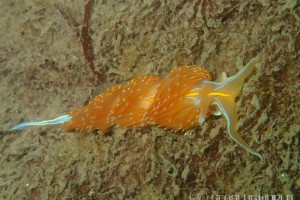
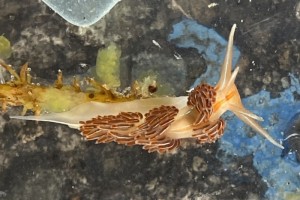
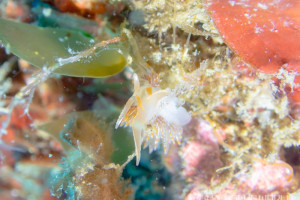
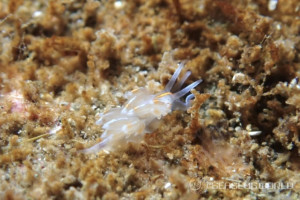
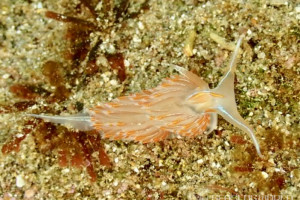
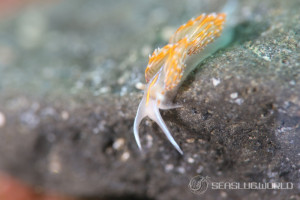
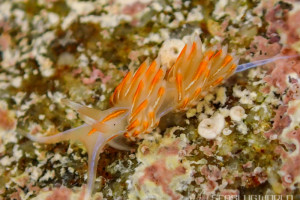
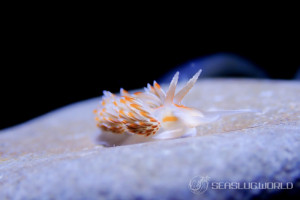
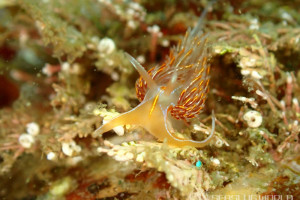
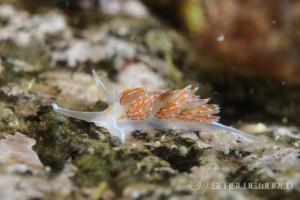
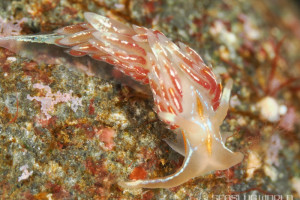
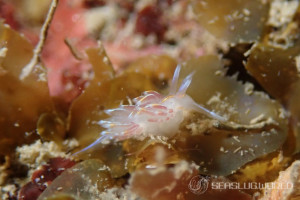
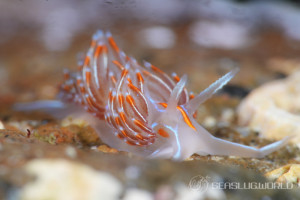
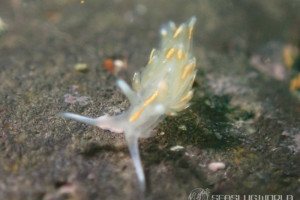
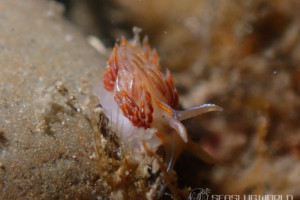
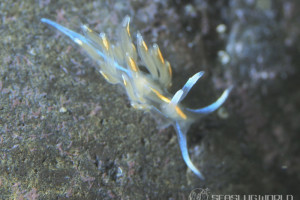
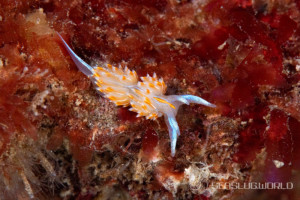
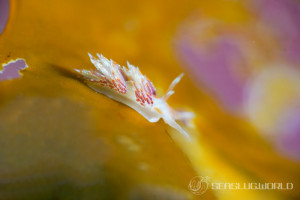
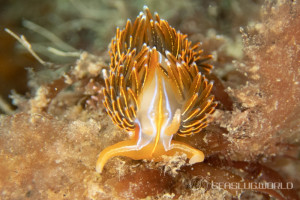
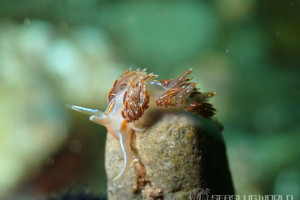
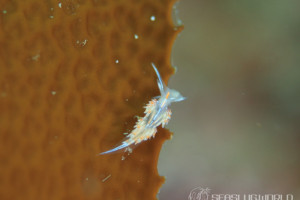
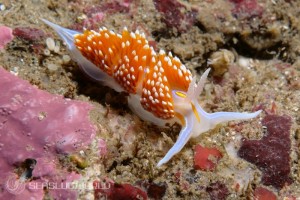
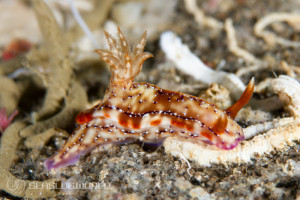
Living animals 10–35 mm in length. The antero-lateral corners of the head are produced into two strong pointed oral tentacles. Rhinophores are shorter, with annular constrictions along their whole length but not perfoliate. Branchial papillae are fusiform and very deciduous; they appear superficially in three rows but are actually arranged in 5–6 groups on each side, each group lying on a roughly horseshoe-shaped base opening outward. The first group commences postero-lateral to the rhinophore, contains over 50 papillae, and is widely separated from the second. The genital opening lies immediately below the first group on the right side. The anus lies near the centre of the second group on the right side. The foot is bilabiate with a notch in the middle of the upper lip, and is produced laterally into two tentaculiform processes.Coloration
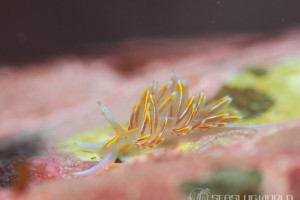
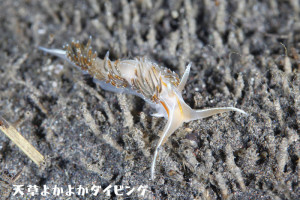
Ground colour pale (fleshy) yellow. Two bluish bilateral lines run along the mid-dorsal region, passing forward up the rhinophores and oral tentacles, and converging posteriorly at the tip of the tail. A broken mid-dorsal vermilion line runs about half way down from the head. The sides bear an upper bluish line and a shorter lower vermilion line, running parallel. Branchial papillae are chocolate-coloured, usually with a white vein and a vermilion mark just below the whitish tip. The antero-lateral tentaculiform processes of the foot each carry a bluish line.Distribution
Type locality: Niigata, on the Sea of Japan side, Japan (April 1934, fairly common).Etymology
The original description (Baba, 1937) attributes the name to Prof. Emura of Niigata Kôtô-Gakkô (Niigata Higher School), who sent specimens and a coloured sketch to Baba for identification. Emura also appears in Baba's acknowledgements (Part I) as one of the colleagues who supplied material.Remarks
Originally described as Cuthona (Hervia) emurai; later transferred to the genus Hermissenda. Resembles Cuthona (Hervia) sibogae in body form and the multi-toothed radula, but differs in coloration and in the more robust median spine of the radular teeth.References
- Cuthona (Hervia) emurai nov. sp., Baba K. (1937). Opisthobranchia Of Japan (II). Journal of the Faculty of Agriculture, Kyushu University. 5(7): 289-344. https://doi.org/10.5109/22586
- Hervia emurai Baba Emura-minoumiushi, Baba, K. 1957. A revised list of the species of Opisthobranchia from the northern part of Japan, with some additional descriptions. J. Fac. Sci., Hokkaido Univ.,ser. 6, Zool. 13(1-4):8-14.
- 高岡生物研究会. (2002). 日本海のウミウシ. 第2版.
- Hermissenda emurai, Lindsay T. & Valdés Á. (2016). The Model Organism Hermissenda crassicornis (Gastropoda: Heterobranchia) Is a Species Complex. PLOS ONE. 11(4): e0154265. https://doi.org/10.1371/journal.pone.0154265
A Kindle field guide by the site author
Kimoto N. (2026). Sea Slugs of Japan & the Indo-Pacific, 2nd Edition.
Kindle Edition
View on Amazon PR (Amazon Associates)Seasonality
Shooting Locations
Loading shooting locations...
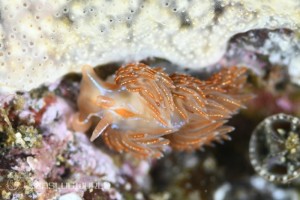
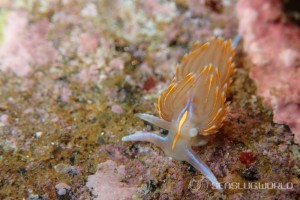
Photos of Hermissenda emurai



















Same Genus Nudibranchs

Similar Colors Nudibranchs
Academic Database
Sea slug observation data is available in international marine biodiversity databases.