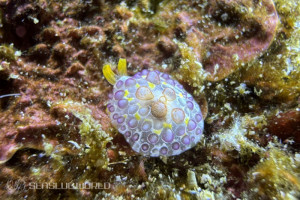
Coryphellina marcusorum (Gosliner & Kuzirian, 1990)
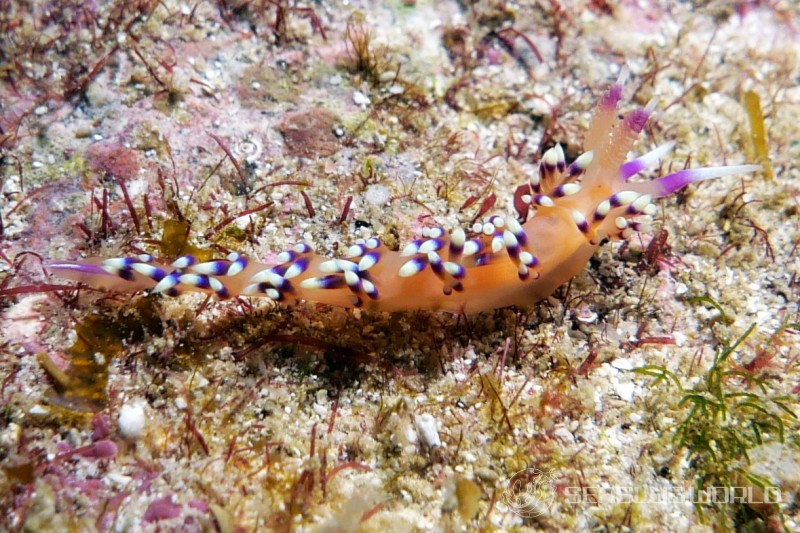
- Location
- La Paz, Baja California, Mexico
- Date
- 2020/11/26
- Length
- ??mm
- Depth
- ??m
- Water temperature
- ??℃
Description
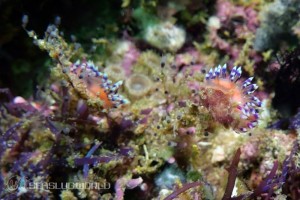
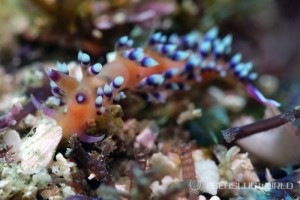
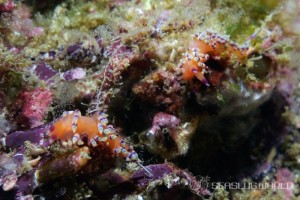
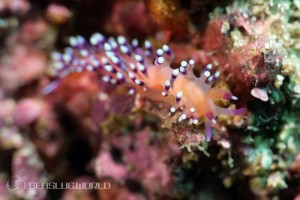
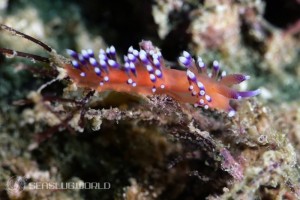
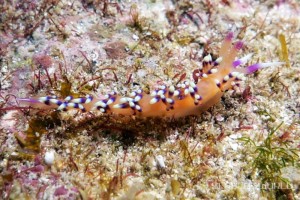
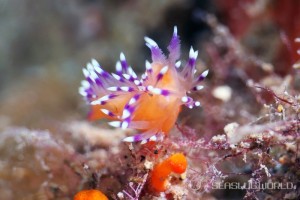
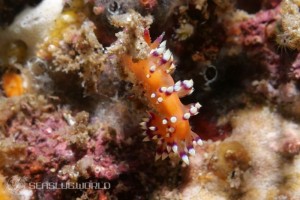
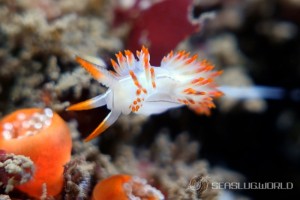
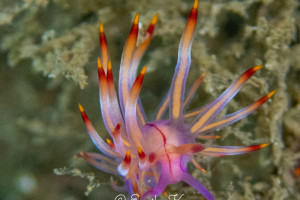
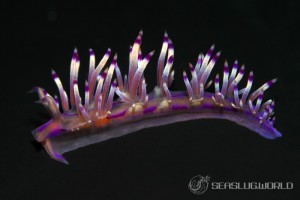
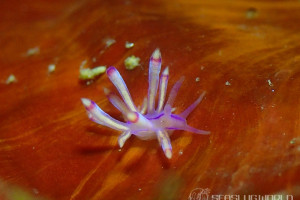
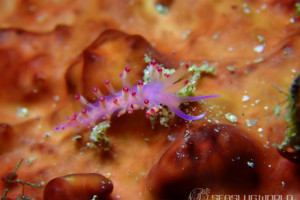
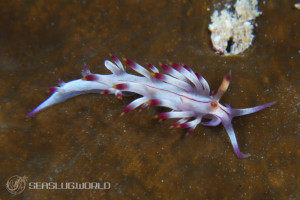
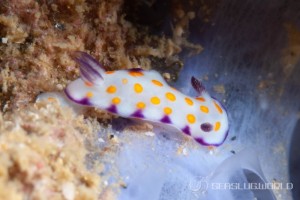
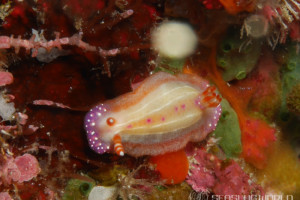
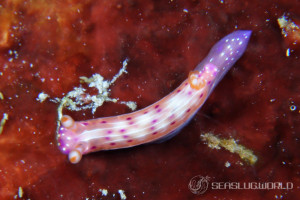
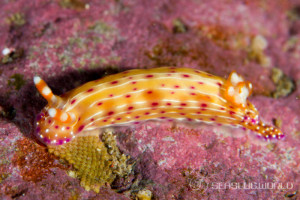
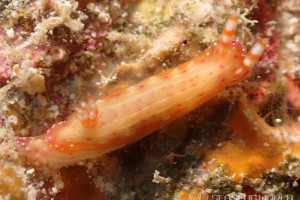
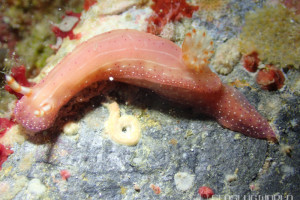
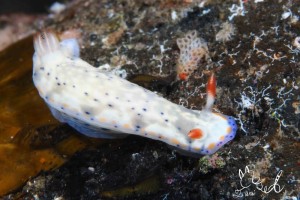
Coryphellina marcusorum is a small rose-pink aeolid nudibranch of tropical America, with white-tipped cerata and long, papillate rhinophores. The oral tentacles, foot corners and rhinophores are rose at the base, purple in the middle and opaque white at the tip; the purple band is broad on the oral tentacles but forms only a narrow ring on the cerata, between the pink and the white. In some animals the ceratal tips are yellowish rather than white. The rhinophores are elongate and conical, reaching about 4 mm, and bear roughly one hundred papillae over the middle two-thirds of the posterior face, which carries much more purple pigment than the anterior face. The oral tentacles are thin, elongate and longer than the rhinophores. The cerata are cylindrical with rounded tips and are arranged in distinct groups, 3-5 rows on each side anteriorly and 6-8 groups behind; the digestive gland running inside them is the same rose colour as the body. The hind end of the foot is purple with an opaque white line or spot above. Living animals are 7-30 mm long.Distribution
Two widely separated populations on either side of the Americas: the eastern Pacific from the Gulf of California south to Ecuador, and the western Atlantic from the Caribbean coast of South America down to Brazil. The type locality is San Diego Reef, southeast of Isla San Diego in the Gulf of California, Mexico, at 13 m. At the time of the original description the species was known on the Pacific side from Isla Cedros, Baja California, south to Sayulita, Nayarit, within the Gulf of California from San Agustín, Sonora, south to Los Islotes north of La Paz, and on the Atlantic side from São Sebastião, Brazil.Etymology
The describers named the species for Ernst Marcus and Eveline du Bois-Reymond Marcus, who first reported it — as Coryphellina rubrolineata — from Brazil and from the Gulf of California. The Latin plural genitive ending -orum marks a dedication to two people.Remarks
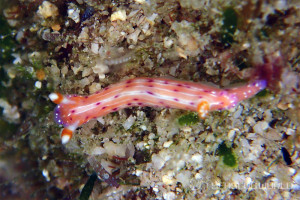
A hydroid feeder. During three years of monthly surveys in Bahía de Banderas on the Pacific coast of Mexico, animals were most often found on a hydroid with white tentacles and purple-blue hydranths, but they are not tied to a single prey species. It was the most abundant of the six closely related aeolids surveyed in that bay, building up from May and June when the water temperature rises sharply; animals are usually solitary and live on shallow reef from about 1 m downwards. The egg mass is rose pink.Coryphellina rubrolineata is the species most easily confused with it. That species carries red-purple longitudinal lines along the mid-dorsum and along each side of the body, and its rhinophores are opaque white at the base with purple towards the tip. C. marcusorum never has the longitudinal lines, and its rhinophore colours are the other way round, purple at the base and opaque white at the tip. The West African Coryphellina arveloi is very similar in colour.
The placement of this species in Coryphellina rests on morphology alone; molecular data are still needed to confirm it.
References
- Coryphellina rubrolineata O'Donoghue, 1929 (misappl.), Marcus Ev. & Marcus Er. (1961). On Coryphellina rubrolineata O'Donoghue, 1929 (Opisthobranchia, Eolidacea). Proceedings of the Malacological Society of London. 34(4): 224-227.
- Coryphellina rubrolineata (misappl.), Marcus Ev. & Marcus Er. (1970). Some gastropods from Madagascar and West Mexico. Malacologia. 10(1): 181-223.
- Flabellina telja (misappl.), Ferreira A.J. & Bertsch H. (1972). Additional data on Flabellina telja (Gastropoda: Opisthobranchia). The Veliger. 14(4): 414-415.
- Flabellina telja (misappl.), Kerstitch A. (1989). Sea of Cortez marine invertebrates: a guide for the Pacific coast, Mexico to Ecuador. Sea Challengers, Monterey. 112 pp.
- Flabellina marcusorum sp. nov., Gosliner T.M. & Kuzirian A.M. (1990). Two new species of Flabellinidae (Opisthobranchia: Aeolidacea) from Baja California. Proceedings of the California Academy of Sciences, Series 4. 47(1): 1-15.
- Flabellina marcusorum, Millen S.V. & Hermosillo A. (2007). The genus Flabellina Voight, 1834 (Mollusca: Opisthobranchia) from Bahía de Banderas (Pacific coast of Mexico) with ecological observations, the description of a new species, and the redescription of Flabellina cynara. Proceedings of the California Academy of Sciences, Series 4. 58(26): 543-559.
- Coryphellina marcusorum comb. n., Korshunova T., Martynov A., Bakken T., Evertsen J., Fletcher K., Mudianta I.W., Saito H., Lundin K., Schrödl M. & Picton B. (2017). Polyphyly of the traditional family Flabellinidae affects a major group of Nudibranchia: aeolidacean taxonomic reassessment with descriptions of several new families, genera, and species (Mollusca, Gastropoda). ZooKeys. 717: 1-139. https://doi.org/10.3897/zookeys.717.21885
- Coryphellina marcusorum, Behrens D.W., Hermosillo A., Fletcher K. & Jensen G.C. (2022). Nudibranchs & Sea Slugs of the Eastern Pacific. Molamarine.
- Coryphellina marcusorum, Ekimova, I., Carmona, L., Mikhlina, A. L., Grishina, D., Stanovova, M. V., Schepetov, D. M., Hoover, C., de Souza-Canal, J., Kuznetsov, K. O., & Valdés, Á. (2026). Neither "lumpers" nor "splitters": A global revision of Flabellinidae s.l. nudibranchs (Gastropoda: Heterobranchia: Nudibranchia). PLoS One. 21(5): e0347759. https://doi.org/10.1371/journal.pone.0347759
Featured in this book
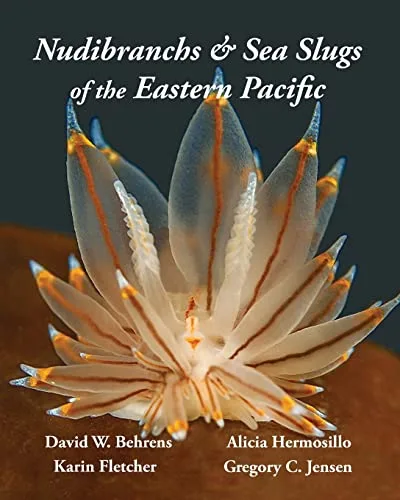
Behrens D.W., Hermosillo A., Fletcher K. & Jensen G.C. (2022). Nudibranchs & Sea Slugs of the Eastern Pacific. Molamarine.
Molamarine
This species, Coryphellina marcusorum, is included in the book.
View on Amazon PR (Amazon Associates)Seasonality
Shooting Locations
Loading shooting locations...
Photos of Coryphellina marcusorum
Tag:

Same Genus Nudibranchs


Similar Colors Nudibranchs
Academic Database
Sea slug observation data is available in international marine biodiversity databases.