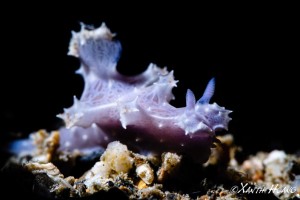
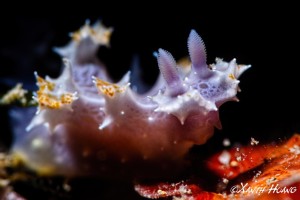
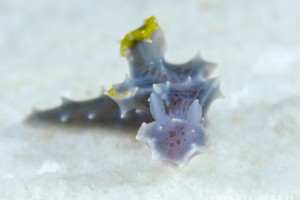
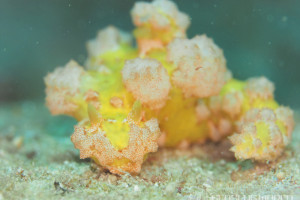
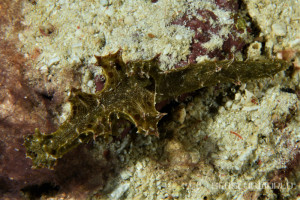
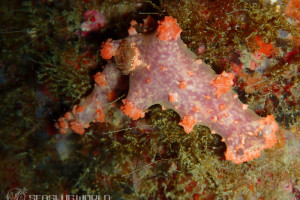
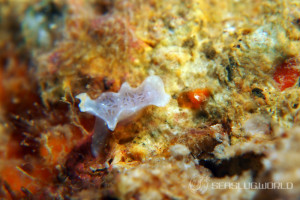
Miamira moloch (Rudman, 1988)
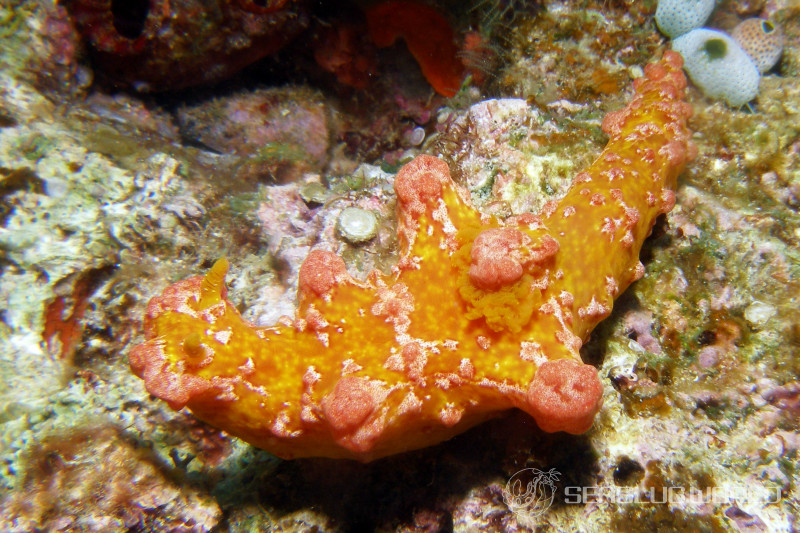
- Location
- Horse Shoes, Okinawa Island (Onna and Yomitan area), Okinawa, Japan
- Date
- 2011/04/02
- Length
- 150mm
- Depth
- 15.0m
- Water temperature
- 20.0℃
Description
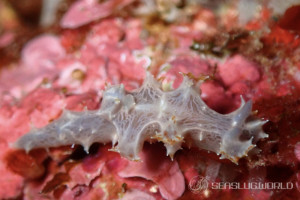
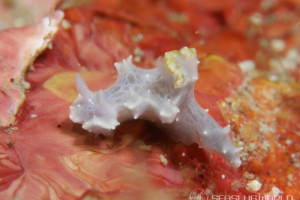
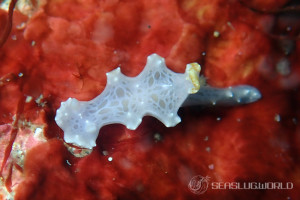
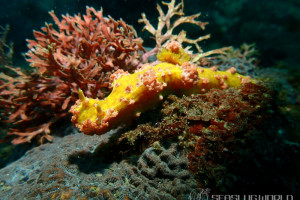
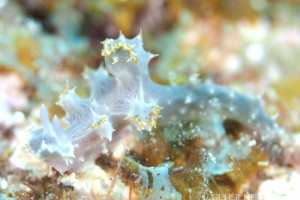
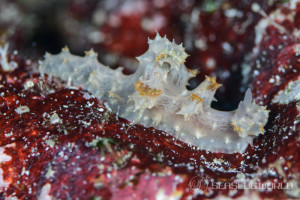
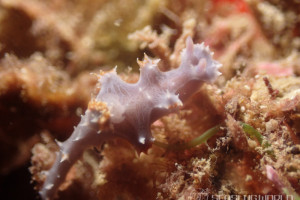
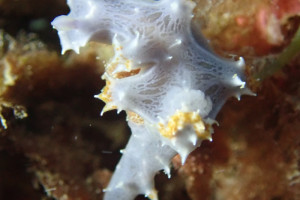
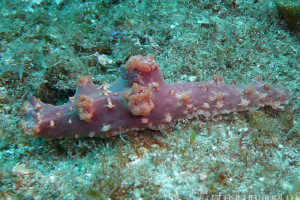
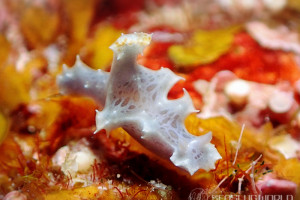
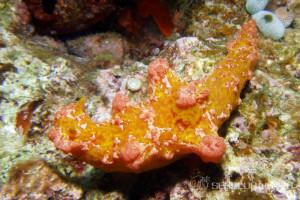
The body is elongate, firm and rigid, highest about midway along its length at the posterior end of the mantle. The mantle skirt is reduced to three pairs of flattened tuberculate lobes along each side: one pair on either side of the head, a large pair just in front of the gills, and a third pair midway between. Between the lobes the mantle edge is reduced to a slight ridge or is absent. Just behind the gills the posterior end of the mantle is produced into a large recurved horn on the dorsal midline. In larger animals the middle and posterior pairs of lobes and the posterior horn become rounded and multituberculate. Small conical and compound tubercles are scattered over the mantle and sides of the body and become dense over the posterior foot behind the mantle. Mantle glands are confined to the tubercles, with one whitish opaque region beneath the tip of each tubercle.Two specimens from Heron Island had a pink ground colour with whitish-pink tubercles outlined by an irregular cream band, and a whitish border along the foot edge; rhinophores translucent pink with white specks but no white tip; gills translucent pink. A third smaller specimen from North Stradbroke Island was translucent pink mottled with reddish-pink, with whitish (turning yellow at the edge) longitudinal, transverse and radial lines on the dorsum and lateral lobes, diffuse purple spots on the lobes and tubercles, and a yellow-tinged foot edge. Reaches 140 mm alive.
Distribution
Eastern Australia: Heron Island (Capricorn Group, Great Barrier Reef) and Shag Rocks (NW of Point Lookout, North Stradbroke Island, southern Queensland). A juvenile from Indonesia previously figured as Ceratosoma cornigerum may be referable to this species.Etymology
The name derives from a resemblance to Moloch horridus, the thorny dragon, an agamid lizard from the arid regions of Australia; the numerous tubercles covering the body evoke the spiny scales of the thorny dragon.Remarks
Readily characterised by the tuberculate lateral lobes and tubercles on the body sides, together with the recurved dorsal horn behind the gills. Originally placed in Ceratosoma and later transferred to Miamira based on subsequent molecular and morphological evidence; currently accepted as Miamira moloch.References
- Ceratosoma moloch sp. nov., Rudman W.B. (1988). The Chromodorididae (Opisthobranchia: Mollusca) of the Indo-West Pacific: the genus Ceratosoma J. E. Gray. Zoological Journal of the Linnean Society. 93(2): 133-185. https://doi.org/10.1111/j.1096-3642.1988.tb01532.x
- モロックニシキウミウシ(新称), 小野篤司. (2004). 沖縄のウミウシ. ラトルズ.
- Miamira moloch, Johnson R.F. & Gosliner T.M. (2012). Traditional taxonomic groupings mask evolutionary history: a molecular phylogeny and new classification of the chromodorid nudibranchs. PLoS ONE 7(4): e33479.
A Kindle field guide by the site author
Kimoto N. (2026). Sea Slugs of Japan & the Indo-Pacific, 2nd Edition.
Kindle Edition
View on Amazon PR (Amazon Associates)Seasonality
Shooting Locations
Loading shooting locations...
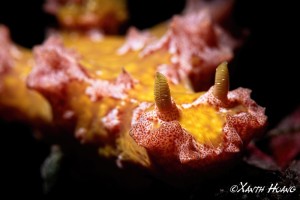
Photos of Miamira moloch

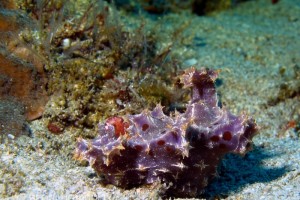














Same Genus Nudibranchs
Academic Database
Sea slug observation data is available in international marine biodiversity databases.