Phidiana salaamica Rudman, 1980
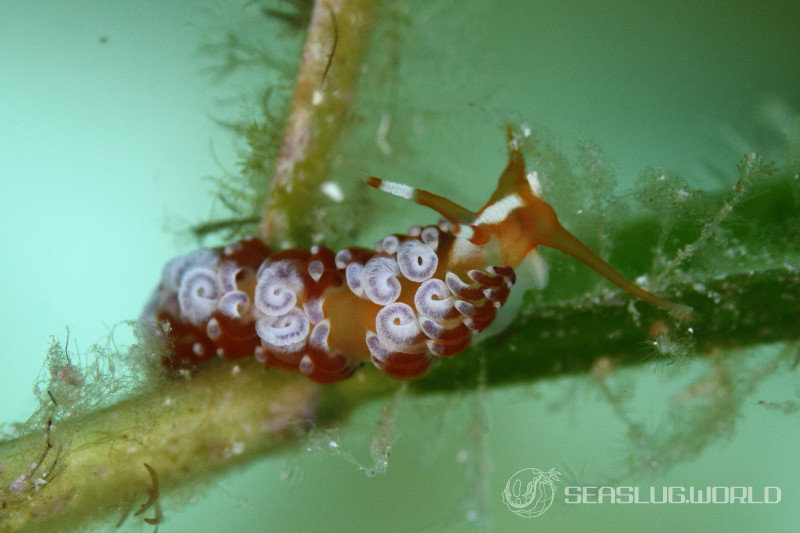
- Location
- CATEDRAL, Balicasag Island, Bohol, Philippines
- Date
- 2012/02/19
- Length
- ??mm
- Depth
- ??m
- Water temperature
- ??℃
Description
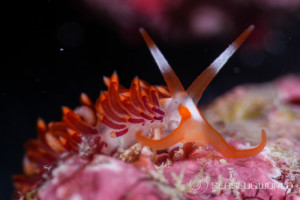
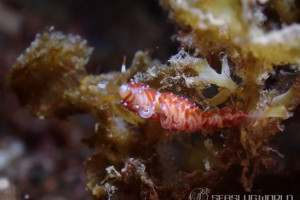
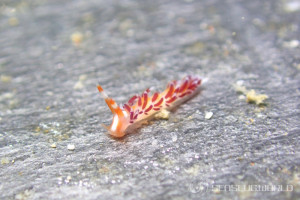
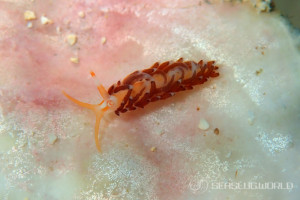
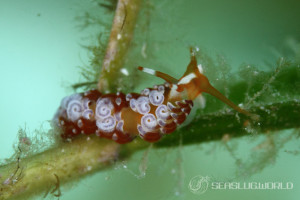
Body shape typical for the genus, elongate and rather high with a prominent pericardium. Rhinophores and oral tentacles smooth, of similar length, tapering to a rounded point. Anterior edge of the foot extended into a pair of tapering foot corners. Ceratal arrangement clearest in the 13 mm holotype: an anterior cluster of 5 rows; behind the pericardium most rows are paired but the most posterior few are single. Cerata are long for the genus, many as long as the rhinophores; the innermost cerata are exceptionally long, up to two-thirds of the body length when held erect. The longest cerata are usually at the top of the most posterior row of each cluster; they normally lie curled over the dorsum at rest but stand stiffly erect when alarmed (basis for the Japanese name "kuru-kuru").Head and oral tentacles translucent whitish, with the bright orange of the buccal bulb showing through; body translucent with a watery-yellow tinge from internal organs and haemocoel. Rhinophores translucent orange with a wide white mid-band. Foot translucent white. Most cerata transparent with apricot-yellow digestive gland and a reddish-purple distal cap; smallest cerata (first rows) also bear reddish spots on the wall. Upper two-thirds of the wall of the longest cerata is whitish, masking but not completely hiding the internal colour. Reaches 13 mm.
Distribution
Type locality: Kunduchi Beach, 12 km north of Dar es Salaam, Tanzania. Originally known only from Tanzania (Kunduchi Beach and Pangavini Island). Subsequent records from Papua New Guinea, the Philippines, and Japan exist, but molecular confirmation is desirable to verify conspecificity with the Tanzanian type material.Etymology
The specific epithet salaamica is a toponymic adjective referring to Dar es Salaam, Tanzania.Remarks
Within the genus, externally distinguished from congeners by the post-pericardial cerata being arranged in clusters of only two rows (the diagnostic external character) together with the colour pattern and ceratal arrangement.References
- (仮称)クルクルミノウミウシ, 小野篤司. (1999). ウミウシガイドブック. TBSブリタニカ.
- クルクルミノウミウシ(新称), 小野篤司. (2000). ウミウシガイドブック. 第2版. TBSブリタニカ.
- クルクルミノウミウシ, 小野篤司. (2004). 沖縄のウミウシ. ラトルズ.
- Phidiana salaamica, Terrence Gosliner, Ángel Valdés and David Behrens. (2015). Nudibranch and Sea Slug Identification Indo-Pacific. New World Pubns Inc.
Featured in this book

Terrence Gosliner, Ángel Valdés and David Behrens. (2018). Nudibranch and Sea Slug Identification Indo-Pacific 2nd Edition. New World Pubns Inc.
New World Publications
This species, Phidiana salaamica, is included in the book.
View on Amazon PR (Amazon Associates)Seasonality
Shooting Locations
Loading shooting locations...
Photos of Phidiana salaamica







Same Genus Nudibranchs
Academic Database
Sea slug observation data is available in international marine biodiversity databases.