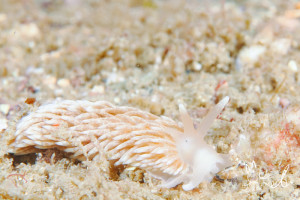
Tritonia hombergii Cuvier, 1803
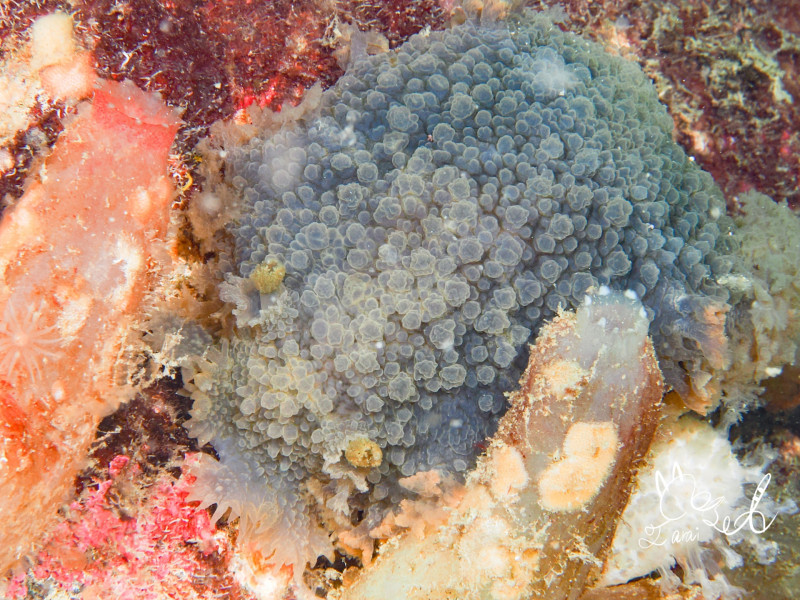
- Location
- SOL SKORVEN, West Coast of Sweden, Sweden
- Date
- 2025/06/28
- Length
- 200mm
- Depth
- 20.0m
- Water temperature
- 14.5℃
Description
The largest tritoniid nudibranch, reaching over 200 mm (up to 300 mm) in body length. Body broad, with a relatively few to moderate number of distinct branched dorsolateral appendages along the indistinct notal edge. Rhinophoral sheaths closed, lacking a lateral opening. Oral veil bilobed, bearing numerous long processes. Jaws oval; masticatory edge furnished with strong conical or elongate bristle-like elements. Central radular teeth tricuspid. Many rows of lateral teeth, more than 50 (up to 200) per half row. Coloration ranges from translucent white in juveniles to dark purplish-brown in fully grown specimens, becoming progressively darker with age.Distribution
North-eastern Atlantic, from Norway and the British Isles southwards to Spain and the western Mediterranean.Etymology
The specific epithet honours Wilhelm Guillaume Homberg (1652–1715), the German-Dutch-French chemist and natural philosopher.Remarks
Type species of the genus Tritonia Cuvier, 1798. Feeds on the soft coral Alcyonium digitatum (dead man's fingers). Korshunova & Martynov 2020 restricted Tritonia to a clade of large-bodied tritoniids with bilobed oral veil bearing numerous processes and high lateral-tooth counts (typified by T. hombergii); they confirm the taxonomic identity of the neuroscience model species T. tetraquetra as a related congener. Pale juveniles were historically described as a separate species before being recognised as conspecific.References
A Kindle field guide by the site author

Kimoto N. (2026). Sea Slugs of Japan & the Indo-Pacific, 2nd Edition.
Kindle Edition
View on Amazon PR (Amazon Associates)Seasonality
Shooting Locations
Loading shooting locations...
Photos of Tritonia hombergii

Same Genus Nudibranchs


Similar Colors Nudibranchs

Academic Database
Sea slug observation data is available in international marine biodiversity databases.