Aldisa vozinhai: the red sea slug named for goalkeeper Vozinha
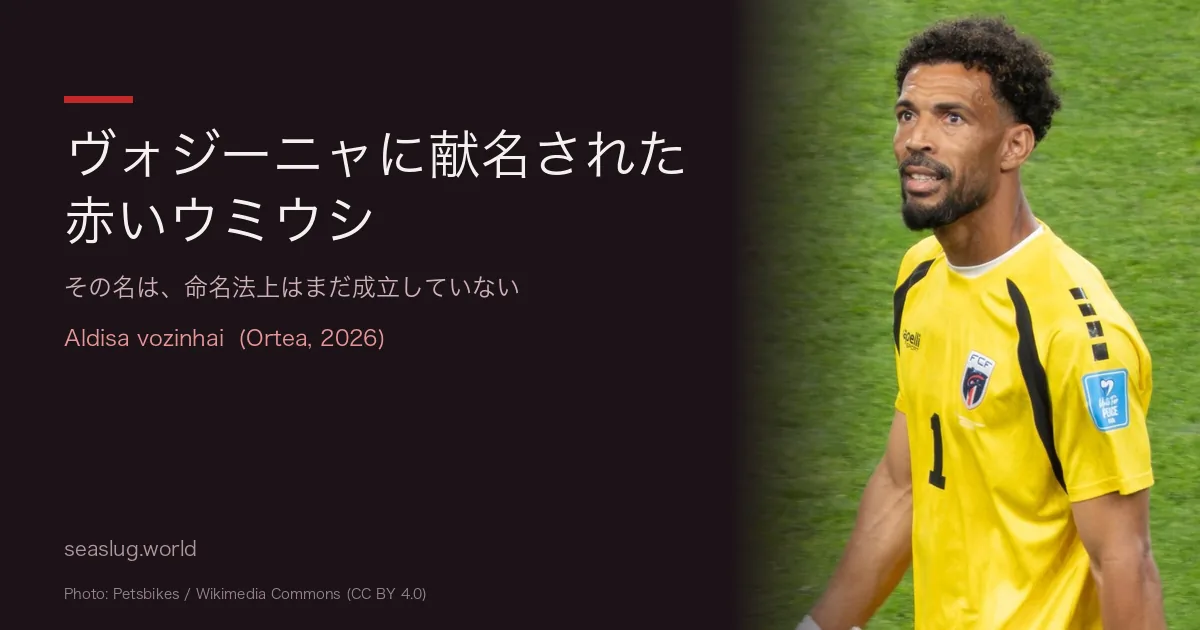
In June 2026, at the World Cup, Cape Verde's goalkeeper Vozinha kept out seven shots from Spain and held his side to a 0–0 draw. A few weeks later, sports outlets around the world reported that a red sea slug had been named after him: Aldisa vozinhai. As a naming story it works well. But once you open the original description, there is a second half to it: under the rules of zoological nomenclature, the name is not yet available.
The story, and what the red color means
The species was described by the Spanish malacologist Jesús Ortea, based at the University of Oviedo, who has spent decades describing sea slugs from the Caribbean and Macaronesia (the Canary Islands, Cape Verde and neighbouring archipelagos). The description appears in his own book Historias de la Bioadversidad, volume 3 (pages 195–204). This is not a peer-reviewed journal but Ortea's own self-published book (author's edition).
In the paper's etymology, the name is dedicated to Vozinha, the 40-year-old Cape Verde international goalkeeper from Mindelo. On 15 June 2026, against Spain (nicknamed La Roja, "the red one"), he stopped everything and put Cape Verde on football's world map. The animal's bright red mantle is tied to the memory of that match. Ortea also states a second reason: Cape Verde awarded him the national Medal of Environmental Merit on 29 June 2023, and the naming is a gesture of thanks to the country.
Ortea's habit of naming species after footballers
What makes this fun is that it is not the first time. The paper itself lists Ortea's earlier footballer dedications:
- Granulina keilori (2019), a tiny snail named for the Costa Rica goalkeeper Keylor Navas.
- Prunum quini (2018), a snail named for Quini (Enrique Castro), the "wizard" of Sporting Gijón, whose live coloration reportedly matches the club's colors.
Ortea also notes, almost in passing, that a red sea slug he described in 1988, Aldisa barlettai, comes from São Vicente, the island where Vozinha was born. For this author, naming species after footballers has become something of a signature.
Reading the original description: how thin the material is
For a science-focused reader, the more interesting question is not the story behind the name but what specimens the description rests on. Read closely, the foundation is slender.
- The description is based on just two specimens, both 4 mm long. One was collected off Havana in November 2001; the other was found moribund off Guadeloupe in 2012.
- There is no DNA at all. The description relies only on the external form, radula and jaws of two poorly preserved, decades-old specimens, and Ortea himself notes that he described the species "despite the deficient state of the available material." He also writes that fixation causes both the red color and the network of spicules to disappear.
- The holotype (the name-bearing specimen) is in the author's personal collection, "pending shipment to the National Aquarium of Cuba." In other words, it is not yet housed in a public museum.
There is also a small but telling detail. The spelling everyone is using, Aldisa vozinhai, appears nowhere in the original description. Throughout the paper the epithet is consistently vozinha (no final i): the species-establishing heading and the plate captions all read "Aldisa vozinha n. sp." The vozinhai form is the one used by WoRMS and the news outlets, not the original spelling. As noted above, Ortea's other footballer dedications (Granulina keilori, Prunum quini) end in the genitive -i, so vozinhai reads like the intended genitive, but the published spelling is vozinha.
WoRMS lists it as an "unavailable name"
This is the heart of the story. The World Register of Marine Species (WoRMS) lists Aldisa vozinhai as unaccepted / an unavailable name.
The reason lies in the electronic-publication rules of the International Code of Zoological Nomenclature (ICZN). Since 2012, to make a new name available in a work issued only electronically (without a printed edition), the work must be registered in ZooBank and must state that registration inside the publication itself. Historias de la Bioadversidad is electronic-only, and no ZooBank registration is evident. Because that condition is not met, Aldisa vozinhai is, for now, not a formally available name — that is WoRMS's assessment.
So the very name the world celebrated as "a new species named after Vozinha" has not, procedurally, come into existence yet. And the specimens come not from Cape Verde but from the Caribbean (Cuba and Guadeloupe).
"Unavailable" is not a verdict on the science
It is worth being clear that the "unavailable" label is not a judgment on whether the description is correct. Zoological nomenclature sets conditions on how and where a name is published, but it requires neither peer review nor any particular standard of descriptive quality. "Unavailable," then, is a procedural status, on a different axis from scientific assessment.
The same label can sit over very different situations. I once wrote about donating to Japan's National Diet Library a book that was stuck on ICZN Article 8.1.2. There, a substantial, DNA-based reorganization of the nudibranchs by senior researchers was left in limbo purely because the book (100 copies, distributed only within Russia) failed the wide-distribution requirement — a logistics problem, which a single donated copy to the library helped resolve. Aldisa vozinhai, by contrast, trips on the electronic-publication formality, in a description that also rests on scant material, carries no DNA, and has not been peer-reviewed. Same status, but in one case sound work was halted by distribution, and in the other a formal gap sits alongside a thin foundation.
The naming story and the name's validity are two different things
The wish to dedicate a red sea slug to Vozinha comes through clearly in the paper. But a good naming story and a validly established name are two separate matters, and at present Aldisa vozinhai satisfies only the first.
That said, this is not a closed case. If Ortea issues a printed edition, or registers the work in ZooBank, the name could still be validated in the future. Whether a sea slug bearing Vozinha's name formally enters the record remains to be seen.
Primary sources:
- Ortea, J. (2026) original description, Historias de la Bioadversidad 3: 195–207. on ResearchGate
- Aldisa vozinhai on WoRMS
- Aldisa vozinhai on Wikipedia
Enjoyed this post? You can tip the author directly —
Tip this post