How a Russian Sea Slug Book Found a Permanent Home in Tokyo: Martynov & Korshunova (2025) and the Quiet Mechanics of Taxonomic Stability
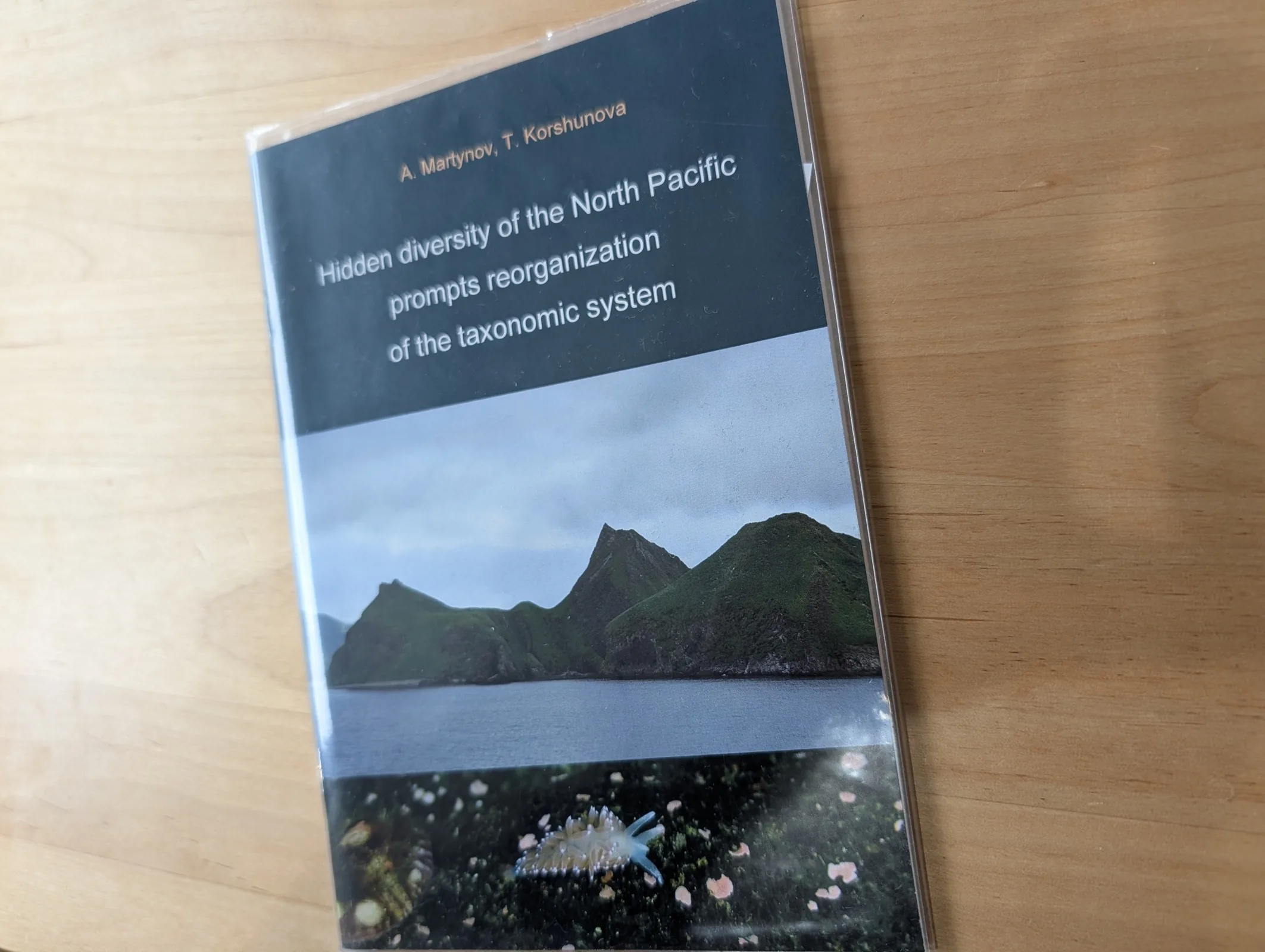
In early 2025, the Moscow publisher Neptune issued a 45-page book with a sea slug on the cover and an unusually heavy table of contents inside. The authors are Alexander Martynov and Tatiana Korshunova — senior researchers at Moscow State University's Zoological Museum and at the Koltzov Institute of Developmental Biology, with thirty-five years of nudibranch taxonomy between them. The book is titled, with characteristic understatement, Hidden diversity of the North Pacific prompts reorganization of the taxonomic system.
The contents do exactly what the title says. Nine new species. Thirteen new genera. Three new families. Several long-buried genera reinstated. The reinstatement of Polycera capitata Alder & Hancock, 1854 as a valid species, with the recently-described Polycera norvegica Sørensen et al., 2020 absorbed as its junior synonym. And, most consequentially, a textbook-level reorganisation at the ordinal level: Order Doridida is reinstated as a separate order, and Order Nudibranchia is restricted to the cladobranch (aeolid-type) lineages.
The World Register of Marine Species — WoRMS, the global authority that most field guides, citizen-science platforms, and catalogue websites trust as the canonical name source for marine animals — initially declined to adopt the book's nomenclatural acts. The objection was not the science. It was the distribution.
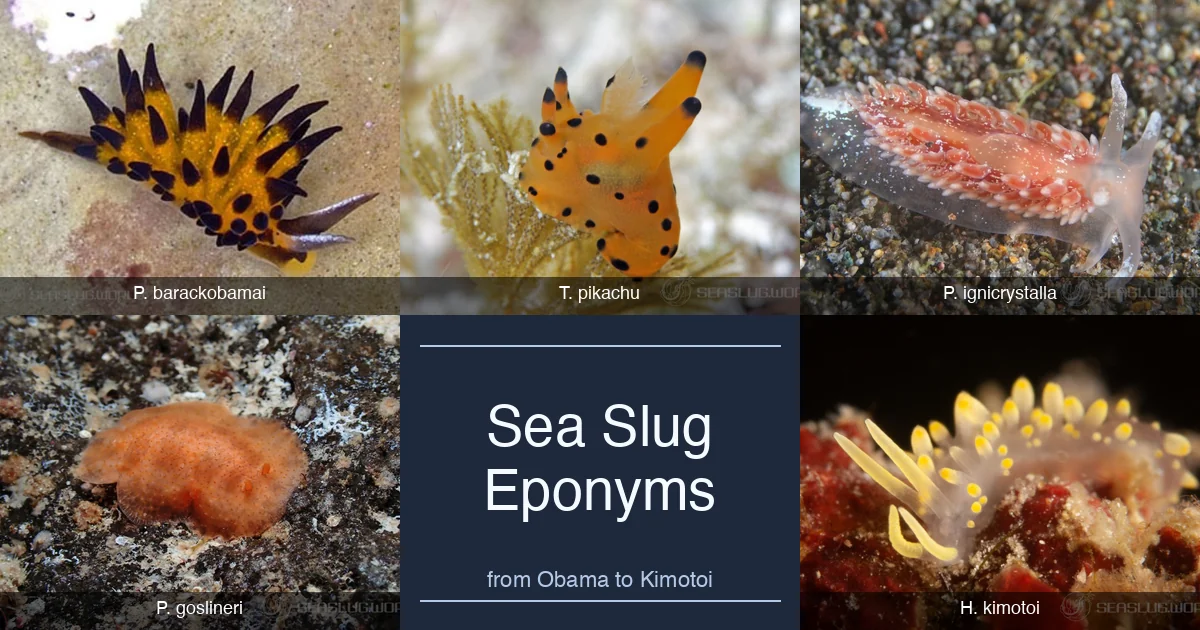
Both authors are personal friends — Alexander goes by Sasha, and Tatiana by Tanya, and that is how I will refer to them below. The Moscow group's relationship with my catalogue site has been running for several years. Earlier in 2025, in a separate paper in the Zoological Journal of the Linnean Society, Korshunova, Fletcher and Martynov described a new aeolid species from northern Japan — Hantazuia kimotoi — and named it after me.
So when the new monograph appeared, I asked Sasha for a copy. He sent me one of the hundred. The procedural question came later, and not from me. It came from a piece of background news: WoRMS was apparently not adopting the book's nomenclatural acts. I was curious why and wrote to the editorial board to ask. The reply pointed at Article 8 — distribution. The donation idea was an experiment that grew out of that exchange. If a major national library held a permanent copy, would that satisfy one of the working tests for "widely distributed"? I had a copy on my desk. The cleanest way to find out was to send it.
This article is the record of that experiment.
When a complete book is treated as "unavailable"
The International Code of Zoological Nomenclature (the ICZN, fourth edition, 1999) defines under Article 8 the conditions a publication must meet for the names it contains to count as scientifically established. The core requirement is that the work must be "issued for the purpose of providing a public and permanent scientific record" (Article 8.1.1) and must be obtainable, when first issued, through "purchase or as a free distribution" in "numerous identical and durable copies" (Article 8.1.3). A second clause, Article 8.4 (formally codified in the 2012 amendment as 8.5 for electronic works), reinforces this with practical tests around library accessibility and ZooBank registration.
Why the formality? A scientific name has to be traceable to a moment of first publication. If the original publication cannot be located by future workers — if the only existing copies sit in private hands, or live on a website that disappears — then the name itself loses its anchor. The Code therefore demands a kind of public-record character from the documents that establish names.
For papers in commercial journals or museum bulletin series, this requirement is satisfied automatically. Major libraries acquire the journal through standing subscriptions; the issue is catalogued; the publisher commits to permanent archival. Even modern open-access electronic journals like Zootaxa satisfy the requirement through ZooBank registration combined with simultaneous deposit in CLOCKSS, Portico, and other distributed-archive services.
The friction zone is small-press scholarly publishing with limited international reach. Regional monographs, museum-internal field guides, and short-run conference proceedings sometimes carry serious taxonomic content but cannot show the same paper trail outside their home region. Martynov & Korshunova (2025) is a properly issued book — Neptune is a Moscow publisher, the work has an ISBN, and copies are sold within Russia through the publisher and through the lead author's office — but the colophon specifies a print run of 100 copies, and distribution outside Russia goes essentially through individual mail orders and inter-library exchange. To a WoRMS editor evaluating Article 8 availability, that does not look like "numerous, simultaneously obtainable, durable copies, widely distributed."
This is not a personal failing on either side. It is a structural friction. A great deal of solid taxonomic work — particularly from Russian, Eastern European, Latin American, and South-East Asian institutions — emerges through publication channels that work fine for the originating community but stop short of the global-distribution test that catalogue authorities apply.
How "Order Nudibranchia" split in two
The book's most consequential act is at the ordinal level. Until now, virtually every textbook and field guide listed the dorids and the aeolids as two suborders within a single Order Nudibranchia. The 2025 book formally breaks them apart.
The argument is not new. It rests on a body of molecular and morphological work — most directly Korshunova et al. (2020) in the Zoological Journal of the Linnean Society — that recovers dorids and aeolids as deeply divergent lineages, each as different from the other as either is from external groups like the side-gilled Pleurobranchida. The dorids carry a circular gill plume around the dorsally-shifted anus, with a distinct gill cavity in early development; the aeolids ("cladobranchs" in the older Willan & Morton 1984 terminology) carry rows of finger-like cerata along the back, with no true gill at all. Combining them as suborders within one order, the argument runs, is no less arbitrary than absorbing the side-gilled slugs into Nudibranchia would be.
What the 2025 book adds, beyond the prior molecular and morphological work, is the formal nomenclatural act. It revives the name "Order Doridida" — first applied by Pelseneer in 1894 — at the rank of order, with a new diagnosis tied to the gill cavity character and the dorsal gill circle. It restricts "Order Nudibranchia" to the cladobranch lineages (aeolids, arminids, dendronotids, and their relatives), citing Cuvier in Blainville (1814) as the original concept. From that moment on, anyone writing about the higher classification of sea slugs has either to follow the Doridida-and-Nudibranchia split, or to actively argue against it. Catalogue platforms like WoRMS that aspire to track the consensus state of the literature have to come to a decision.
For a small catalogue site like seaslug.world, this reorganisation cascades into the category tree, with downstream effects on textbooks, citizen-science platforms, and any guide that lists the higher classification of sea slugs.
A book deposit at the National Diet Library of Japan
I read the WoRMS reply and looked at the copy on my desk. The thought that surfaced was simple: what if I sent this one copy to a major national library and let it produce a public bibliographic record? Would that satisfy at least one of the practical tests behind Article 8.4?
The National Diet Library of Japan (NDL) is the country's national library and operates the Japanese legal-deposit system. It accepts donations of foreign-published works with substantive scientific content; accepted donations enter the national bibliographic record and the perpetual physical collection. The procedure required a donation form, the bibliographic data, and the physical book. I prepared the paperwork, sent the copy Sasha had given me, and waited for the result.
The Library accepted the donation and processed the bibliographic record. The catalogue entry is now public:
- Title: Hidden diversity of the North Pacific prompts reorganization of the taxonomic system
- Authors: Alexander Martynov, Tatiana Korshunova
- Imprint: Neptune, Moscow, 2025
- Physical description: 45 pages, 21 cm
- ISBN: 978-5-9905149-3-5
- NDL bibliographic ID: 034333142
- Call number: RA525-D6
- Permanent record URL: https://ndlsearch.ndl.go.jp/books/R100000002-I034333142
NDL's call number RA525 is the invertebrate-zoology section, with -D6 the format subdivision. Anyone in the world can now resolve the book by ISBN, by title, by author, or by NDL ID. The physical copy sits on a permanent-collection shelf in central Tokyo. The Russian State Library deposit, the author-managed personal mailings, and now NDL — three independent legs of the availability stool.
What happened next
Some months after the donation was sent, with no individual notification from the Library, I happened to check the catalogue: the bibliographic record was simply there. The donation had been accepted and the record processed at some point along the way, quietly, the way library workflows tend to operate.
Then, while looking up something unrelated on the WoRMS site, I found that the book had been registered as a source in their database, and at the time of writing eighty-one taxa entries were drawing on it for original descriptions, status changes, distributions, and etymologies. Every nomenclatural act in the book had been integrated into the global authoritative catalogue.
I cannot claim a causal connection between my donation and the WoRMS adoption. The book may simply have accumulated enough downstream citation, library presence, and editorial attention to clear the working test on its own timeline. My deposit is, at best, one small input into a larger movement.
Even so, the sequence is worth documenting. Whatever the actual causal pathway, a copy of the book — the one Sasha sent me — is now permanently held at a major national library, where anyone can verify its physical presence by an online catalogue search. That much is a stable fact in the world.
What Article 8 of the Code ultimately requires is that someone, somewhere, gives a book a permanent public address — and the Code is silent on which actor in the chain does that. Editors, authors, libraries, and citizen-catalogue maintainers are all eligible. This time, one of the people who did it happened to be me.
What this means for the seaslug.world database
The seaslug.world database already links five products to the 2025 book as a primary reference. All five are species recorded from waters relevant to East Asian divers and citizen scientists, all five represent new combinations introduced by Martynov and Korshunova, and all five connect explicitly back to Japanese and Russian taxonomic history:
- Longibranchus putnami (Fernandez-Simon and Moles in Cunha et al., 2023) comb. nov. — formerly Eubranchus putnami.
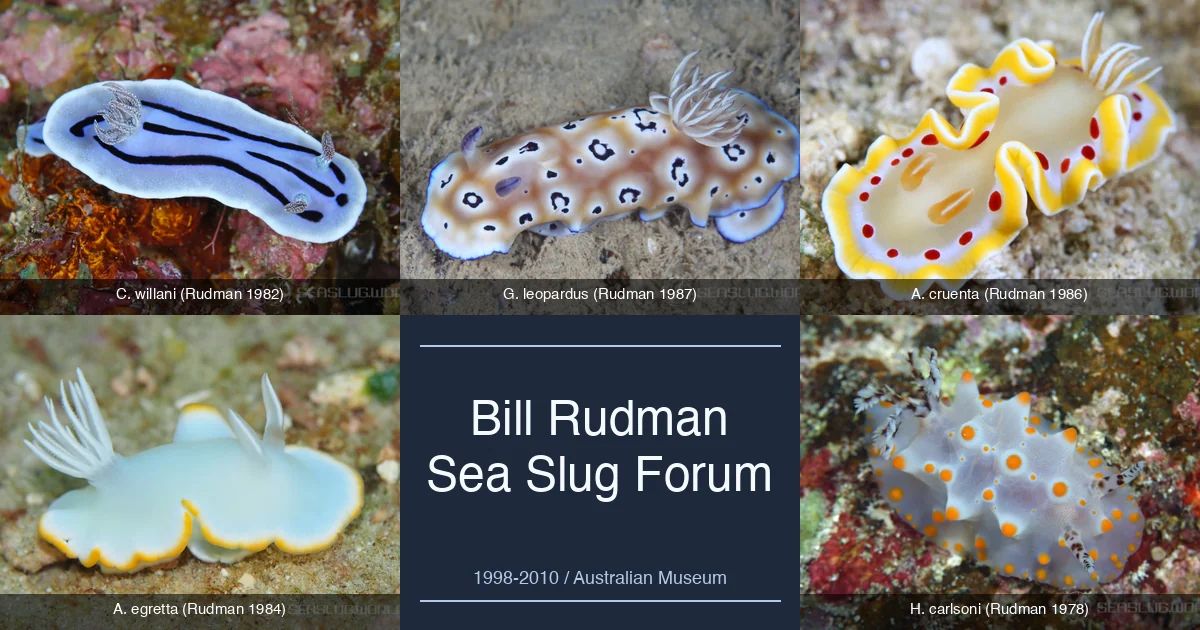
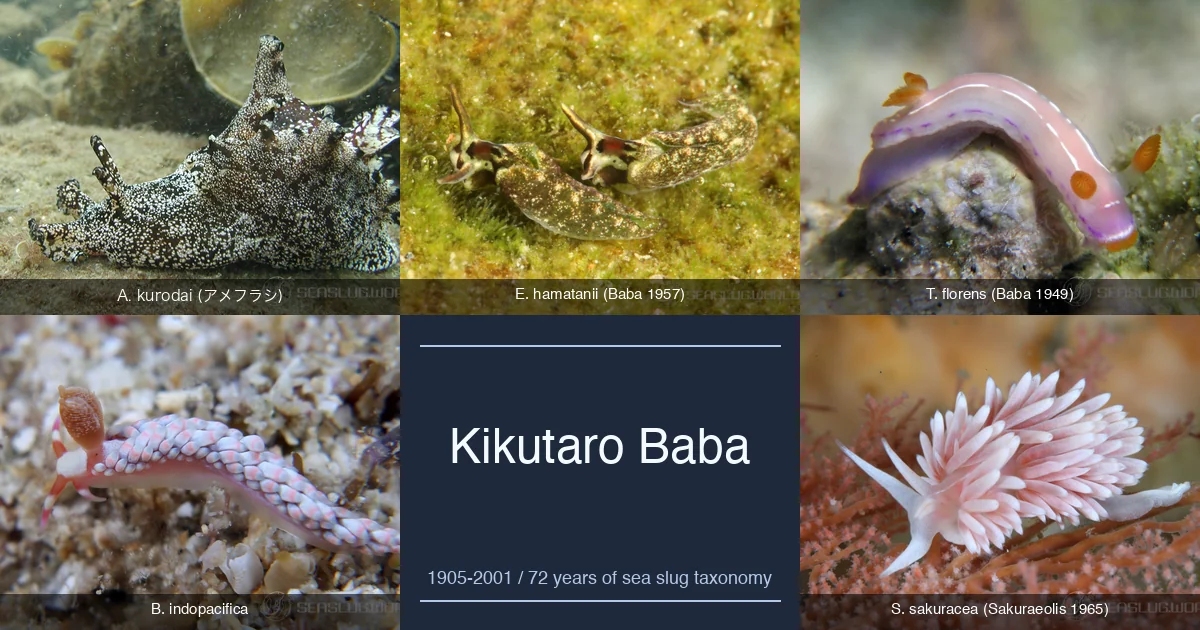
- Nella osyoro (Baba, 1940) comb. nov. — formerly Cuthona osyoro, originally described by Kikutaro Baba from Hokkaido.
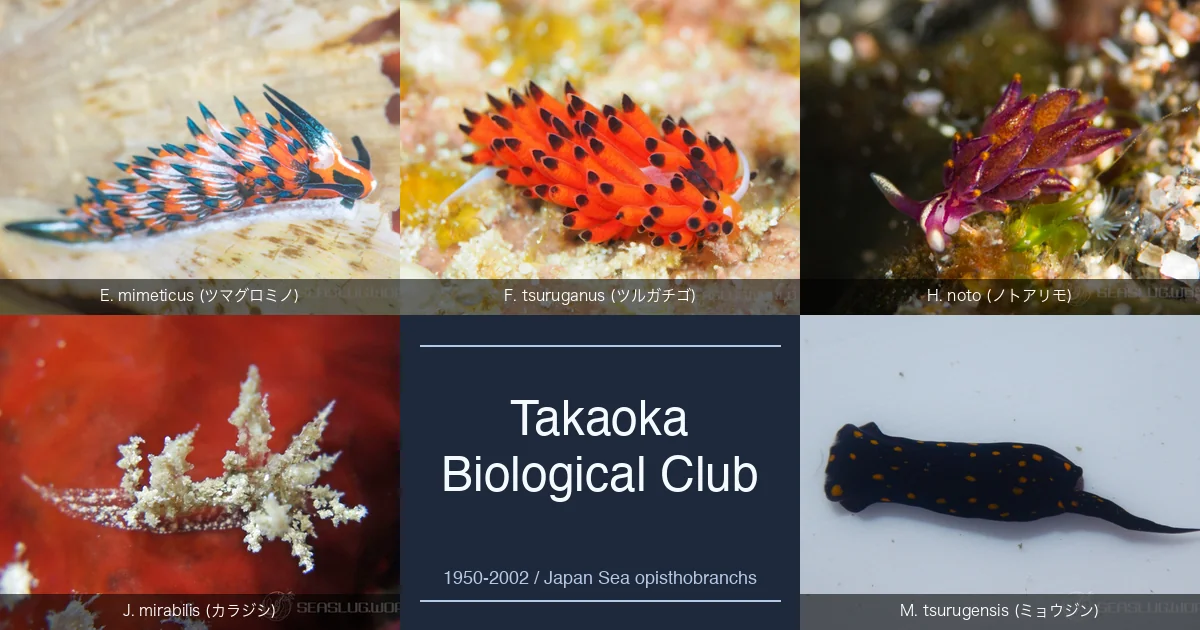
- Nella soboli (Martynov, 1992) comb. nov. — described from the Sea of Japan.
- Nihonbranchus horii (Baba, 1960) comb. nov. — formerly Eubranchus horii, again a Baba species. The new genus name is Japanese in origin: "Nihon" for Japan, with the type and main range explicitly in the Japanese coastal waters.
- Corruptobranchus malakhovi (Ekimova et al., 2021) comb. nov.
That two of these involve names Kikutaro Baba erected eighty-five and sixty-five years ago, now finding their way into a 2025 reorganisation, says something about the continuity of North Pacific malacology that the publication frictions tend to obscure.
The unglamorous work of keeping a book a book
I have run a sea slug catalogue site for eleven years. This is the first time I have actually been in this kind of situation. A solid piece of taxonomic work existed; a procedural-availability question was holding it back from the canonical catalogue chain; the most useful thing I could do, given the copy on my desk, was send it to a major library and let the bibliographic record speak for itself.
I should be clear about my own position. I do not hold an academic affiliation. I run seaslug.world as an independent citizen catalogue, with no institutional access to subscription journals or rare-book archives. My usual experience is the inverse of this article: I am almost always the person being helped — by friends, colleagues, and researchers who share PDFs of papers I cannot otherwise read, who answer my taxonomic questions from inside their universities and museums, who scan obscure original descriptions when I ask. Sasha mailing me one of the hundred copies of the new book was itself part of that long chain of generosity. This time, by accident, I happened to be on the giving side of one small loop. Watching a freshly-printed monograph travel from a friend's hand into a national library and then into the global authoritative database was new to me, and I did not know going in whether the experiment would actually produce that outcome.
This is not the same as writing papers, describing new species, or photographing live animals. It is more like maintenance — making sure that the books exist where they need to exist, so that the names they describe can keep referring to the animals they were assigned to. The Code is explicit that names need a permanent public record. The Code is silent on who, exactly, is supposed to make that record happen.
WoRMS, iNaturalist, GBIF, the Encyclopedia of Life, and citizen-curated catalogues like seaslug.world are all downstream of the printed page. The 100-copy run that Sasha and Tanya printed in Moscow in 2025 now has, among its destinations, a single copy that travelled from Sasha's hands to my desk in Tokyo and then four floors underground into the National Diet Library's permanent stacks. That, for now, is enough.
It is unglamorous work. I find it satisfying.
References
- Martynov, A. & Korshunova, T. (2025). Hidden diversity of the North Pacific prompts reorganization of the taxonomic system. Moscow: Neptune. 45 pp. ISBN 978-5-9905149-3-5.
- National Diet Library of Japan, bibliographic record ID 034333142. https://ndlsearch.ndl.go.jp/books/R100000002-I034333142
- ICZN. (1999). International Code of Zoological Nomenclature. 4th ed. London: International Trust for Zoological Nomenclature.
- Korshunova, T., Fletcher, K., Picton, B., Lundin, K., Kashio, S., Sanamyan, N., Sanamyan, K., Padula, V., Schrödl, M. & Martynov, A. (2020). The Emperor's Cadlina, hidden diversity and gill cavity evolution: new insights for the taxonomy and phylogeny of dorid nudibranchs. Zoological Journal of the Linnean Society 189: 762–827.
- Pelseneer, P. (1894). Recherches sur divers Opisthobranches. Mémoires de l'Académie Royale de Belgique 53: 1–137.
- Wägele, H. & Willan, R. C. (2000). Phylogeny of the Nudibranchia. Zoological Journal of the Linnean Society 130: 83–181.
- Blainville, H. M. D. de. (1814). Mémoire sur la classification méthodique des animaux mollusques. Bulletin des Sciences, Société Philomathique 1814: 175–180.
Enjoyed this post? You can tip the author directly —
Tip this post