Nihonbranchus horii (Baba, 1960)
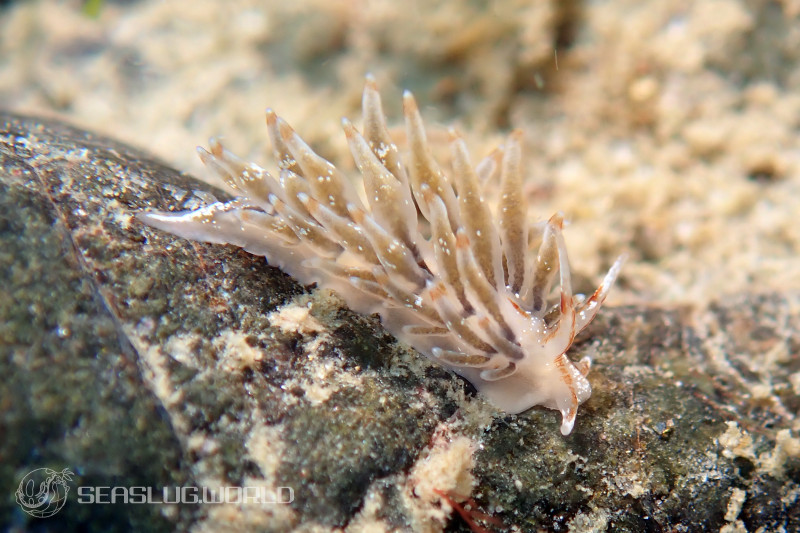
- Location
- Beach, Oyashirazu, Niigata, Japan
- Date
- 2018/04/14
- Length
- 10mm
- Depth
- 5.0m
- Water temperature
- 10.0℃
Description
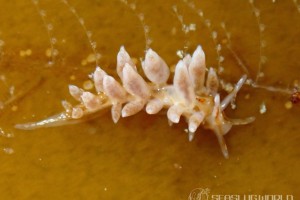
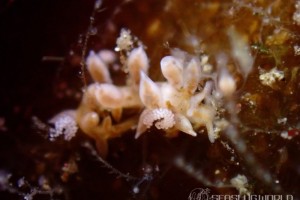
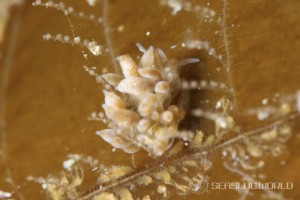
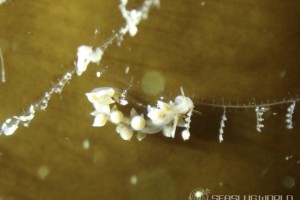
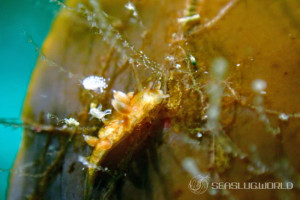
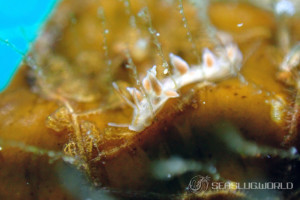
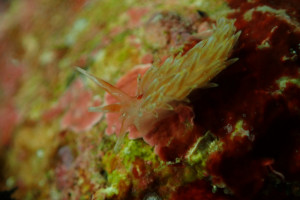
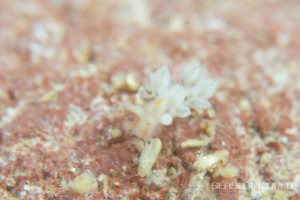
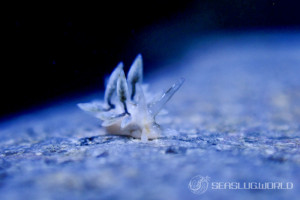
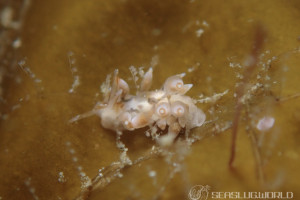
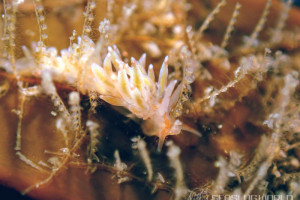
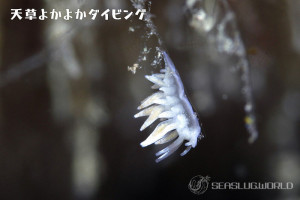
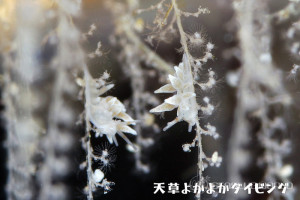
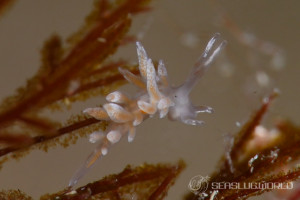
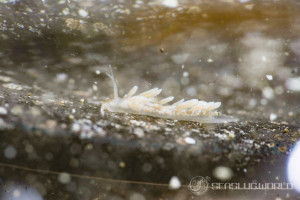
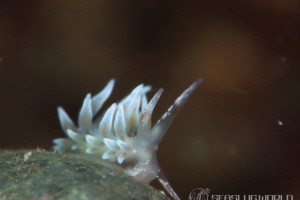
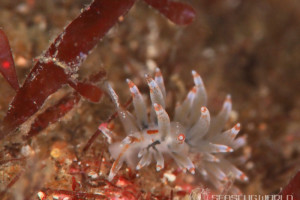
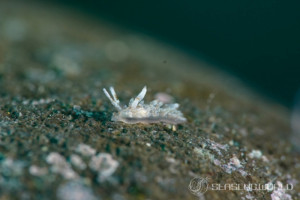
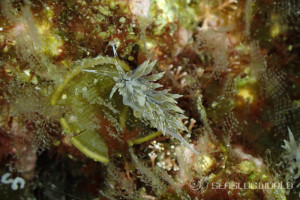
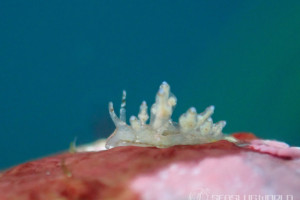
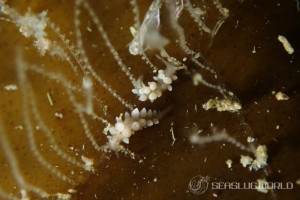
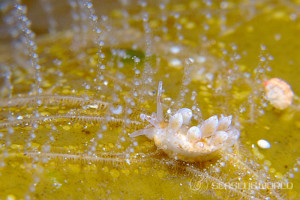
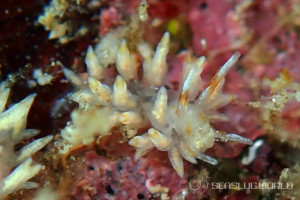
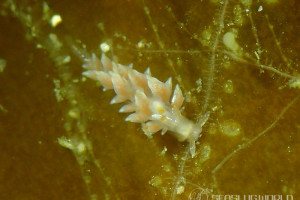
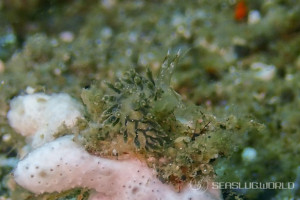
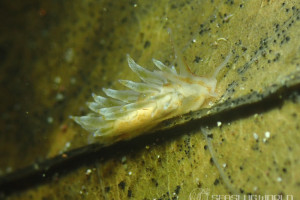
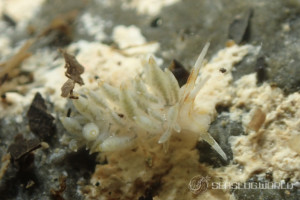
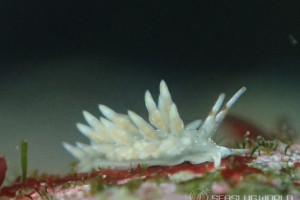
A small aeolid 3-7 mm in length. General ground colour of the body yellowish white; the cephalic tentacles and rhinophores are always linked by a longitudinal brown band running along the edge of the head, and a short longitudinal brown marking is always present on the median line of the back at about the level of the anterior liver rows. Cephalic tentacles and rhinophores each banded with brown in the middle of their length. Branchial papillae long, fusiform and smooth, each with a dark-brown liver-vein and a subapical brown ring. Sole colourless. The cerata are arranged in 7-8 oblique rows on each side: about 2-3 in the 1st row, 3 in the 2nd, 4 in the 3rd, 2-3 in the 4th and 5th, and 1-2 in the succeeding rows; the first three rows are placed rather close together, with the posterior rows somewhat separated. Anus in the interhepatic space, just in front of the inner corner of the right post-anal row; genital orifice below the middle of the anterior liver rows. Abundant on hydroid colonies.Distribution
Type locality: Hayama, Sagami Bay, Japan. Additional records from Tannowa (Osaka Bay), Mukaishima (Inland Sea of Seto, on hydroid colonies on Ecklonia leaves) and Abugashima (Toyama Bay).Etymology
The species was named after Dr. Kenzo Hori, in recognition of his contributions to the extension of nudibranch surveys in Toyama Bay and the surrounding area.Remarks
Original combination: Eubranchus horii. The species has subsequently been placed in the genus Nihonbranchus, which is its currently accepted placement.References
- Hori-minoumiushi (n. n.), Baba K. (1960). TWO NEW SPECIES OF THE GENUS EUBRANCHUS FROM JAPAN (NUDIBRANCHIA-EOLIDACEA). Publications of the Seto Marine Biological Laboratory. 8(2): 299-302. https://doi.org/10.5134/174650
- 高岡生物研究会. (2002). 日本海のウミウシ. 第2版.
- Nihonbranchus horii (Baba, 1960) comb. nov., Martynov, A. & Korshunova, T. (2025). Hidden diversity of the North Pacific prompts reorganization of the taxonomic system. Moscow: Neptune. ISBN 978-5-9905149-3-5. 48 pp.
A Kindle field guide by the site author
Kimoto N. (2026). Sea Slugs of Japan & the Indo-Pacific, 2nd Edition.
Kindle Edition
View on Amazon PR (Amazon Associates)Seasonality
Shooting Locations
Loading shooting locations...
Photos of Nihonbranchus horii
Tag:


















Similar Colors Nudibranchs
Academic Database
Sea slug observation data is available in international marine biodiversity databases.