Adalaria proxima (Alder & Hancock, 1854)
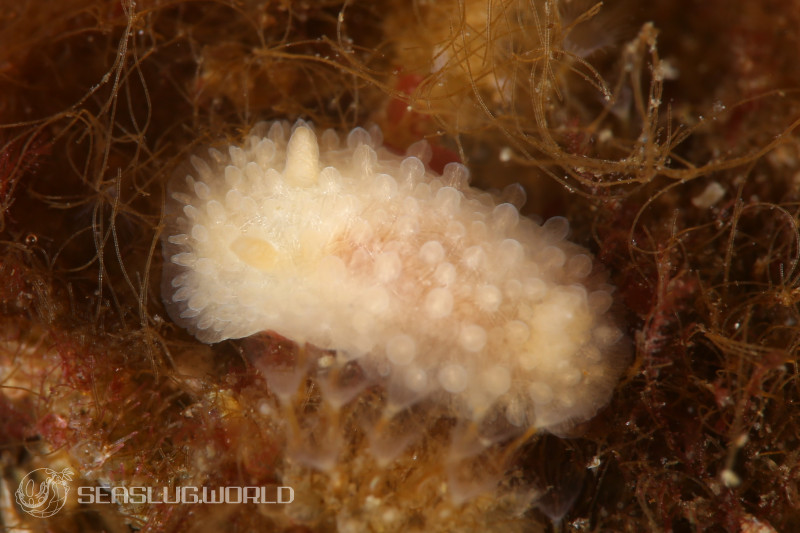
- Location
- Rousokuiwa, Rausu, Hokkaido, Japan
- Date
- 2015/05/29
- Length
- 10mm
- Depth
- 10.0m
- Water temperature
- 4.0℃
Description
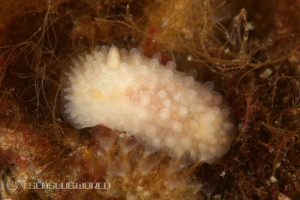
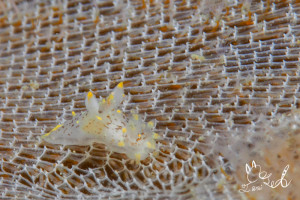
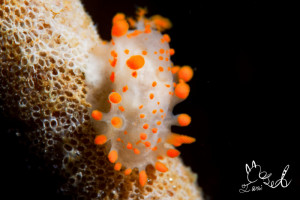
A small to medium-sized dorid reaching about 25 mm in length. The body is oval and slightly depressed, with a thick, firm mantle. The dorsum is densely covered with low conical to club-tipped tubercles of fairly uniform height; the tips of the tubercles are often marked with a small white spot.Ground colour is translucent white to pale yellowish-white, generally paler towards the mantle margin. Some individuals are tinged orange or yellow. Rhinophores are translucent white or the ground colour, lamellate. The gill consists of 10-13 simply pinnate plumes, translucent white, arranged in a circle on the posterior dorsum. Both rhinophores and gill retract fully into pockets in the mantle.
Distribution
A boreal-Arctic species widely distributed across the northern North Atlantic and adjacent seas. Type locality: British coast (Alder & Hancock, 1854). Recorded from the north-east Atlantic (Norway, North Sea, Irish Sea, Northern Ireland), the north-west Atlantic (Maine, Canadian Atlantic coast) and the North Pacific, with observation records from northern Japan (Hokkaido, Tohoku) and Korea. It is common in the lower intertidal and shallow subtidal of rocky shores.Etymology
The specific epithet proxima is the feminine of Latin proximus ("near, neighbouring, closely allied"), referring to the species' close morphological similarity to other dorids treated alongside it in the original description.Remarks
Originally described by Alder & Hancock 1854 from British material as Doris proxima; later transferred to the genus Adalaria Bergh, 1879, the parentheses in the current author citation reflecting that generic transfer.Like other species of Adalaria, this nudibranch is a bryozoan-feeder, prey records being dominated by encrusting bryozoans such as Electra pilosa. Spiral egg masses are deposited on rock or directly on the host bryozoan. Development is planktotrophic, with a free-swimming veliger stage. Martynov, Korshunova, Sanamyan & Sanamyan 2009 re-examined the genus-level relationships of the Onchidorididae of the Russian Far East, including comparison with this species.
References
- Doris proxima Alder & Hancock, 1854 — original description, Alder J. & Hancock A. (1854). Notice of some new species of British Nudibranchiata. Annals and Magazine of Natural History. (2)14(80): 102-105.
- アダラリア・プロキシマ, 中野理枝. (2004). 本州のウミウシ. ラトルズ.
- Adalaria proxima (Alder & Hancock, 1854), Martynov A.V., Korshunova T.A., Sanamyan N.P. & Sanamyan K.E. (2009). Description of the first Cryptobranch Onchidoridid Onchimira cavifera gen. et sp. nov., and of three new species of the genera Adalaria Bergh, 1879 and Onchidoris Blainville, 1816 (Nudibranchia: Onchidorididae) from the Russian Far East. Zootaxa. 2159: 1-43.
- ユキノハラウミウシ(新称), 中野理枝. (2018). 日本のウミウシ. 文一総合出版.
- Adalaria proxima, Behrens D.W., Hermosillo A., Fletcher K. & Jensen G.C. (2022). Nudibranchs & Sea Slugs of the Eastern Pacific. Molamarine.
Featured in this book
Behrens D.W., Hermosillo A., Fletcher K. & Jensen G.C. (2022). Nudibranchs & Sea Slugs of the Eastern Pacific. Molamarine.
Molamarine
This species, Adalaria proxima, is included in the book.
View on Amazon PR (Amazon Associates)Seasonality
Shooting Locations
Loading shooting locations...
Photos of Adalaria proxima



Similar Colors Nudibranchs

Academic Database
Sea slug observation data is available in international marine biodiversity databases.