Avaldesia tamatoa Donohoo & Gosliner, 2024
Avaldesia tamatoa
No field photograph submitted for this species yet
Have you photographed this species?Description
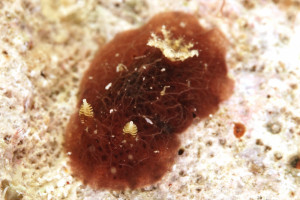
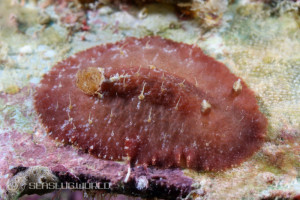
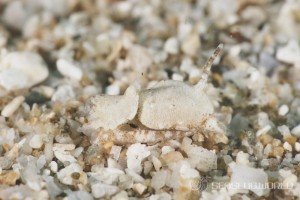
Body oval-shaped with a dome-like dorsum, 10-22 mm in length. Background colouration is highly variable, ranging from light yellow and yellow-orange through deep red and reddish-purple to dark brown. The dorsum bears a low, complex ridge pattern with short tan tubercles and longer white tubercles concentrated towards the edge. A white spot anterior to the gill pouch is present in some specimens but, unlike the closely related Avaldesia albomacula, it is not consistently expressed. Living animals are often coated with sand and particulates.Distribution
Type locality: Bigej-Meck Reef, Kwajalein Atoll, Marshall Islands. Also recorded from the Philippines, Papua New Guinea, and Midway Atoll. Found under coral rubble and on rocky reefs, sandy sediments, and algal fields (particularly Halimeda spp. in the Marshall Islands) at depths of about 5-10 m.Etymology
Verbatim from a 2024 revision:Named after Tamatoa, the villainous giant crab from the Disney movie Moana due to the claw-shaped vestibular spines and the similarities between the dorsum tubercule/papillae patterning in lighter specimens and Tamatoa's extravagant shell decoration.
Remarks
The genus Avaldesia was erected in the same paper to accommodate this new species along with two previously described congeners, Avaldesia albomacula and A. tahala, both transferred from Thordisa. The generic name honours malacologist Ángel Valdés, formed by appending the Latin feminine ending -ia to his surname; verbatim from a 2024 revision:Named in honour of Dr Ángel Valdés, for his numerous taxonomic contributions to the Discodorididae and Mollusca.
References
A Kindle field guide by the site author
Kimoto N. (2026). Sea Slugs of Japan & the Indo-Pacific, 2nd Edition.
Kindle Edition
View on Amazon PR (Amazon Associates)Seasonality
Shooting Locations
Loading shooting locations...
Same Genus Nudibranchs

Similar Colors Nudibranchs
Academic Database
Sea slug observation data is available in international marine biodiversity databases.