Ceratophyllidia papilligera (Bergh, 1890)
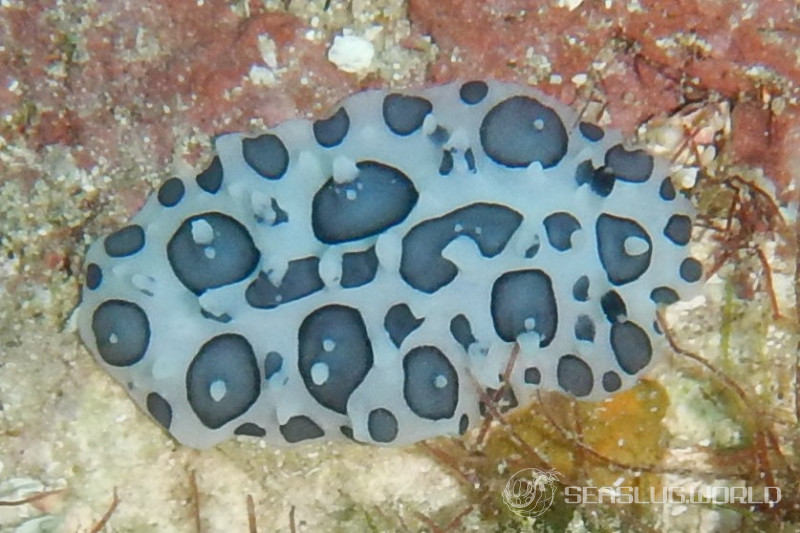
- Location
- Shark Reef, Negril, Jamaica
- Date
- 2017/11/28
- Length
- 50mm
- Depth
- 15.0m
- Water temperature
- 29.0℃
Description
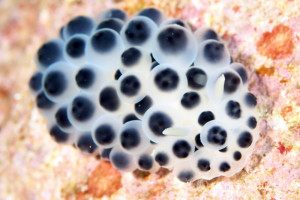
A small phyllidiid reaching about 12 mm in body length. The dorsum is whitish with scattered round to oval black blotches of variable size, the largest reaching 2.5 mm in diameter. Most of the black blotches bear flattened tubercles, some of which are also black; the underside of the mantle margin is whitish with the black dorsal blotches showing through, while the rest of the underside is yellowish-white. The rhinophores and the outer mouth are tinged yellow. The dorsum bears numerous tubercles up to about 1.6 mm high, more or less black-coloured especially on the anterior side. The rhinophore openings are widely separated, and the strong rhinophore club bears 20–25 leaves. The anal pore lies median posteriorly on the dorsum. The innermost part of the mantle margin is densely packed with thin transverse leaves up to 1.5 mm long; the leaf rows meet posteriorly above the tail base and extend forward to the outer mouth, with 45–50 leaves on each side. No trace of oral tentacles was seen, and the outer mouth opens as a strongly perforated papilla in front of the foot. Bergh's alcohol-preserved type measured 12 mm long, 11 mm wide and 4.5 mm high; mantle margin 3 mm wide; retracted rhinophores 1.5 mm high; foot 7.5 × 6 mm.Distribution
Western Atlantic, Gulf of Mexico and Caribbean Sea. Type locality: Gulf of Mexico, 25°33′ N, 84°21′ W, at 101 fathoms (≈ 184 m), based on a single specimen dredged by the U. S. Coast Survey Steamer Blake under the supervision of Alexander Agassiz in 1877–78. Subsequently recorded from the Caribbean Sea and the wider tropical Atlantic.Etymology
The specific epithet papilligera combines Latin papilla ("nipple, pap") with the suffix -gera ("bearing, carrying"), meaning "bearing papillae". Bergh described this as the first phyllidiid known to bear papillae on the dorsum, and the name reflects that diagnostic feature.Remarks
Originally placed by Bergh in Phyllidiopsis. Bergh remarked that this was the first phyllidiid species known to bear dorsal papillae and considered it to occupy a position among the phyllidiids analogous to that of Echinodoris among dorids. The species was later transferred to Ceratophyllidia erected by Eliot 1894; the parentheses in the author citation reflect this generic transfer.References
A Kindle field guide by the site author

Kimoto N. (2026). Sea Slugs of Japan & the Indo-Pacific, 2nd Edition.
Kindle Edition
View on Amazon PR (Amazon Associates)Seasonality
Shooting Locations
Loading shooting locations...
Photos of Ceratophyllidia papilligera

Same Genus Nudibranchs
Similar Colors Nudibranchs

Academic Database
Sea slug observation data is available in international marine biodiversity databases.