Clio pyramidata Linnaeus, 1767
Description
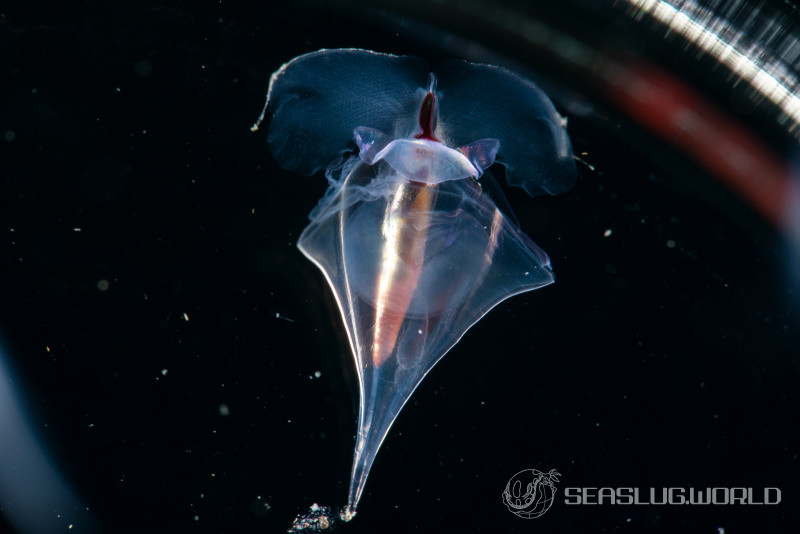
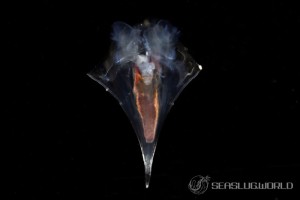
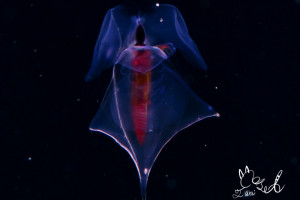
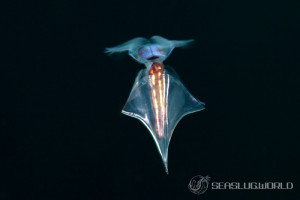
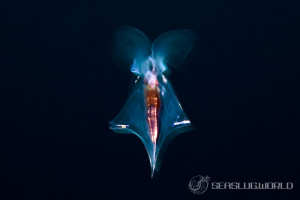
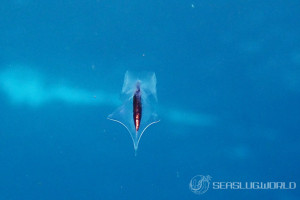
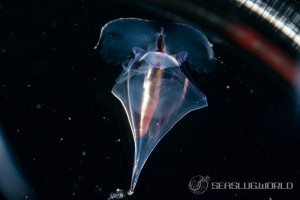
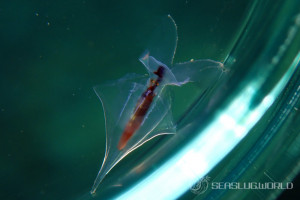
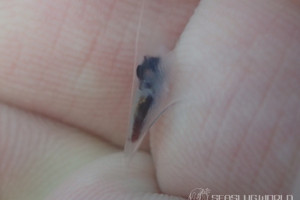
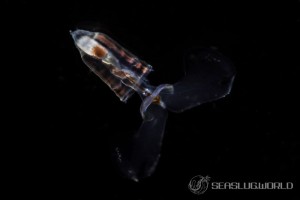
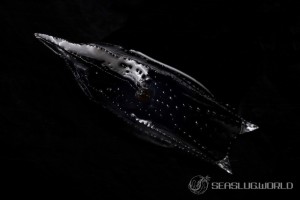
One of the most familiar shelled pteropods ("sea butterflies"), with a glass-like, transparent, diamond-shaped shell roughly 20 mm long. The ventral surface is almost flat while the dorsal surface bears a prominent median longitudinal ridge, producing a subtriangular aperture. The shell tapers toward the rear, and a slight constriction marks the boundary with the teardrop-shaped protoconch (embryonic shell). Paired wing-feet extend from the aperture and flap to propel the animal through the water. Several forms are recognised: forma pyramidata with a relatively narrow shell and rounded protoconch, and forma lanceolata with a laterally expanded shell and elongated protoconch are among the more distinctive — van der Spoel 1967/1976 accepted up to eight forms.Distribution
Exceptionally wide-ranging, occurring from the tropical and temperate zones of all oceans to the northern and southern polar fronts. It is among the most commonly encountered pteropods in coastal Japanese waters. The species was described by Linnaeus in the 12th edition of Systema Naturae 1767; no specific type locality was designated.Etymology
The specific epithet pyramidata is the feminine form of a Latin adjective derived from pyramis ("pyramid") and means "pyramid-shaped", a reference to the triangular, pyramid-like outline of the shell seen from above. The generic name Clio honours Clio (Κλειώ), the Muse of history in Greek mythology — part of Linnaeus's fondness for mythological names in his genera.Remarks
Individuals are occasionally found in which the soft body is unusually small relative to the shell. Van der Spoel 1962 (1973, 1979) interpreted these as an "aberrant stage" resulting from strobilation — a mode of transverse fission otherwise unknown in Mollusca. The detached anterior portion is said to swim away without a shell, but no such shell-less Clio has ever been observed in the field, and the phenomenon remains only partly understood (Lalli & Gilmer 1989).References
- Clio pyramidata n.sp., Linnaeus C. (1767). Systema naturae per regna tria naturae: secundum classes, ordines, genera, species, cum characteribus, differentiis, synonymis, locis. Editio duodecima reformata. Vol. 1 (Regnum Animale), parts 1 & 2. Laurentius Salvius, Holmiae (Stockholm). 1327 pp.
- ウキビシガイ Clio pyramidata Linnaeus, 1767, 奥谷喬司 (2016). わが国近海に見られる浮遊性巻貝類―IV. 有殻翼足類 (1):カメガイ科のウキビシガイ亜科・ウキヅツガイ亜科. うみうし通信 91: 8-9.
- ウキビシガイ, 中野理枝. (2019). 日本のウミウシ. 第二版. 文一総合出版.
Featured in this book

中野理枝. (2019). 日本のウミウシ. 第二版. 文一総合出版.
文一総合出版
This species, Clio pyramidata, is included in the book.
View on Amazon PR (Amazon Associates)Seasonality
Shooting Locations
Loading shooting locations...
Photos of Clio pyramidata








Similar Colors Nudibranchs
Color:
Transparent
Academic Database
Sea slug observation data is available in international marine biodiversity databases.