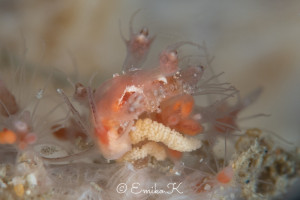
Clione elegantissima Dall, 1871
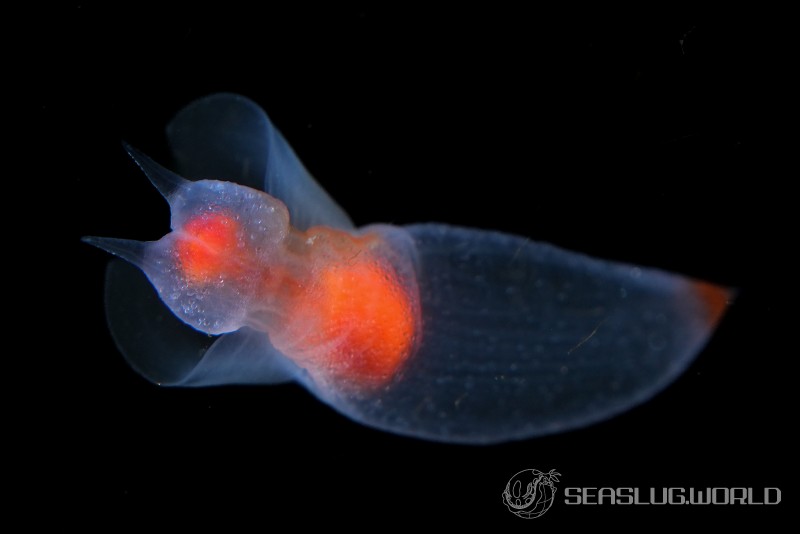
- Location
- Rousokuiwa, Rausu, Hokkaido, Japan
- Date
- 2026/04/12
- Length
- 8mm
- Depth
- 1.0m
- Water temperature
- -2.0℃
Description
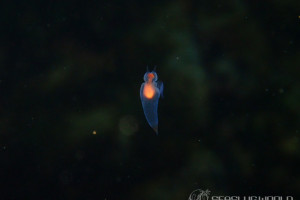
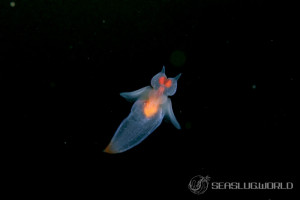
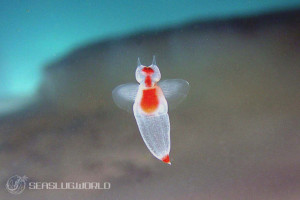
A small, cylindrical pelagic gastropod with a translucent body, often tinged with pale orange-red on the head and visceral mass. The larval shell is shed early in development, leaving the adult entirely shell-less. A pair of wing-like parapodia projects from the sides of the body and is flapped continuously to swim, giving the animal its popular name "sea angel." During predation, six buccal cones (three pairs) are everted from the head in an instant to seize the prey's shell, and chitinous hooks are then extruded from internal hook sacs to extract the soft body. Adults of the North Pacific–Okhotsk Sea population (= C. elegantissima) reach about 30 mm in body length, distinctly smaller than the North Atlantic Clione limacina (up to 70–85 mm). The species is widely known in Japan by the popular name "Clione."Distribution
The original description (Dall, 1871) was based on specimens from eastern Kamchatka, Russian Far East. The species is distributed in cold-water masses of the North Pacific and Okhotsk Sea; in Japan, it is abundant in the southern Okhotsk Sea, with the southern limit recorded at Oarai, Ibaraki Prefecture (Inaba & Okutani, 1999). Long misidentified as Clione limacina, the North Pacific population was reassigned by Yamazaki & Kuwahara (2017) on the basis of molecular, morphological and behavioural evidence, with the earlier name Clione elegantissima Dall, 1871 resurrected as the valid name. Two additional Clione species occur sympatrically in the region: Clione okhotensis Yamazaki & Kuwahara, 2017 (Mombetsu, Hokkaido; shallow water; body length up to 8 mm) and Clione japonica Yamazaki, Shimada & Zhang, 2025 (Toyama Bay deep water; cryptic species; body length about 5 mm).Etymology
The specific epithet elegantissima is the Latin feminine superlative of elegans ("elegant, refined"), meaning "most elegant." The genus name Clione derives from Cleio (Clio), a sea nymph in Greek mythology.Remarks
A holopelagic gymnosome pteropod that spends its entire life cycle in the open water column. A simultaneous hermaphrodite, breeding in spring and summer, with a life span of at least two years. Adults feed almost exclusively on the shelled pteropod Limacina helicina, with handling times of roughly thirty minutes per prey item. Because Limacina shells are highly vulnerable to dissolution under ocean acidification, the species has attracted attention as a sentinel taxon for polar pelagic ecosystems. The Japanese vernacular name "Hadaka-kamegai" means "naked sea-shelled pteropod," contrasting with the shelled pteropods (kamegai-rui).References
- Clio limacina n.sp. (misappl.), Phipps C.J. (1774). A Voyage Towards the North Pole, Undertaken by His Majesty's Command 1773. London: J. Nourse. xv + 253 pp.
- Clione elegantissima n. sp., Dall W.H. (1871). Descriptions of sixty new forms of mollusks from the west coast of North America and the North Pacific Ocean, with notes on others already described. American Journal of Conchology, 7: 93-160.
- Clione limacina, Sromek L., Lasota R. & Wolowicz M. (2015). Genetic evidence for the existence of two species of the "bipolar" pelagic mollusk Clione limacina. American Malacological Bulletin. 33(1): 118-120. https://doi.org/10.4003/006.033.0108
- Clione elegantissima Dall, 1871, Yamazaki T. & Kuwahara T. (2017). Description of a new sea angel (Gastropoda: Gymnosomata) from the Sea of Okhotsk and the validity of Clione okhotensis. Journal of Molluscan Studies. 83(1): 19-26. https://doi.org/10.1093/mollus/eyw032
- ハダカカメガイ Clione elegantissima (Dall, 1871), 奥谷喬司 (2017). わが国近海に見られる浮遊性巻貝類—VII 裸殻翼足類. うみうし通信 94: 8-9.
A Kindle field guide by the site author

Kimoto N. (2026). Sea Slugs of Japan & the Indo-Pacific, 2nd Edition.
Kindle Edition
View on Amazon PR (Amazon Associates)Seasonality
Shooting Locations
Loading shooting locations...
Photos of Clione elegantissima
Tag:






Same Genus Nudibranchs

Similar Colors Nudibranchs
Academic Database
Sea slug observation data is available in international marine biodiversity databases.