Diaphoreolis viridis (Forbes, 1840)
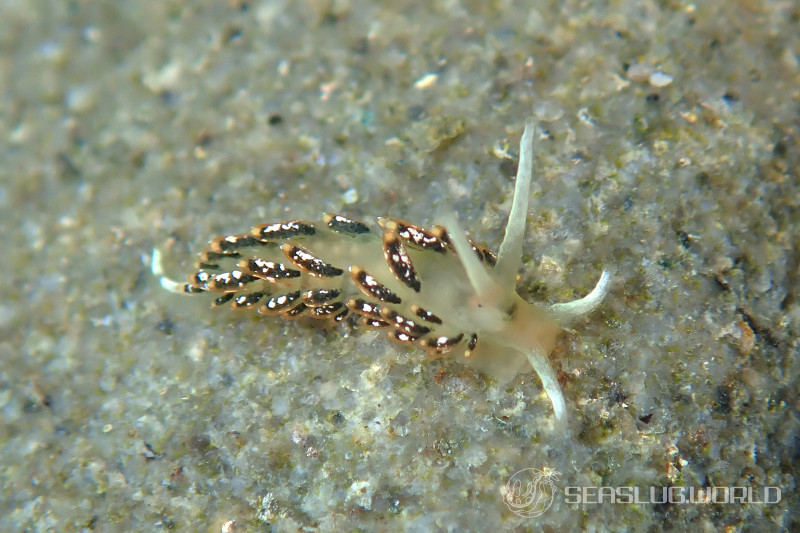
- Location
- Beach, Oyashirazu, Niigata, Japan
- Date
- 2019/05/01
- Length
- 5mm
- Depth
- 5.0m
- Water temperature
- 12.0℃
Description
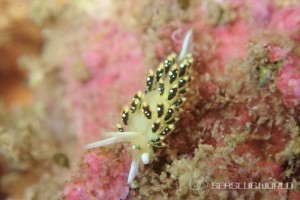
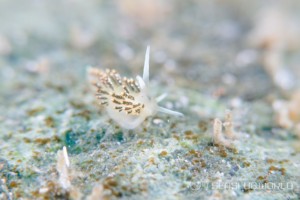
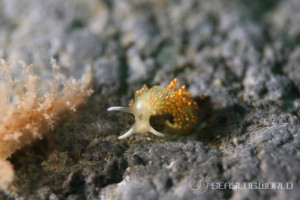
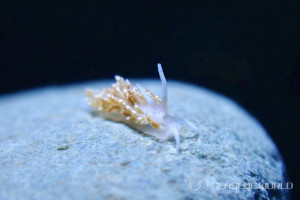
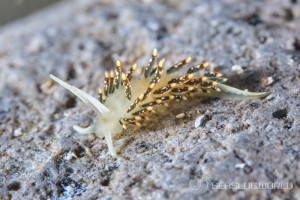
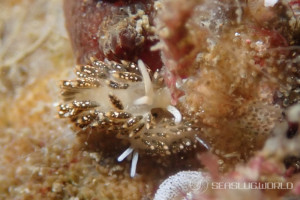
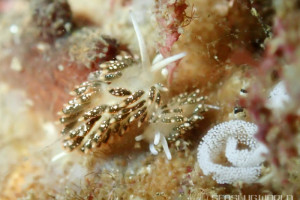
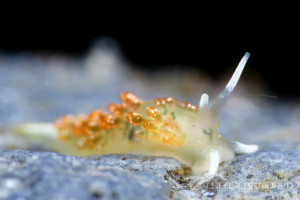
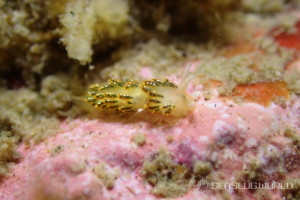
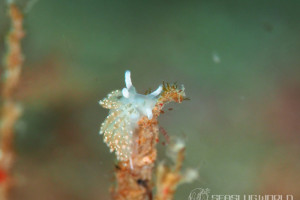
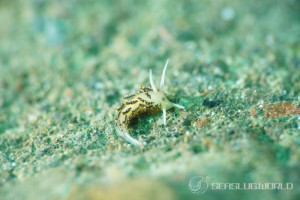
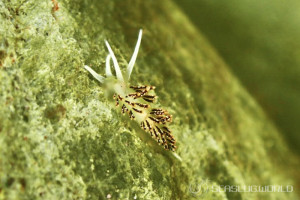
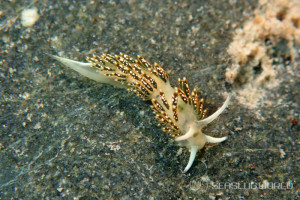
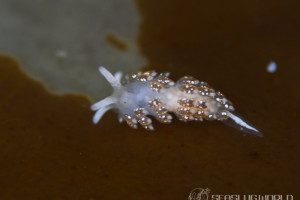
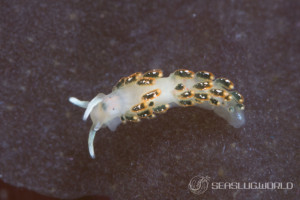
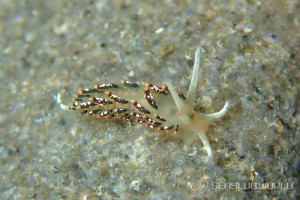
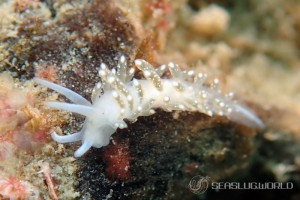
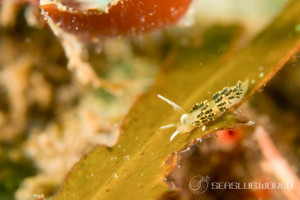
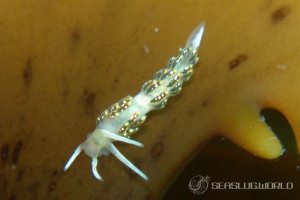
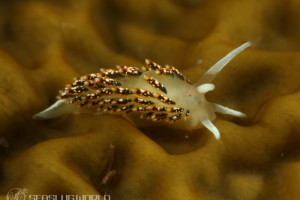
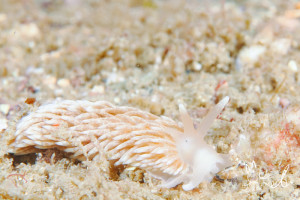
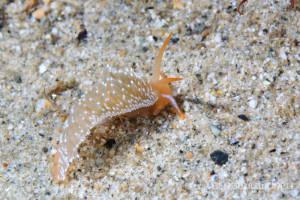
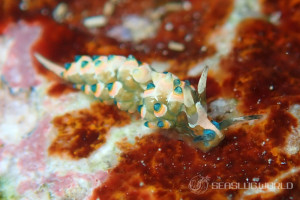
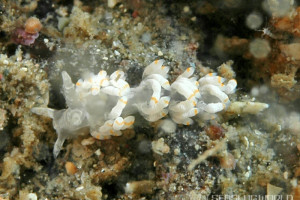
A small to mid-sized aeolid up to 25 mm long, with an elongate, narrow body. Rhinophores and oral tentacles are smooth, the rhinophores noticeably longer than the oral tentacles. Cerata are cylindrical, pointed at the tip, and arranged in continuous, regular, comb-shaped transverse rows on the dorsolateral side (up to six preanal rows).Background coloration is whitish to yellowish and semitransparent, with white pigment concentrated apically on the rhinophores and oral tentacles. The colour of the digestive gland inside the cerata varies geographically, from brownish green to reddish in North Pacific populations and from dark green to orange in North Atlantic populations. White ceratal pigmentation also differs between basins: in the North Pacific the cerata bear large rounded white spots scattered randomly across the dorsal side, whereas in the North Atlantic the pigment forms an intermittent dorsal line or chain of small spots, sometimes large rounded spots, with occasional individuals nearly lacking white pigment altogether. The ceratal apices bear shining white cnidosacs, and a median opaque white line is often present on the tail.
Distribution
An amphiboreal species occurring in both the North Atlantic and the North Pacific. Type locality is Ballaugh, Isle of Man (UK). North-East Atlantic records cover Greenland, Iceland, Denmark, France, the Netherlands, Ireland, Norway, Sweden and the UK; in the Arctic the species is recorded from the White Sea and the Barents Sea. In the North-West Pacific it occurs in the Sea of Japan from central Honshu to western Hokkaido (including Toyama Bay, the Echizen coast, the Shakotan Peninsula and Usujiri) and in the Kurile Islands; in the North-East Pacific it ranges from Alaska to Washington State. The bathymetric range extends from the lower intertidal to about 35 m.Etymology
The specific epithet viridis is Latin for "green", referring to the green digestive gland inside the cerata. The Japanese vernacular name "Hatsuyuki-mino-umiushi" ("first-snow aeolid") alludes to the white pigment on the rhinophores and oral tentacles. The junior synonym midori is the Japanese word for "green" and likewise refers to the dark green digestive gland.Remarks
The Sea of Japan population was originally described as Trinchesia midori and later combined with Diaphoreolis. An integrative reassessment combining a three-marker phylogeny (COI, 16S, H3) with nuclear markers (18S and ITS2) and dense geographic sampling found no species-level genetic isolation and no consistent morphological discontinuity among populations from the North-East Atlantic, the North-West Pacific and the North-East Pacific. As a result, Diaphoreolis midori has been formally synonymized under Diaphoreolis viridis, and the previously proposed Pacific subspecies D. viridis emeraldi has likewise been merged with the nominal species.Mitochondrial COI defines three haplogroups (two North Pacific, one North Atlantic and sub-Arctic), whereas nuclear 18S and ITS2 are essentially identical across all populations. This pattern is interpreted as repeated isolation during Pleistocene glacial maxima, followed by gene flow through the open Bering Strait during interglacials, which homogenized the nuclear genome.
Prey records are dominated by sertulariid hydroids of the genera Diphasia, Hydrallmania, and Sertularella; spawning has been observed from February to August around the British Isles.
References
- Montagua viridis n.sp., Forbes E. (1840). XII.—On some new and rare British Mollusca. Journal of Natural History, 5(29), 102-108.
- Tenellia viridis (Yasuhiro Shamoto 2007, Sea Slug Forum), Rudman W.B. (1998-2010). Sea Slug Forum. Australian Museum, Sydney. http://www.seaslugforum.net/
- ハツユキミノウミウシ(新称), 高岡生物研究会. (2002). 日本海のウミウシ. 第2版.
- Trinchesia midori sp. nov., Martynov A.V., Sanamyan N.P. & Korshunova T.A. (2015). Review of the opisthobranch mollusc fauna of Russian Far Eastern seas: Pleurobranchomorpha, Doridida and Nudibranchia. Bulletin of Kamchatka State Technical University, 34, 62-87. https://doi.org/10.17217/2079-0333-2015-34-62-87
- ハツユキミノウミウシ, ミドリミノウミウシ(新称), 中野理枝. (2018). 日本のウミウシ. 文一総合出版.
- Diaphoreolis viridis (Forbes, 1840), Korshunova T., Fletcher K., Bakken T. & Martynov A. (2023). The first consolidation of morphological, molecular, and phylogeographic data for the finely differentiated genus Diaphoreolis (Nudibranchia: Trinchesiidae). Canadian Journal of Zoology, 101(8), 635-657. https://doi.org/10.1139/cjz-2023-0035
- Diaphoreolis viridis (Forbes, 1840), Grishina, D., Schepetov, D., Mikhlina, A., Antokhina, T., Deart, Y., & Ekimova, I. (2026). What you can see from here: A critical role of integrative approach and sample size in defining species boundaries for trans-Arctic nudibranchs (Gastropoda: Heterobranchia). Zoologica Scripta. https://doi.org/10.1111/zsc.70058
Featured in this book

中野理枝. (2019). 日本のウミウシ. 第二版. 文一総合出版.
文一総合出版
This species, Diaphoreolis viridis, is included in the book.
View on Amazon PR (Amazon Associates)Seasonality
Shooting Locations
Loading shooting locations...
Photos of Diaphoreolis viridis
Tag:
















Similar Colors Nudibranchs


Academic Database
Sea slug observation data is available in international marine biodiversity databases.