Felimida baumanni (Bertsch, 1970)
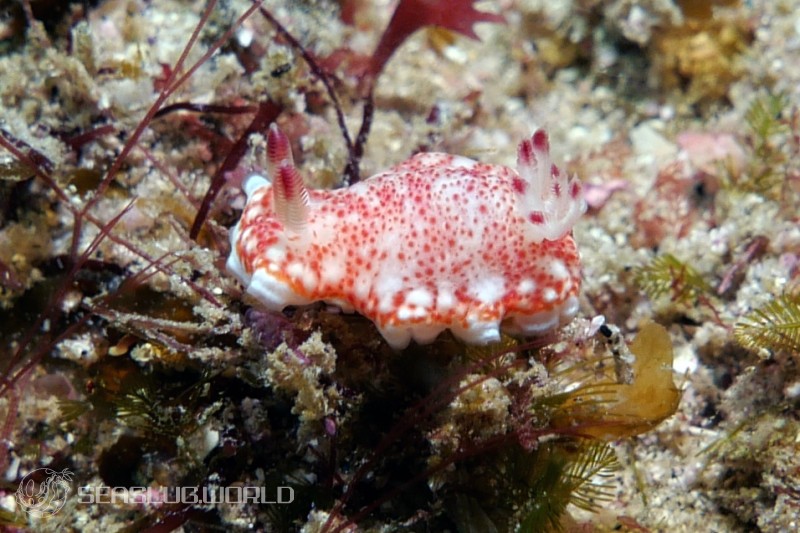
- Location
- La Jeringa, Huatulco, Oaxaca, Mexico
- Date
- 2021/03/19
- Length
- ??mm
- Depth
- ??m
- Water temperature
- ??℃
Description
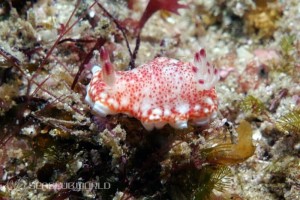
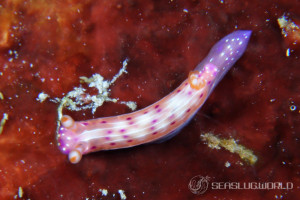
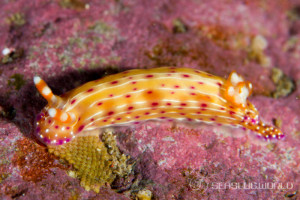
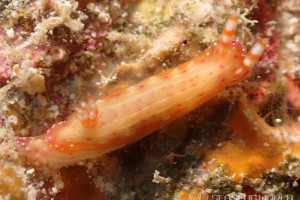
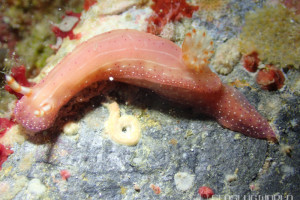
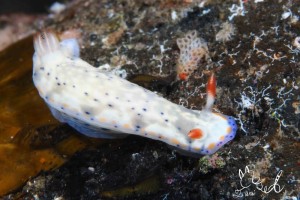
Felimida baumanni is a large white chromodorid nudibranch of the tropical eastern Pacific, reaching at least 62 mm. The background colour of the mantle and foot is white, turning light yellow along the middle of the back. Numerous small red-purple dots are scattered over the mantle and over the sides and rear of the foot, and an interrupted band of orange to light red dots and streaks runs around the outer edges of both mantle and foot. The rhinophores are white with red-purple towards the tip and a white point at the very end; the gills are white, shaded purplish distally. In large animals the gills are triangular in cross-section, the smooth outer face speckled with red.Colour varies a good deal: in some animals the red dots are packed so closely that the mantle looks almost uniformly coloured, while in others the orange-red spots are well separated.
Distribution
Tropical eastern Pacific. The type locality is Isla San Francisco in the Gulf of California. By the 1978 revision the species was recorded from the Gulf of California, southern Mexico, Central America and the Galápagos Islands, with Bahía San Carlos, Sonora, given as the northernmost record; it is reported south to Ecuador.Remarks
A sponge feeder. At Bahía de Banderas on the Pacific coast of Mexico animals have been photographed feeding on orange and on white sponges, and there the species is nocturnal, only rarely seen crawling in daylight. An animal laying eggs beneath a rock has been photographed in the Galápagos.The original description is credited as the first use of scanning electron microscopy to illustrate the radula in the naming of a new nudibranch species.
Felimida norrisi, which shares the eastern Pacific and also has a spotted white mantle, differs in carrying evenly rounded red and yellow markings and in having the distal part of the gills orange; F. baumanni has finer, denser red-purple dots and purplish gills.
References
- Chromodoris norrisi (misappl.), Marcus Er. & Marcus Ev. (1967). American Opisthobranch Mollusks. Studies in Tropical Oceanography, Miami. 6: 1-256.
- Chromodoris baumanni n. sp., Bertsch H. (1970). Opisthobranchs from Isla San Francisco, Gulf of California, with the description of a new species. Contributions in Science, Santa Barbara Museum of Natural History. 2: 1-16.
- Chromodoris baumanni Bertsch, 1970, Bertsch H. (1978). The Chromodoridinae nudibranchs from the Pacific coast of America. Part II. The genus Chromodoris. The Veliger. 20(4): 307-327.
- Chromodoris baumanni (Rudman 2000), Rudman W.B. (1998-2010). Sea Slug Forum. Australian Museum, Sydney. http://www.seaslugforum.net/
- Glossodoris baumanni, Johnson R.F. & Gosliner T.M. (2012). Traditional taxonomic groupings mask evolutionary history: a molecular phylogeny and new classification of the chromodorid nudibranchs. PLoS ONE 7(4): e33479.
- Felimida baumanni, Behrens D.W., Hermosillo A., Fletcher K. & Jensen G.C. (2022). Nudibranchs & Sea Slugs of the Eastern Pacific. Molamarine.
Featured in this book
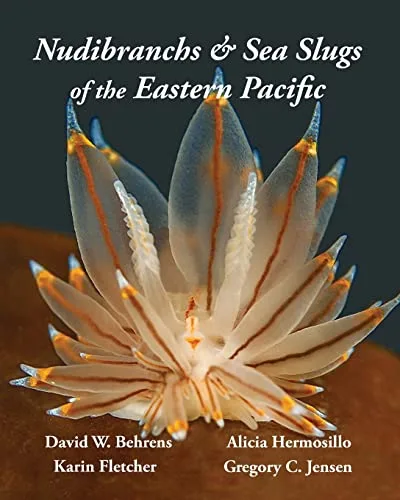
Behrens D.W., Hermosillo A., Fletcher K. & Jensen G.C. (2022). Nudibranchs & Sea Slugs of the Eastern Pacific. Molamarine.
Molamarine
This species, Felimida baumanni, is included in the book.
View on Amazon PR (Amazon Associates)Seasonality
Shooting Locations
Loading shooting locations...
Photos of Felimida baumanni

Same Genus Nudibranchs
Similar Colors Nudibranchs
Academic Database
Sea slug observation data is available in international marine biodiversity databases.