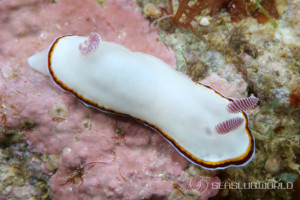
Felimida binza (Ev. Marcus & Er. Marcus, 1963)
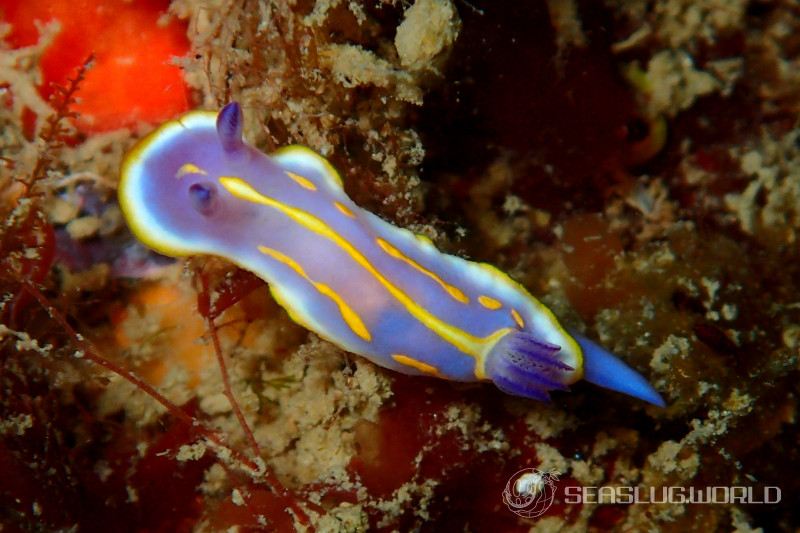
- Location
- L'Estartit, Costa Brava, Spain
- Date
- 2017/08/28
- Length
- 20mm
- Depth
- 28.0m
- Water temperature
- 17.0℃
Description
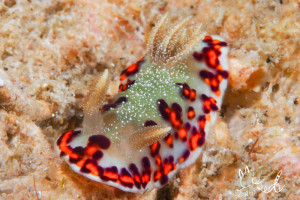
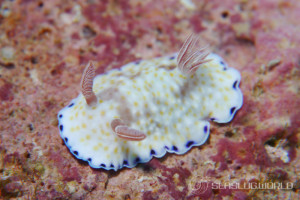
A small chromodorid, 1-2 cm in body length, with a white to pale yellow ground colour and strikingly polymorphic dorsal pigmentation.Caribbean specimens typically display oval or short streak-like dark reddish-purple spots over the dorsum, often outlined in yellow (formerly recognised as the "binza" or "clenchi" pattern). Eastern Atlantic populations from the Azores, Madeira and Canary Islands, as well as Mediterranean specimens, instead bear a dark purple mantle with yellow longitudinal lines or rows of yellow spots and a purple submarginal band (formerly known as the "britoi" pattern). Although these morphotypes appear strikingly different, molecular phylogenetic analyses have shown them to represent geographic colour variants of a single species.
Distribution
Type locality: Curaçao, Dutch Caribbean. Recorded from the Caribbean Sea (Curaçao, Costa Rica, Mexico, Panama, Virgin Islands, Cuba), north-eastern Brazil, Saint Helena Island, the eastern Atlantic (Azores, Madeira, Canary Islands) and the Mediterranean (Menorca, Greece).Etymology
The derivation of the specific epithet binza is not stated in the original description by Marcus & Marcus 1963.Remarks
Originally described in Chromodoris; under current classification the species is reassigned to Felimida, hence the parentheses in the author citation.Padula et al. 2016, combining molecular phylogenetic analyses (COI, 16S, H3) and species-delimitation methods (ABGD, GMYC, PTP), revised the Felimida clenchi species complex. They showed that the four nominal species traditionally recognised (F. clenchi, F. neona, F. binza and F. britoi) actually comprise only three lineages: a redefined F. clenchi, a redefined F. binza, and an undescribed Brazilian species. As a consequence Felimida britoi (Ortea & Pérez, 1983) was synonymised with this species, and F. binza now encompasses populations from the Caribbean, the eastern Atlantic and the Mediterranean.
References
- Felimida binza, Johnson R.F. & Gosliner T.M. (2012). Traditional taxonomic groupings mask evolutionary history: a molecular phylogeny and new classification of the chromodorid nudibranchs. PLoS ONE 7(4): e33479.
- Felimida binza (= Felimida britoi syn. nov.), Padula V., Bahia J., Stöger I., Camacho-García Y., Malaquias M.A.E., Cervera J.L. & Schrödl M. (2016). A test of color-based taxonomy in nudibranchs: Molecular phylogeny and species delimitation of the Felimida clenchi (Mollusca: Chromodorididae) species complex. Molecular Phylogenetics and Evolution. 103: 215-229. https://doi.org/10.1016/j.ympev.2016.07.019
A Kindle field guide by the site author

Kimoto N. (2026). Sea Slugs of Japan & the Indo-Pacific, 2nd Edition.
Kindle Edition
View on Amazon PR (Amazon Associates)Seasonality
Shooting Locations
Loading shooting locations...
Photos of Felimida binza

Same Genus Nudibranchs
Similar Colors Nudibranchs

Academic Database
Sea slug observation data is available in international marine biodiversity databases.