Glaucilla marginata Reinhardt & Bergh, 1864
Description
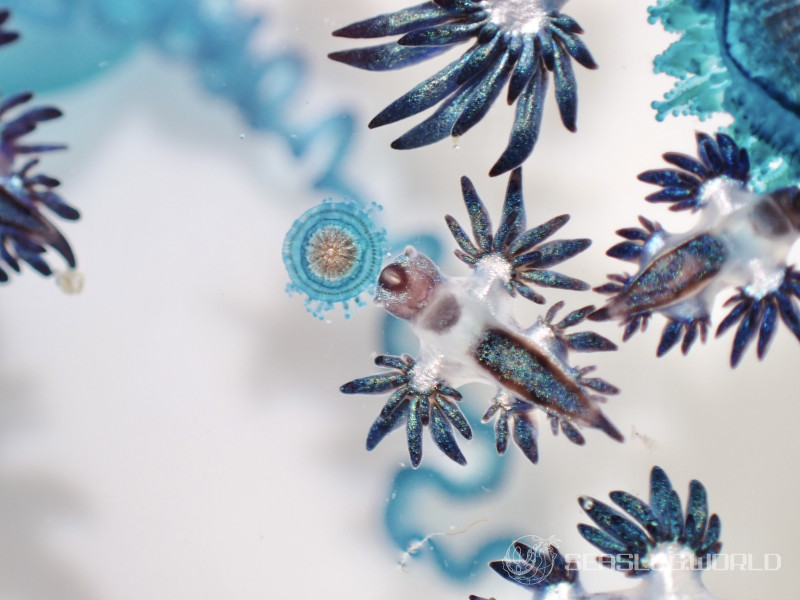
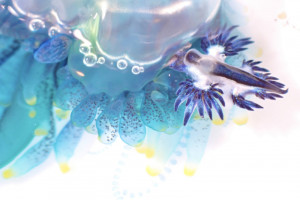
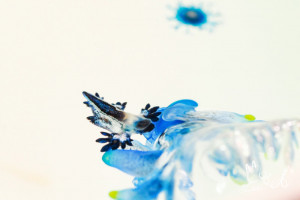
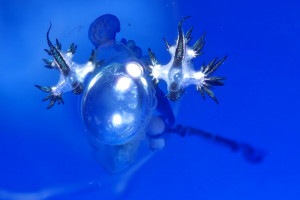
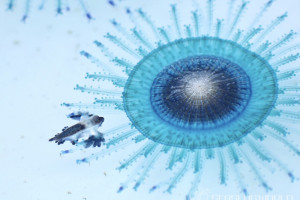
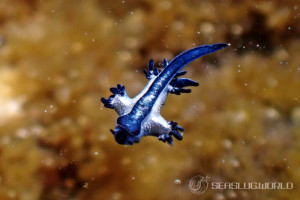
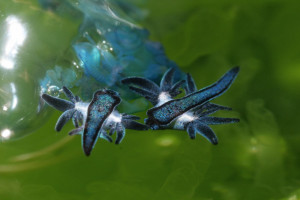
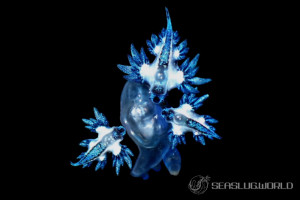
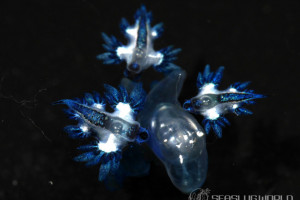
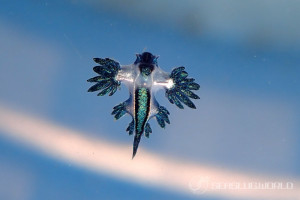
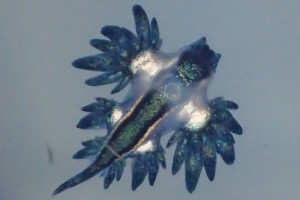
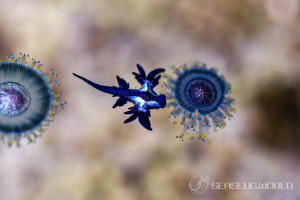
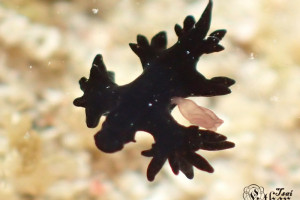
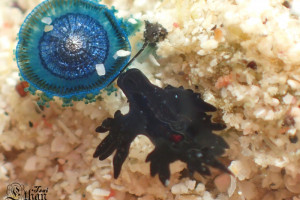
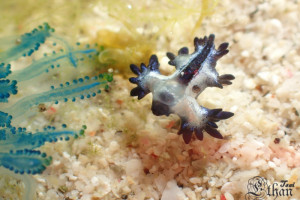
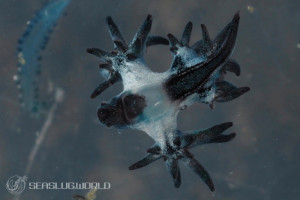
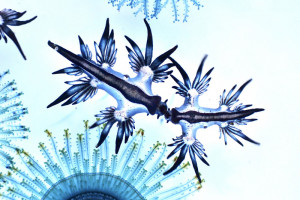
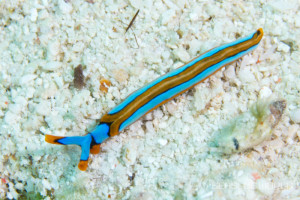
A small pelagic aeolid; body length in life around 13-16 mm. The anterior pair of arm-like extensions is elongate and as long as the longest cerata; the second pair is shorter but quite distinct. The cerata are shorter than in Glaucus, and the posterior cerata of the third group are shorter than the tail. The penis lacks a horny hook.In life the pure-white ground colour with silvery sheen is more strongly mixed with blue than in other species of Glaucus. The front of the head and the entire underside of the head shade to a reddish-grey; the underside (head excepted) is light ultramarine blue with silvery sheen. The foot is far deeper and darker blue than the rest of the underside, lacks the silvery sheen, and is completely framed by a narrow black-blue rim and a fine pale outer edge. The cerata are pale blue with a faint reddish tint and a dark-blue median line on the underside, and silvery-white with a bluish edge on the upper side. The posterior cerata of the third group are shorter than the tail.
Cerata occur in three rows in the first (anterior) group, two in the second, and a single row in the third and fourth. Cerata counts: 14-25 (typically 18-19) in the anterior group; 6-8 (sometimes 4-5) in the second; 3-5 in the third; 2-3 in the fourth. The largest cerata reach 1.5 mm in preserved material.
Distribution
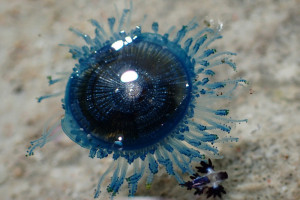
Type locality: North Pacific near the Sandwich Islands, where the type series was collected at the surface together with Glaucus longicirrus, Velella, Porpita and Janthina. A pelagic neustonic predator of siphonophores such as Velella and Physalia.Etymology
The specific epithet marginata is the feminine form of Latin marginatus ("edged, bordered"). The motivation is the deep dark-blue foot, sharply set off from the rest of the underside by a narrow black-blue rim and a fine outer pale edge.Remarks
Originally erected as the new subgenus Glaucilla, distinguished from Glaucus by the smaller and stouter body, the strong development of both pairs of arm-like body extensions, the cerata in multiple rows in the anterior groups, the short hookless penis, and the absence of the very large nematocysts characteristic of Glaucus. Glaucilla is now treated as a valid genus with this as its only valid species. Molecular work supports Glaucilla marginata as a lineage distinct from the Glaucus atlanticus complex.References
- Gl. marginata (Reinh.) n. sp. [Subg. Glaucilla, Bgh.], Bergh R. (1864). Anatomiske Bidrag til Kundskab om Aeolidierne. Det Kongelige Danske Videnskabernes Selskabs Skrifter, 5. Række, Naturvidenskabelig og Mathematisk Afdeling. 7: 139-316, Tab. I-IX.
- Glaucilla marginata, Valdés A. & Campillo O.A. (2004) Systematics of pelagic aeolid nudibranchs of the family Glaucidae (Mollusca, Gastropoda). Bulletin of Marine Science 75(3): 381–389.
- Churchill C.K.C., Alejandrino A., Valdés Á. & Ó Foighil D. (2013). Parallel changes in genital morphology delineate cryptic diversification of planktonic nudibranchs. Proceedings of the Royal Society B: Biological Sciences. 280(1765): 20131224. https://doi.org/10.1098/rspb.2013.1224
- Glaucus marginatus, Terrence Gosliner, Ángel Valdés and David Behrens. (2015). Nudibranch and Sea Slug Identification Indo-Pacific. New World Pubns Inc.
- タイヘイヨウアオミノウミウシ(新称), 中野理枝. (2018). 日本のウミウシ. 文一総合出版.
- Glaucilla marginata, Martynov A., Mehrotra R., Chavanich S., Nakano R., Kashio S., Lundin K., Picton B. & Korshunova T. (2019). The extraordinary genus Myja is not a tergipedid, but related to the Facelinidae s. str. with the addition of two new species from Japan (Mollusca, Nudibranchia). ZooKeys. 818: 89-116. https://doi.org/10.3897/zookeys.818.30477
Featured in this book
Terrence Gosliner, Ángel Valdés and David Behrens. (2018). Nudibranch and Sea Slug Identification Indo-Pacific 2nd Edition. New World Pubns Inc.
New World Publications
This species, Glaucilla marginata, is included in the book.
View on Amazon PR (Amazon Associates)Seasonality
Shooting Locations
Loading shooting locations...
Photos of Glaucilla marginata
Tag:










Same Genus Nudibranchs
Similar Colors Nudibranchs
Academic Database
Sea slug observation data is available in international marine biodiversity databases.