Godiva rachelae Rudman, 1980
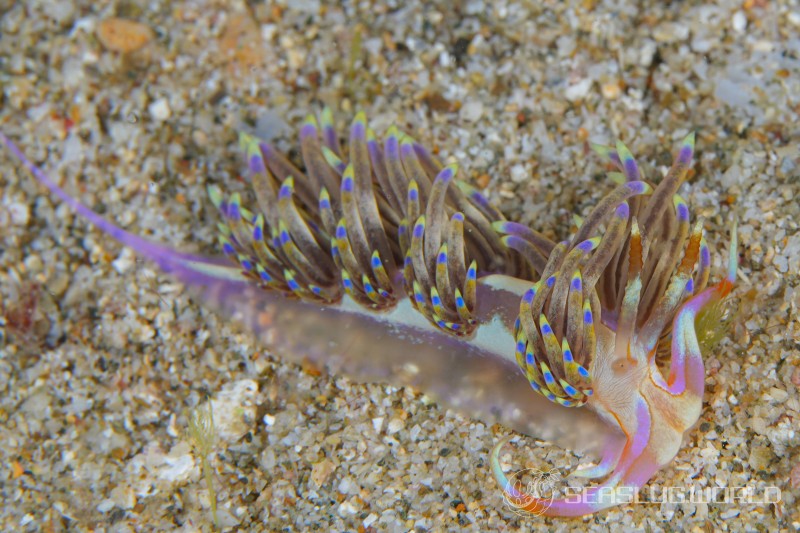
Description
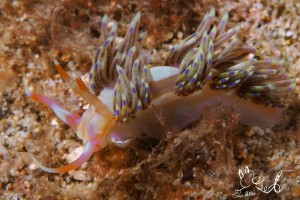
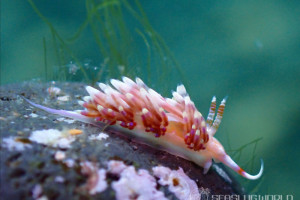
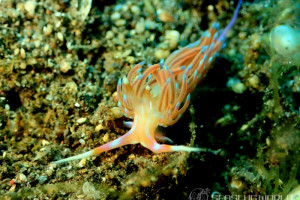
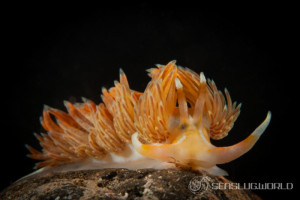
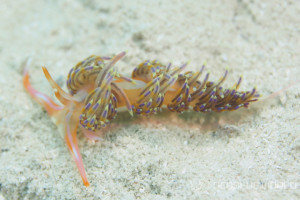
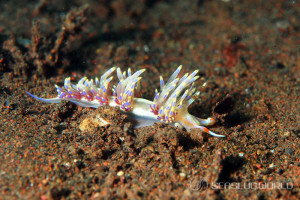
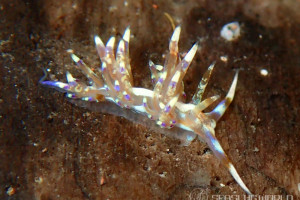
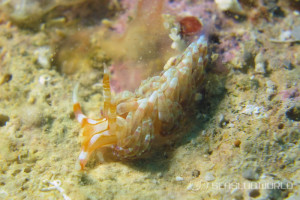
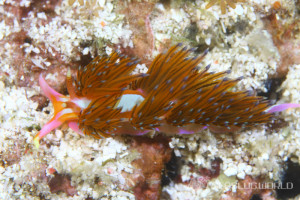
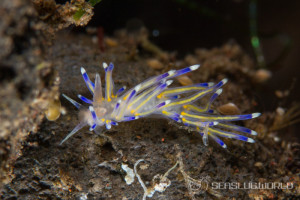
Body elongate and high, the pericardium forming a prominent hump. Tail long and slender (12 mm in a 37 mm long animal). Rhinophores long and tapering, sometimes appearing slightly wrinkled and annulate; oral tentacles also long and slender, with a ventral flap on each side of the mouth. The foot is slightly wider than the body, with narrow tapering anterior corners. Cerata arranged in five to seven multi-rowed clusters per side, each on a slightly raised pad; the largest cerata sit at the tops of the arches and stand vertically (12 mm in a 30 mm animal) when alarmed.Head watery orange with fine deeper-orange speckling; a pair of bright orange lines runs from inside each rhinophore forward and outward along each oral tentacle, and a parallel inner pair runs from below and behind each rhinophore to the base of the oral tentacle, the area between them milky yellow. Proximal half of each oral tentacle pinkish-purple (with a milky-yellow dorsal patch); distal half milky yellow. A milky-yellow band runs along each side below the cerata and widens between arches. On the dorsum: a diamond-shaped milky-yellow patch between rhinophores and first arch, an elongate patch over the pericardium, and smaller patches between cerata clusters, all with deep-orange outlines. Rhinophores watery orange tipped with yellow; oral tentacles bear translucent purple bands. Foot translucent white with white patches; leading edge and foot corners milky yellow; distal half of tail watery purple. Lower two-thirds of each ceras watery orange, upper third transparent with a milky-yellow subapical band. Reaches 37 mm.
Distribution
Type locality: Kunduchi, 12 km north of Dar es Salaam, Tanzania. Also recorded from North Reef (Dar es Salaam Harbour) and Broadhurst Reef off Townsville, Queensland (Australia); the species is expected to range widely across the Indo-West Pacific.Etymology
The specific epithet rachelae honours the daughter of the original author, Rachel Elizabeth (born 1977).Remarks
When alarmed the animal swims away by lateral flexion of the body, with the cerata raised. Egg masses are laid on large hydroid colonies and form a tangled tubular chain of segments containing white eggs.References
- ゴディバ属の一種, 殿塚孝昌. (2003). ウミウシガイドブック〈3〉. TBSブリタニカ.
- レイチェルミノウミウシ(新称), 中野理枝. (2018). 日本のウミウシ. 文一総合出版.
Featured in this book
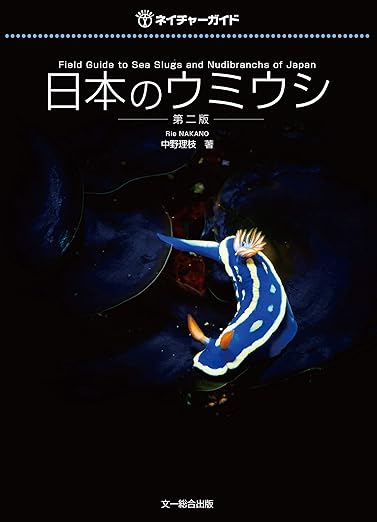
中野理枝. (2019). 日本のウミウシ. 第二版. 文一総合出版.
文一総合出版
This species, Godiva rachelae, is included in the book.
View on Amazon PR (Amazon Associates)Seasonality
Shooting Locations
Loading shooting locations...
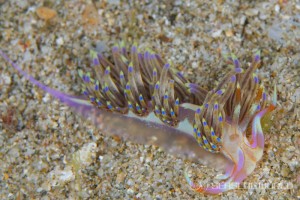
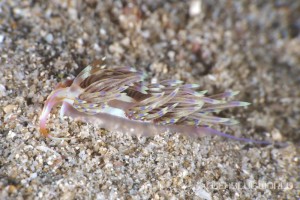
Photos of Godiva rachelae









Same Genus Nudibranchs
Similar Colors Nudibranchs
Academic Database
Sea slug observation data is available in international marine biodiversity databases.