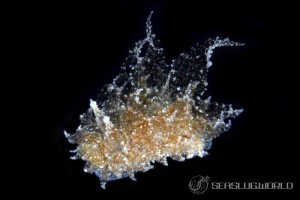
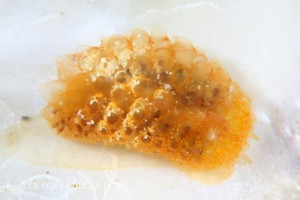
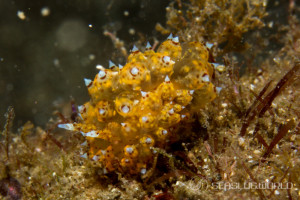
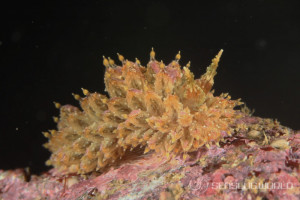
Janolus flavoanulatus Pola & Gosliner, 2019
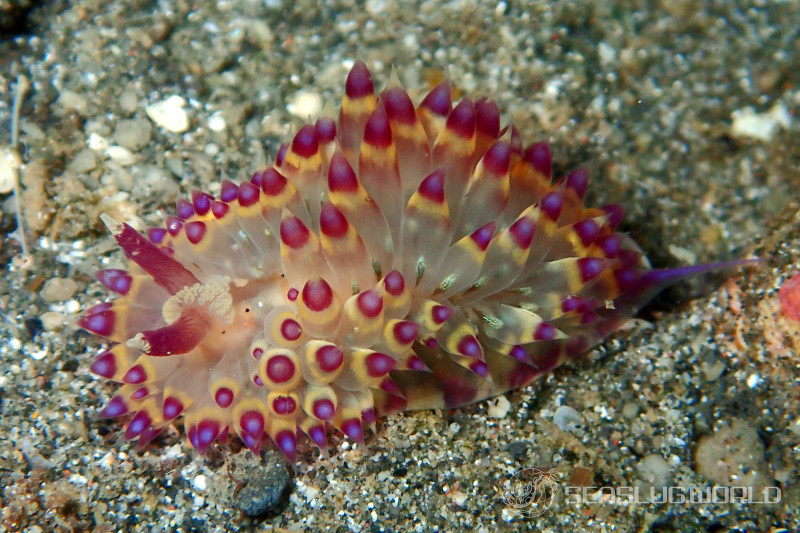
- Location
- Jetty, Padangbai, Pulau Bali, Indonesia
- Date
- 2018/03/09
- Length
- 30mm
- Depth
- 13.0m
- Water temperature
- 27.0℃
Description
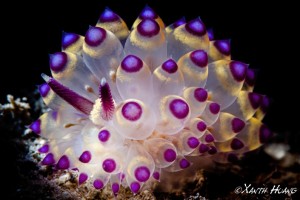
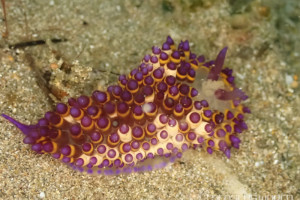
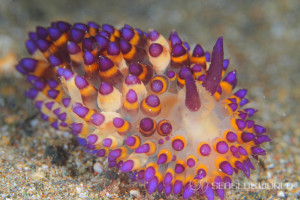
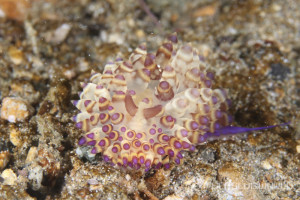
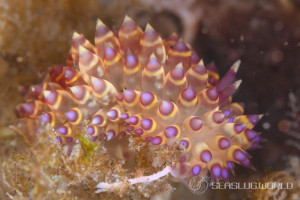
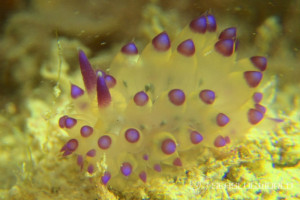
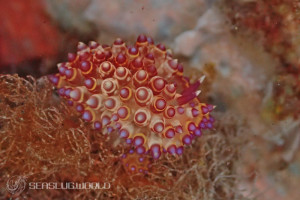
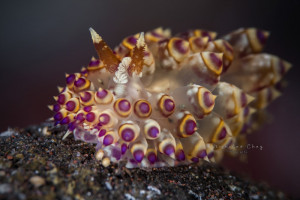
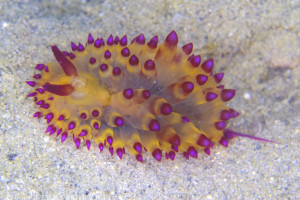
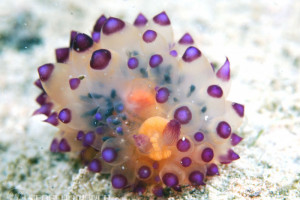
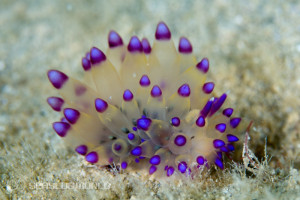
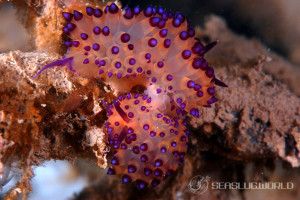
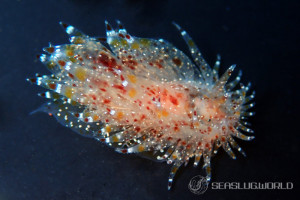
Living specimens reach 50 mm in length. The body is broadest anteriorly and tapers to a long posterior extension of the foot well beyond the notum. Rhinophores are elongate and bear about 20–25 complete or incomplete transverse lamellae. A well-developed, convoluted caruncle is present between the rhinophores. The eyes appear as two small black dots immediately behind the rhinophores, visible by transparency. A large, swollen cardiac area lies near the middle of the notum. A pair of short, digitiform oral tentacles extends from either side of the head.Cerata are elongate, very globose centrally, and end in an acutely pointed apex. Most of the cerata bear many prominent tubercles around the middle. They are arranged in 8–12 closely-packed longitudinal rows, with 4–5 cerata per row on each side, irregularly disposed. The digestive gland inserts into most cerata at the base, splits into numerous branches, and terminates at the globose portion of the ceras. The anteriormost cerata often lack extensions of the digestive gland. The anus is located mid-dorsally near the posterior end of the notum on a raised papilla, anal glands are absent, and the gonopore opens on the right side at the middle of the body.
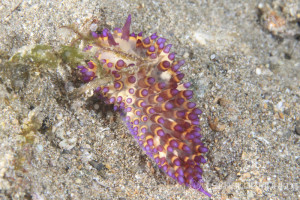
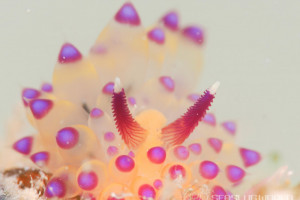
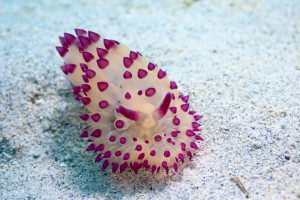
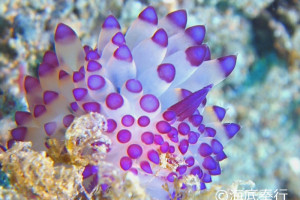
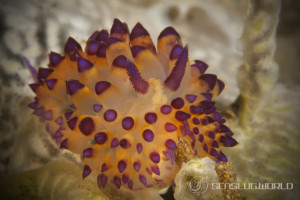
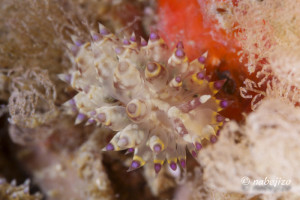
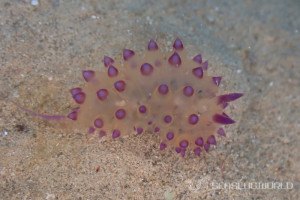
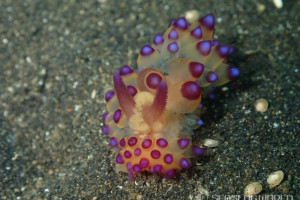
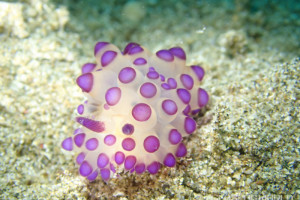
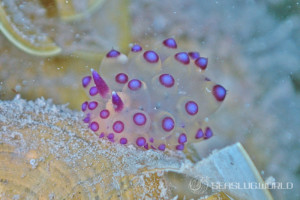
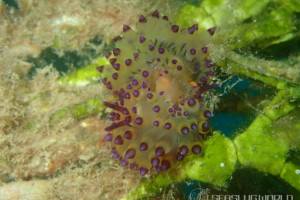
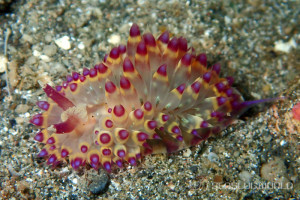
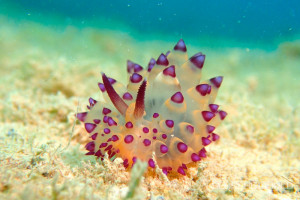
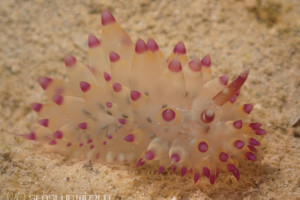
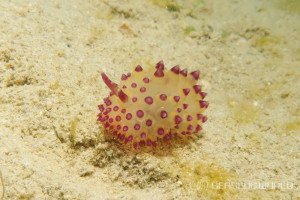
Background coloration is translucent white. Caruncle and tubercles of the cerata are yellowish white, with opaque white pigment also developed on the middle of the head and notum and as scattered spots in the rhinophoral area. The midline of the notum is marked with purple spots and patches, and similar opaque white spots are scattered over the rest of the notum. The basal half of each ceras is translucent white. Above this, a third zone bears purple pigment and prominent purple tubercles, which is followed apically by a narrow brown-reddish ring and then a yellow ring; the very tip is a translucent yellow, sharply pointed apex. Branches of the digestive gland visible inside the cerata are chocolate brown to reddish brown with many small black dots. Rhinophores are reddish brown with white tips. The posterior end of the foot is purple with a translucent white outer outline, and the foot has irregularly scattered white spots.
The buccal mass is large and muscular with an oval opening, with numerous small simple oral glands near the mouth and a pair of long dendritic salivary glands. Paired jaws are large, strong, and thick with an entirely smooth masticatory border. The radular formulae documented by Pola et al. 2019 are 30 × 28.1.28 (CASIZ 177367) and 28 × 18.1.18 (CASIZ 177569) and 15 × 16.1.16 (CASIZ 177561). Rachidian teeth are narrow with a pointed cusp and lack lateral denticles, and the hook-shaped lateral teeth have a long base and are smooth and sharply arched, becoming progressively smaller toward the outer margin. The reproductive system is androdiaulic; the ovotestis consists of numerous lobes giving rise to a long, thick, convoluted ampulla. The vas deferens is very long and convoluted, prostatic throughout its length, and terminates at a thick, wide, unarmed penial sac with a conical apex. The oviduct is short and expands into a semi-spherical receptaculum seminis, with a relatively small elongate bursa copulatrix entering the female atrium near the junction with the vagina.
Distribution
Indian and western Pacific oceans. The species has been recorded from the Philippines, Papua New Guinea, the Solomon Islands, the Red Sea, Indonesia and Vanuatu, with possible additional records from Australia.Etymology
The specific epithet flavoanulatus is derived from the Latin flavus, meaning yellow, and anulatus, meaning ringed, referring to the conspicuous yellow subapical ring on the cerata.Remarks
Originally described as Janolus flavoanulatus Pola & Gosliner, 2019 from Maricaban Island, Philippines (Pola, Hallas & Gosliner, 2019). The species had previously been figured under several informal names including Janolus sp. 1 (Debelius & Kuiter, 2007), Janolus sp. 7 (Gosliner et al., 2008, 2015) and Janolus sp. before formal description.Janolus flavoanulatus is most similar to Janolus tricellariodes and Janolus savinkini in general body form, but differs from both in the coloration of the rhinophores, which are reddish brown in J. flavoanulatus rather than the same colour as the caruncle. The cerata of J. flavoanulatus bear conspicuous purple pigment, opaque white tubercles and a clear yellow subapical ring that are absent or much weaker in the other two species. Internal anatomy is broadly similar across the three species, but the vas deferens and ampulla of J. flavoanulatus are slightly shorter than those of J. savinkini, and the bursa copulatrix is markedly larger than in either congener. Mature specimens of J. flavoanulatus reach about 50 mm, twice the maximum length of J. tricellariodes. Uncorrected COI p-distances are 9.7% from J. tricellariodes and 10.5% from J. savinkini. Within the Philippine population sampled by Pola et al. 2019, specimens fell into two COI sub-clades differing by about 4.5%, but no morphological characters separating them have been found, so they are retained as a single species pending further population genetic study.
Pola et al. 2019 reinstated Janolidae Pruvot-Fol, 1933 as a valid family separate from Proctonotidae and recovered two well-supported clades within the family. Janolus flavoanulatus belongs to the Indo-Pacific clade characterised by tuberculate cerata and denticulate radular teeth, sister to the Atlantic and eastern Pacific clade for which the genus Antiopella Hoyle, 1902 was resurrected.
References
- ヤノルス属の一種, 殿塚孝昌. (2003). ウミウシガイドブック〈3〉. TBSブリタニカ.
- トゲトゲウミウシ, 中野理枝. (2004). 本州のウミウシ. ラトルズ.
- Janolus sp. 1, Helmut Debelius, Rudie H. Kuiter. (2007). Nudibranchs of the World.
- Janolus sp. 7, Terrence Gosliner, Ángel Valdés and David Behrens. (2015). Nudibranch and Sea Slug Identification Indo-Pacific. New World Pubns Inc.
- サーシャコヤナギウミウシ(新称), 中野理枝. (2018). 日本のウミウシ. 文一総合出版.
- Janolus sp. 7, Terrence Gosliner, Ángel Valdés and David Behrens. (2018). Nudibranch and Sea Slug Identification Indo-Pacific 2nd Edition. New World Pubns Inc.
- Janolus flavoanulatus sp. nov., Pola M., Hallas J.M. & Gosliner T.M. (2019). Welcome back Janolidae and Antiopella : Improving the understanding of Janolidae and Madrellidae (Cladobranchia, Heterobranchia) with description of four new species. Journal of Zoological Systematics and Evolutionary Research. 57(2): 345-368. https://doi.org/10.1111/jzs.12257
Featured in this book
Terrence Gosliner, Ángel Valdés and David Behrens. (2018). Nudibranch and Sea Slug Identification Indo-Pacific 2nd Edition. New World Pubns Inc.
New World Publications
This species, Janolus flavoanulatus, is included in the book.
View on Amazon PR (Amazon Associates)Seasonality
Shooting Locations
Loading shooting locations...
Photos of Janolus flavoanulatus
Tag:























Same Genus Nudibranchs
Similar Colors Nudibranchs
Academic Database
Sea slug observation data is available in international marine biodiversity databases.