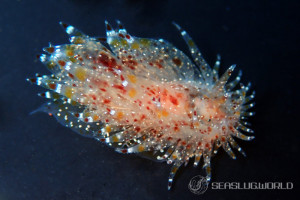
Janolus tricellariodes Pola & Gosliner, 2019
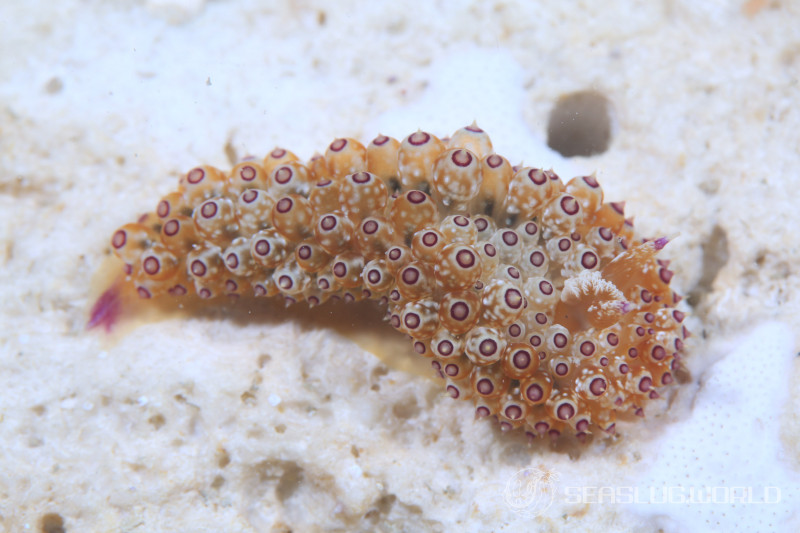
- Location
- Sunabe Water Treatment Plants, Okinawa Island (Chatan and Southern area), Okinawa, Japan
- Date
- 2014/05/07
- Length
- 30mm
- Depth
- 5.0m
- Water temperature
- 23.0℃
Description
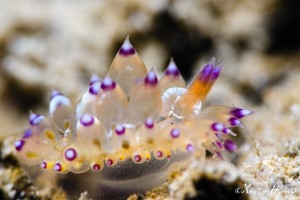
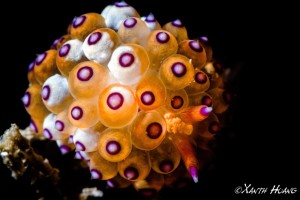
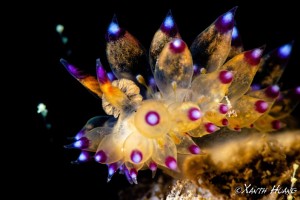
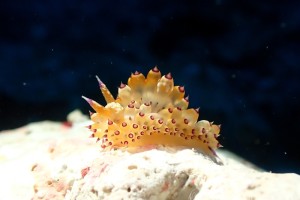
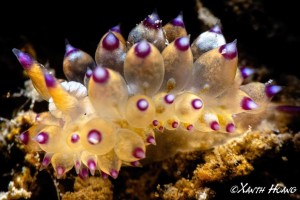
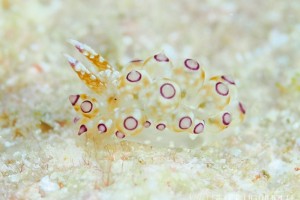
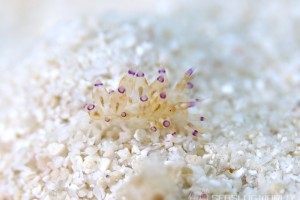
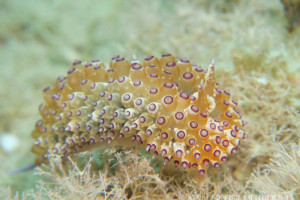
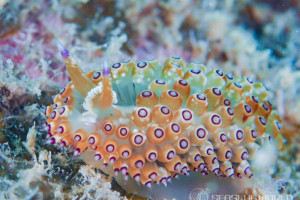
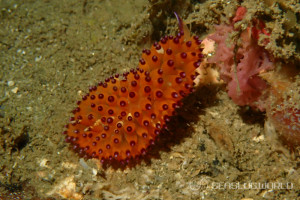
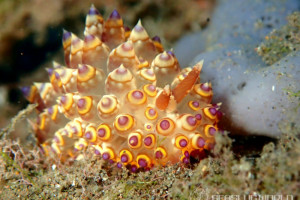
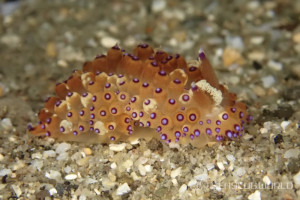
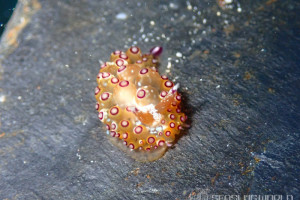
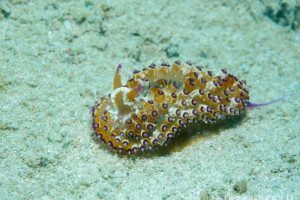
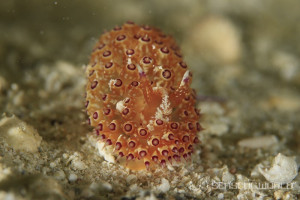
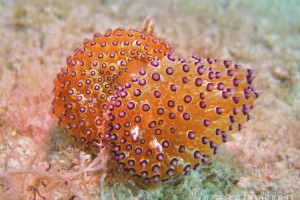
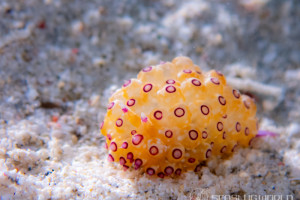
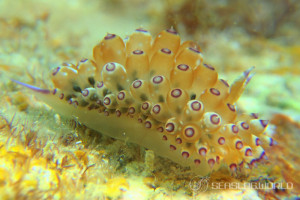
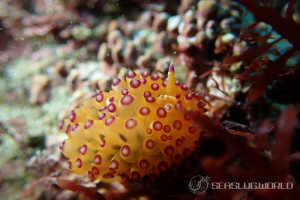
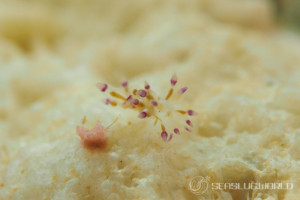
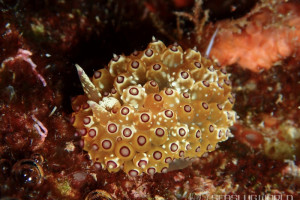
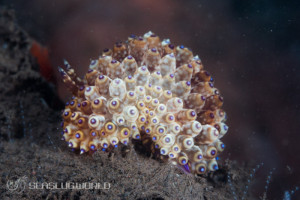
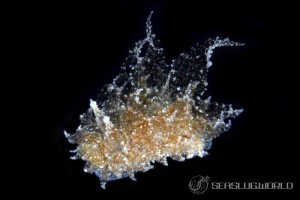
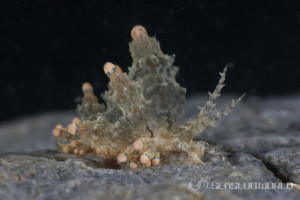
Living specimens reach 25 mm in length. The body is broadest anteriorly and tapers to an elongate posterior extension of the foot well beyond the notum. Rhinophores are elongate with about 15 complete or incomplete transverse lamellae. A well-developed, convoluted caruncle is present between the rhinophores. The eyes appear as two small black dots just behind the rhinophores. A large, swollen cardiac area lies near the middle of the notum. A pair of short, digitiform oral tentacles extends from either side of the head.Cerata are elongate and very globose centrally. Most cerata are not entirely smooth but bear some tubercles. They are distributed over the whole body in 13–16 rows, with 4–5 cerata per row. The digestive gland inserts into most cerata at the base and branches within the papillae. The anteriormost cerata lack extensions of the digestive gland. The anus opens mid-dorsally near the posterior end of the notum, and the gonopore is on the right side at the middle of the body.
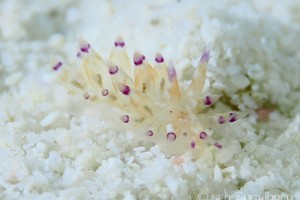
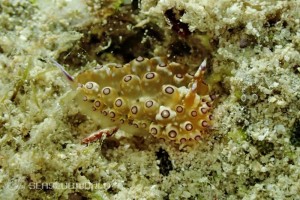
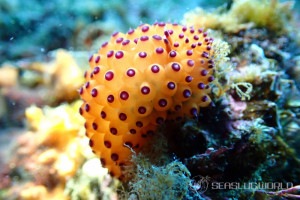
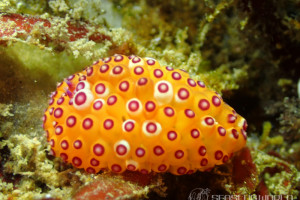
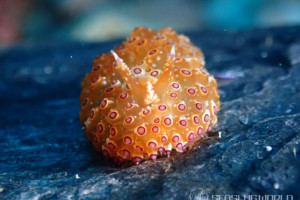
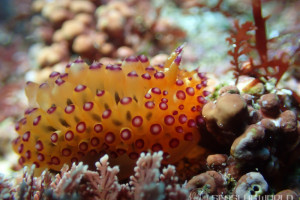
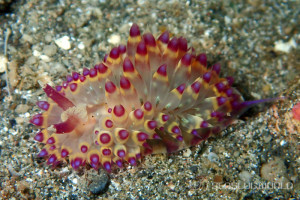
Background coloration is translucent white. The caruncle is opaque white, and opaque white pigment also appears on the middle of the head, notum, and posterior rachis of the rhinophores, and as colour on many of the ceratal tubercles. The basal portion of each ceras is translucent white; near the middle, the globose part bears purple pigment with prominent purple tubercles. A well-defined band of purple sits above the orange coloration that begins to appear, extending toward the ceratal tip. The purple weakens distally and ends at a translucent white tip. Branches of the digestive gland visible within the cerata are chocolate brown with many small black dots. Rhinophores are almost the same color as the cerata, with a darker orange tone varying to brown. The posterior end of the foot is purple with a median line of opaque white.
The buccal mass is large and muscular with an oval opening; numerous small, simple oral glands surround the opening of the mouth, and a pair of large, highly dendritic salivary glands extends anteriorly from the stomach to the buccal mass. The radula has 22–32 rows of teeth, with 25–32 lateral teeth on each side of the rachidian (radular formulae 22 × 25.1.25 in NMP 041287, 26 × 25.1.25 in CASIZ 0837255, 27 × 30.1.30 in CASIZ 083781 and 33 × 26.1.26 in CASIZ 177573). Rachidian teeth are narrow and elongate with pointed cusps and lacking denticles; hook-shaped lateral teeth have a long base, are smooth, and sharply arched. The reproductive system is androdiaulic, with a long convoluted ampulla and a long, prostatic vas deferens terminating in a thick, wide, unarmed penial sac. The oviduct is short and expands into an elongate receptaculum seminis. A small but distinct, digitiform bursa copulatrix enters the female atrium near its junction with the vagina.
Distribution
Western Pacific Ocean. Recorded from the Philippines, Okinawa (Japan) and Indonesia.Etymology
The specific epithet tricellariodes refers to the bryozoan genus Tricellaria, on which the species feeds.Remarks
Originally described as Janolus tricellariodes Pola & Gosliner, 2019 from Kirby's Rock, Caban Island, Tingloy, Batangas Province, Luzon, Philippines (Pola, Hallas & Gosliner, 2019). Before formal description the species was figured under various informal names including Janolus sp. 1 (Gosliner et al., 2008) and Janolus sp. 8 (Gosliner et al., 2015). It feeds on the arborescent bryozoan Tricellaria sp. and is typically found on steep reef walls and pinnacles with strong currents at 20–40 m depth.Janolus tricellariodes is most similar to Janolus savinkini Martynov & Korshunova, 2012, from which it differs in possessing opaque white pigment on the bulbous cerata that J. savinkini lacks. Internally, the radular morphology is very similar in both species, but the vas deferens and ampulla of J. tricellariodes are shorter than in J. savinkini, and although both species share a stalked semi-serial receptaculum seminis and a distinct bursa copulatrix, the tubular bursa is smaller in J. tricellariodes. The penis of J. tricellariodes appears much broader than the conical penis of J. savinkini. The uncorrected COI p-distance between the two species is 11.9%; species delimitation analyses (bPTP and ABGD) also recover them as distinct.
Pola et al. 2019 reinstated Janolidae Pruvot-Fol, 1933 as a valid family separate from Proctonotidae. Within Janolidae, J. tricellariodes falls in a strongly supported Indo-Pacific clade with J. flavoanulatus, J. incrustans and J. savinkini, characterised by tuberculate or papillate cerata and denticulate radular teeth, and sister to the Atlantic and eastern Pacific clade for which the genus Antiopella Hoyle, 1902 was resurrected.
References
- トゲトゲウミウシ(仮称), 益田一. (1999). 海洋生物ガイドブック. 東海大学出版会.
- トゲトゲウミウシ, 益田一. (1999). 海洋生物ガイドブック. 第2刷. 東海大学出版会.
- トゲトゲウミウシ(仮称), 小野篤司. (1999). ウミウシガイドブック. TBSブリタニカ.
- トゲトゲウミウシ(新称), 小野篤司. (2000). ウミウシガイドブック. 第2版. TBSブリタニカ.
- トゲトゲウミウシ, 小野篤司. (2004). 沖縄のウミウシ. ラトルズ.
- Janolus sp. 8, Terrence Gosliner, Ángel Valdés and David Behrens. (2015). Nudibranch and Sea Slug Identification Indo-Pacific. New World Pubns Inc.
- コヤナギウミウシ属の仲間 Janolus sp. 5, 中野理枝. (2018). 日本のウミウシ. 文一総合出版.
- Janolus sp. 8, Terrence Gosliner, Ángel Valdés and David Behrens. (2018). Nudibranch and Sea Slug Identification Indo-Pacific 2nd Edition. New World Pubns Inc.
- Janolus tricellariodes sp. nov., Pola M., Hallas J.M. & Gosliner T.M. (2019). Welcome back Janolidae and Antiopella : Improving the understanding of Janolidae and Madrellidae (Cladobranchia, Heterobranchia) with description of four new species. Journal of Zoological Systematics and Evolutionary Research. 57(2): 345-368. https://doi.org/10.1111/jzs.12257
Featured in this book
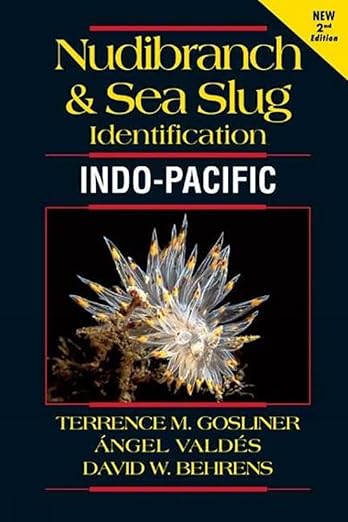
Terrence Gosliner, Ángel Valdés and David Behrens. (2018). Nudibranch and Sea Slug Identification Indo-Pacific 2nd Edition. New World Pubns Inc.
New World Publications
This species, Janolus tricellariodes, is included in the book.
View on Amazon PR (Amazon Associates)Seasonality
Shooting Locations
Loading shooting locations...
Photos of Janolus tricellariodes
Tag:






















Same Genus Nudibranchs
Similar Colors Nudibranchs

Academic Database
Sea slug observation data is available in international marine biodiversity databases.