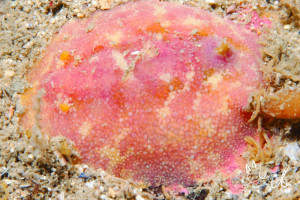
Paratritonia lutea Baba, 1949
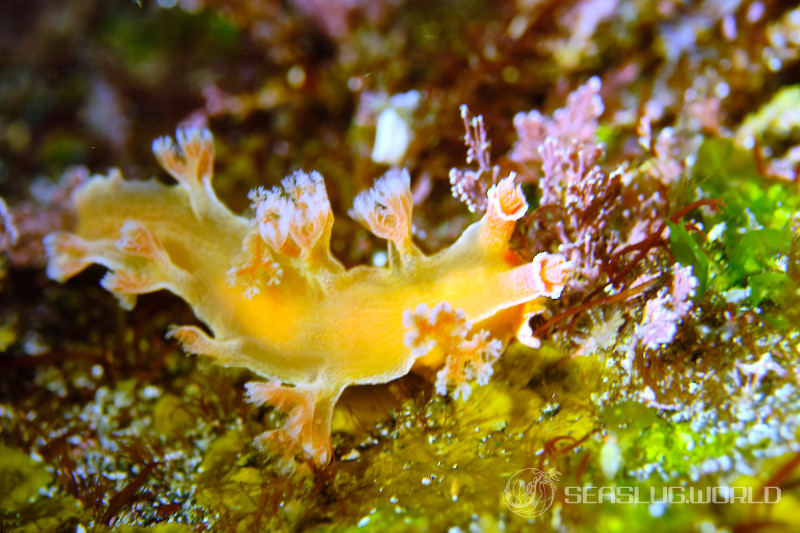
- Location
- Akinohama, Izu Oshima, Tokyo, Japan
- Date
- 2021/05/04
- Length
- 30mm
- Depth
- 40.0m
- Water temperature
- 24.0℃
Description
A medium-sized Tritoniidae, body length 20-35 mm. Type species of the new genus Paratritonia Baba, 1949. Dorsum and body sides smooth. Head veil without a median notch, bearing 3 short simple finger-like processes on each side margin. Spoon-shaped oral tentacles as usual. Rhinophore-sheath margin entire. Cerata 6-7 per side. The genital orifice lies below the first right gill; the anus opens diagonally below and in front of the second gill on the right side; the nephroproct is directly above the anus. The whole body is yellow, with vermilion gills. The masticatory edge of the jaw plate is reflexed, with 8-10 rows of weak denticulate scales on the reflexed face and 3-5 additional rows at the top of the masticatory edge. The radula is relatively large, with a representative formula of 50×100-110.1.1.1.100-110. The central tooth is narrow with a single median cusp, sometimes with 2-4 denticles on each side. The first lateral is asymmetric; from the second lateral onward, the laterals are smooth sickle-shaped. The 8-12 outermost laterals are elongate and bear 20-25 minute denticles each. The stomach has a girdle of about 25 chitinous plates. The left and right livers are fused.Distribution
Type locality is Amadai-ba, Sagami Bay (80-100 m depth, May-July 1935, July 1936, and July 1939, 5 specimens) and off Kameshiro-shō, Sagami Bay (80 m depth, August 1936, 2 specimens). The original description (Baba, 1949) records the species only from deeper waters of Sagami Bay.Etymology
The specific epithet lutea is Latin for yellow. The original description does not give an explicit etymology paragraph; the descriptive sense reflects the bright yellow body colour. The Japanese name "Kiiro-hanagasa-umiushi" (yellow flower-cap sea slug) likewise refers to the colour. The genus name Paratritonia is interpretable as "near Tritonia".Remarks
Originally described as a new genus and species, Paratritonia lutea Baba, 1949. Baba notes that Paratritonia resembles Tritoniopsilla in having a central tooth with a single cusp, but differs in many other characters. From Tritonia, distinguished by the short simple finger-like head-veil processes (only 3 per side), few cerata (6-7), and the relatively modest 50× radula formula. A deep-water species (80-100 m).References
A Kindle field guide by the site author
Kimoto N. (2026). Sea Slugs of Japan & the Indo-Pacific, 2nd Edition.
Kindle Edition
View on Amazon PR (Amazon Associates)Seasonality
Shooting Locations
Loading shooting locations...
Photos of Paratritonia lutea
Tag:



Similar Colors Nudibranchs

Academic Database
Sea slug observation data is available in international marine biodiversity databases.