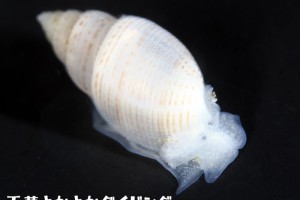
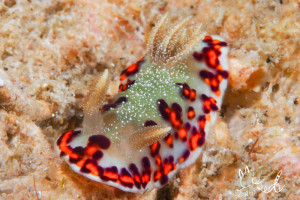
Punctacteon fabreanus (Crosse, 1873)
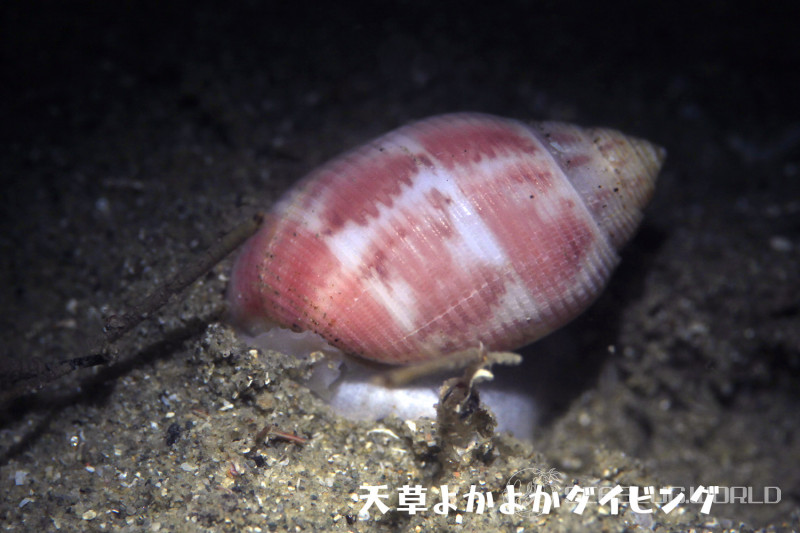
- Location
- Tate Beach, Amakusa, Kumamoto, Japan
- Date
- 2017/07/01
- Length
- 10mm
- Depth
- 10.0m
- Water temperature
- 16.0℃
Description
A small acteonid snail with an ovate shell about 17 mm long. The shell is relatively thin and slightly polished, marked with three spiral bands of reddish-brown blotches, and covered with punctured spiral grooves over the entire surface. The columellar fold is weak and the umbilicus is narrow. Habe (1961) described the columellar fold as single, distinguishing it from the similar Punctacteon kirai (yellowish-brown with a more open umbilicus).Distribution
The original description (Crosse, 1873) was based on specimens from New Caledonia. Habe (1961) recorded Japanese specimens from Sagami Bay southward, in 10–30 m depth on sand bottoms. Okutani (ed.) 2000 (Marine Mollusks in Japan) extended the recorded range from Boso Peninsula on the Pacific coast and Sado Island on the Japan Sea coast southward to the southwestern Pacific, on sand bottoms in 10–300 m depth. Type locality: New Caledonia.Etymology
The specific epithet fabreanus is a Latinized adjective derived from the proper name Fabre, with the eponymic suffix -anus; the original description (Crosse, 1873) does not explicitly identify the person honoured.References
- Tornatella fabreana n. sp., Crosse H. (1873). Diagnoses molluscorum, Novae Caledoniae incolarum. Journal de Conchyliologie. 21(1): 65-67. [published 31 January 1873]
- キジビキガイ Punctacteon fabreaus (CROSSE), 波部忠重. (1961). 続原色日本貝類図鑑. 保育社, 大阪. xii + 183 + 42 pp., 66 pls. [Habe T. (1961). Coloured illustrations of the shells of Japan (II). Hoikusha, Osaka.]
- キジビキガイ Punctacteon fabreanus (Crosse, 1874), 奥谷喬司. (2000). 日本近海産貝類図鑑. 東海大学出版会.
A Kindle field guide by the site author
Kimoto N. (2026). Sea Slugs of Japan & the Indo-Pacific, 2nd Edition.
Kindle Edition
View on Amazon PR (Amazon Associates)Seasonality
Shooting Locations
Loading shooting locations...
Photos of Punctacteon fabreanus

Same Genus Nudibranchs
Similar Colors Nudibranchs
Academic Database
Sea slug observation data is available in international marine biodiversity databases.