Chlamylla ignicrystalla (Korshunova, Martynov, Bakken, Evertsen, Fletcher, Mudianta, H. Saito, Lundin, Schrödl & Picton, 2017)
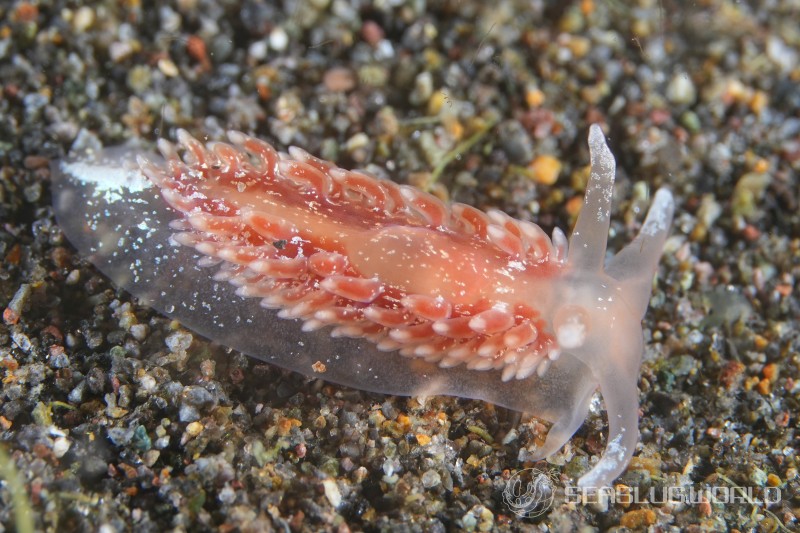
- Location
- Rousokuiwa, Rausu, Hokkaido, Japan
- Date
- 2026/04/11
- Length
- 8mm
- Depth
- 20.0m
- Water temperature
- -2.0℃
Description
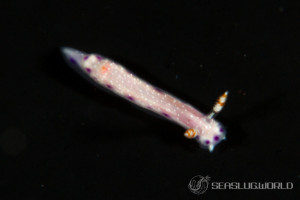
A small flabellinid about 11.5 mm in length (preserved). The background body colour is translucent white with small opaque white spots scattered over the entire dorsum, more frequently on the ceratal bases than on the cerata themselves. The notal edge is continuous and well-defined, with cerata attached directly along it without forming distinct clusters. Cerata are short, fusiform, orange-brown to reddish-brown, and capped with opaque white pigment apically. The rhinophores are about half the length of the oral tentacles, with a smooth to slightly wrinkled surface and no papillae. The anterior foot corners are short.Distribution
The type locality is Vostok Bay, Primorye, Russia (northwestern Sea of Japan), where the holotype (ZMMU Op-490, 11.5 mm preserved) was collected from the intertidal zone on 17 March 1994 by A. V. Martynov. The species is known from the northwestern Sea of Japan, from the intertidal zone down to 5–6 m on stony substrates. Egg masses are white to pinkish, slender cord-shaped, and reproduction occurs from December to April.Etymology
The specific epithet ignicrystalla is a compound of Latin igni (fire) and crystallum (ice, rock crystal). According to the original description (Korshunova et al. 2017), the name refers to the dual combination of morphological features (flame-like short cerata with ice-like white speckles on the dorsum) and the extreme thermal range of the type locality (winter sea temperatures down to -2 °C, summer up to +26 °C). The authors also note an allusion to G. R. R. Martin's "A Song of Ice and Fire" novels.Remarks
The genus Chlamylla contains small to medium-sized flabellinids ranging from the Arctic to the temperate Sea of Japan; C. ignicrystalla represents the southernmost member of the group. Its combination of a translucent white body, short fusiform orange-brown cerata, and scattered opaque white speckles is distinctive within the genus. Placement in Chlamylla (Ekimova et al. 2026) is tentative and based on morphology; molecular confirmation is still pending.References
- Paracoryphella ignicrystalla n.sp., Korshunova T., Martynov A., Bakken T., Evertsen J., Fletcher K., Mudianta I.W., Saito H., Lundin K., Schrödl M. & Picton B. (2017). Polyphyly of the traditional family Flabellinidae affects a major group of Nudibranchia: aeolidacean taxonomic reassessment with descriptions of several new families, genera, and species (Mollusca, Gastropoda). ZooKeys. 717: 1-139. https://doi.org/10.3897/zookeys.717.21885
- ナナカマドウミウシ(新称), 中野理枝. (2018). 日本のウミウシ. 文一総合出版.
- Chlamylla ignicrystalla (Korshunova et al., 2017), comb. nov., Ekimova, I., Carmona, L., Mikhlina, A. L., Grishina, D., Stanovova, M. V., Schepetov, D. M., Hoover, C., de Souza-Canal, J., Kuznetsov, K. O., & Valdés, Á. (2026). Neither "lumpers" nor "splitters": A global revision of Flabellinidae s.l. nudibranchs (Gastropoda: Heterobranchia: Nudibranchia). PLoS One. 21(5): e0347759. https://doi.org/10.1371/journal.pone.0347759
Featured in this book
中野理枝. (2019). 日本のウミウシ. 第二版. 文一総合出版.
文一総合出版
This species, Chlamylla ignicrystalla, is included in the book.
View on Amazon PR (Amazon Associates)Seasonality
Shooting Locations
Loading shooting locations...
Photos of Chlamylla ignicrystalla


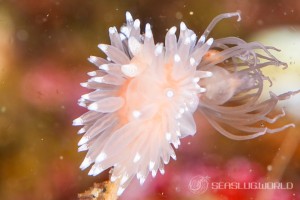
Same Genus Nudibranchs
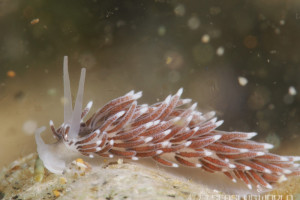
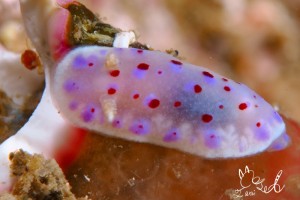
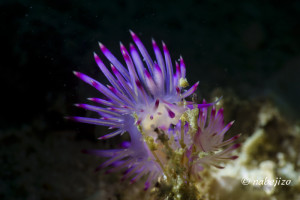
Similar Colors Nudibranchs

Academic Database
Sea slug observation data is available in international marine biodiversity databases.