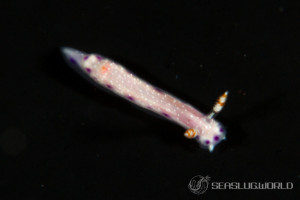
Kabeiro rubroreticulata Shipman & Gosliner, 2015
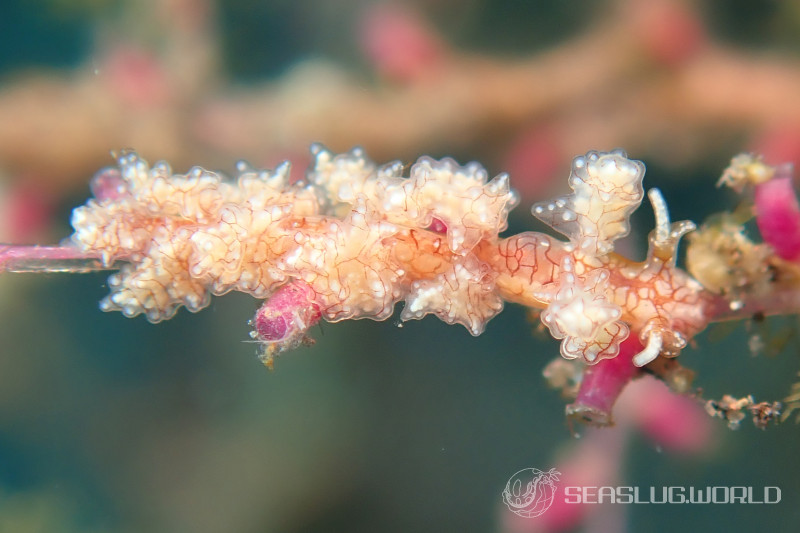
- Location
- Batu Niti, Tulamben, Pulau Bali, Indonesia
- Date
- 2017/11/09
- Length
- 10mm
- Depth
- 20.0m
- Water temperature
- 28.0℃
Description
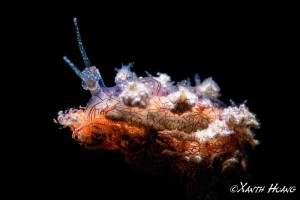
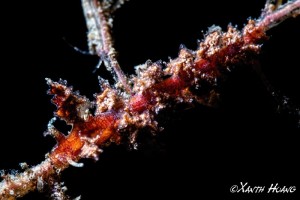
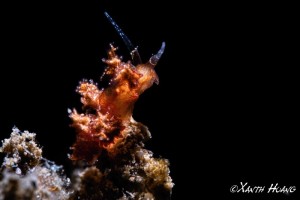
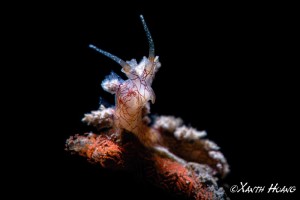
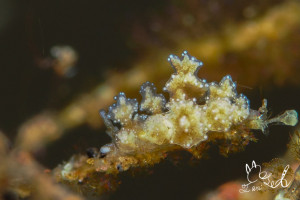
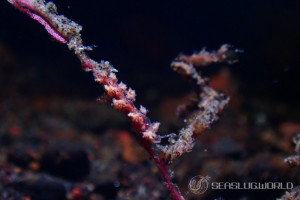
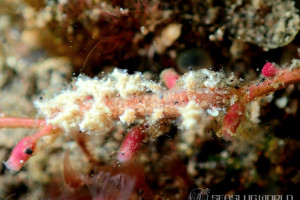
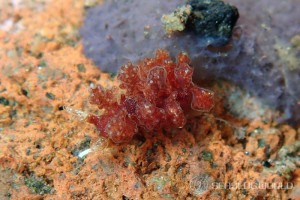
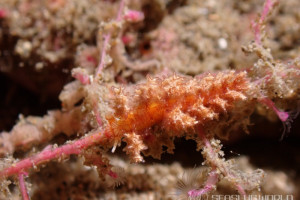
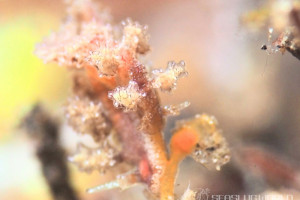
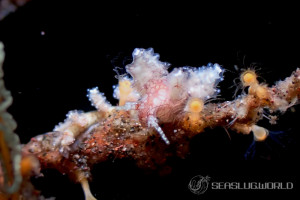
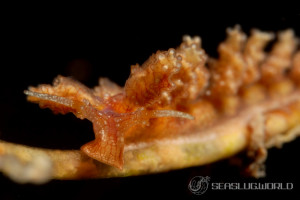
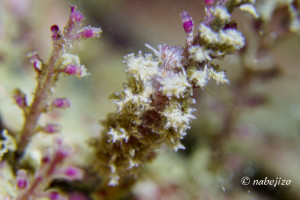
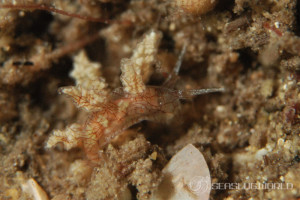
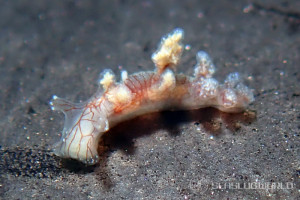
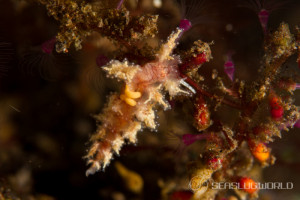
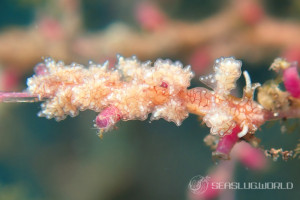
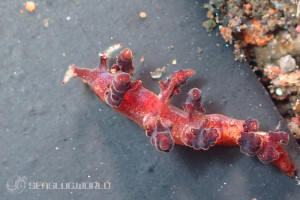
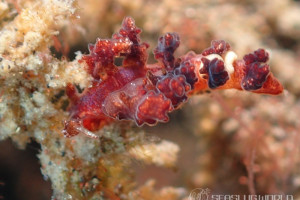
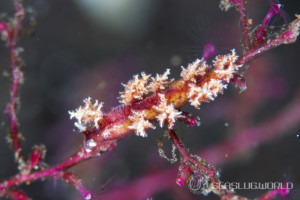
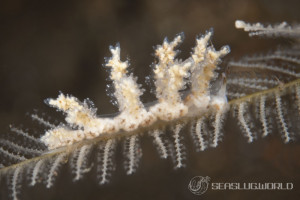
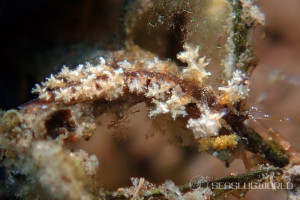
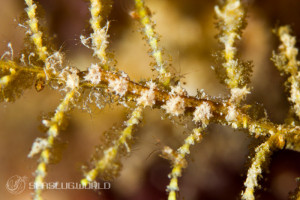
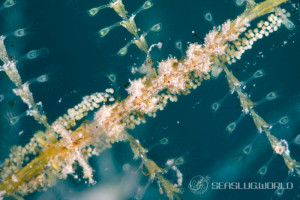
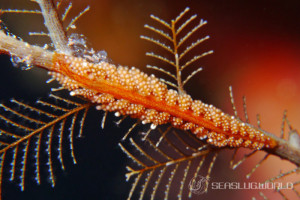
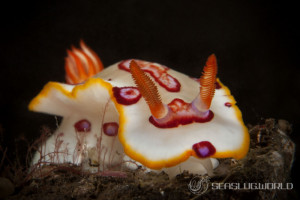
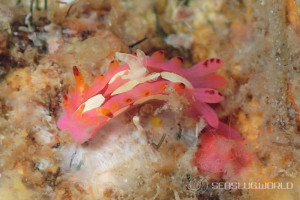
An elongate Kabeiro reaching 20 mm in length (preserved specimens 10–13 mm). The animal bears 7–8 pairs of irregularly shaped, elongate cerata that extend laterally. The species exhibits four distinct color morphs. Color morph one has a bright pink to red body with light-pink to red irregularly shaped cerata sporadically mottled with opaque white on the tubercles; the body, cerata, rhinophoral sheaths, pericardium, and digestive gland are all overlain by fine red reticulations that resemble a network of subdermal blood vessels — a distinctive feature. The finger-like rhinophores are opaque white with pronounced opaque white dots. Pseudobranchs vary in shape and size between cerata, but typically consist of two large bifurcating leaflets with a smaller adjacent third leaflet.Color morph two is brownish-red with fine red-brown reticulations and lacks opaque white tubercles. Color morph three has a cream body and prominent red-pink reticulations. Color morph four has a cream to tan body with irregularly arranged reddish-brown patches but lacks the reticulations. In all morphs, the rhinophoral sheaths are wider anteriorly than posteriorly with rippled margins bearing opaque white spots. The genital pore opens directly below the first right ceras; the anal papilla lies just behind it, adjacent to the pericardium. The radular formula is 71 × 0.1.0; each tooth forms a long round arch with a prominent upper row of 11–12 denticles and a smaller ventral row of 4–8 denticles.
Distribution
Philippines (Bohol Island, Panglao; Luzon, Batangas Province, Maricaban Island, Bethlehem, 0–21 m depth) and Indonesia (Bali, from photographic records). Collected from campanularid hydroids growing on the seagrass Enhalus acoroides in 1–5 m depth. The host hydroid possesses bright pink polyps, and the egg masses are likewise pink.Etymology
Verbatim from the original description (Shipman & Gosliner, 2015):Kabeiro, was a sea nymph in Greek mythology. Kabeiro rubroreticulata is named for the red reticulations, which cover the body of this species.
Remarks
Originally figured as Doto sp. 14 in a 2008 reference work; designated here as the type species of Kabeiro. The genus is distinguished from Doto by an elongate slender body, an enlarged and elevated pericardium, a pocketed prostate (penial gland), and an external tube-like digestive gland running along the dorsum. K. rubroreticulata is sister to Kabeiro christianae, and these two are jointly sister to Kabeiro phasmida. It is most similar in external appearance to the undescribed Doto sp. 17 photographed from Bali, Indonesia, which differs in having a yellowish-brown body with small black pigment spots scattered across the cerata, and in lacking red reticulations.References
- Kabeiro rubroreticulata, Terrence Gosliner, Ángel Valdés and David Behrens. (2015). Nudibranch and Sea Slug Identification Indo-Pacific. New World Pubns Inc.
- Kabeiro rubroreticulata n. sp., Shipman C. & Gosliner T.M. (2015). Molecular and morphological systematics of Doto Oken, 1851 (Gastropoda: Heterobranchia), with descriptions of five new species and a new genus. Zootaxa. 3973(1): 1-49. https://doi.org/10.11646/zootaxa.3973.1.1
Featured in this book
Terrence Gosliner, Ángel Valdés and David Behrens. (2018). Nudibranch and Sea Slug Identification Indo-Pacific 2nd Edition. New World Pubns Inc.
New World Publications
This species, Kabeiro rubroreticulata, is included in the book.
View on Amazon PR (Amazon Associates)Seasonality
Shooting Locations
Loading shooting locations...
Photos of Kabeiro rubroreticulata
Tag:












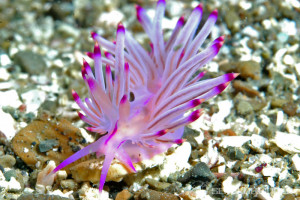
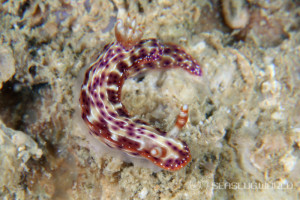
Same Genus Nudibranchs
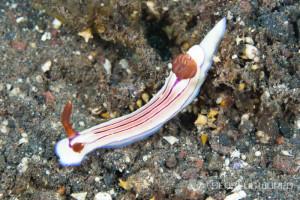
Similar Colors Nudibranchs
Academic Database
Sea slug observation data is available in international marine biodiversity databases.