Hypselodoris maculosa (Pease, 1871)
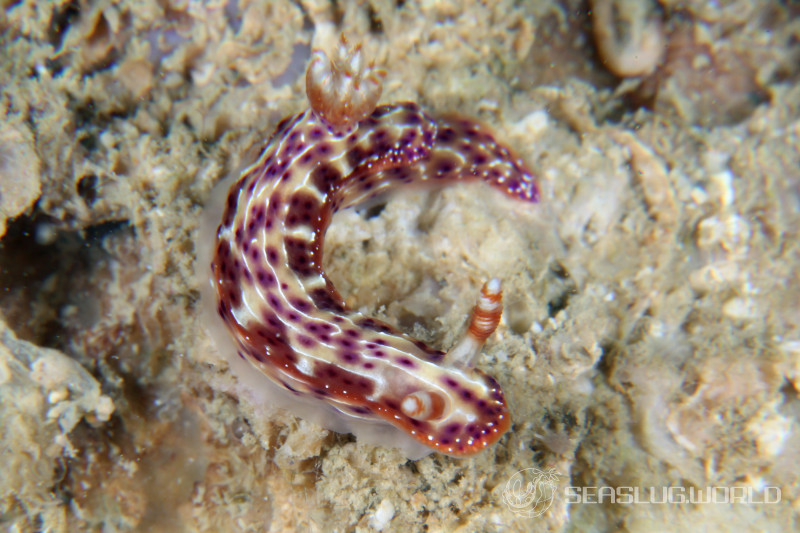
- Location
- Tengan(Kombu), Okinawa Island (East coast), Okinawa, Japan
- Date
- 2015/06/23
- Length
- 12mm
- Depth
- 5.0m
- Water temperature
- 27.0℃
Description
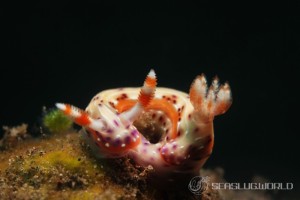
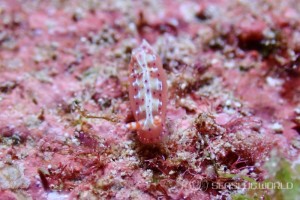
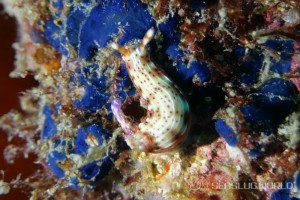
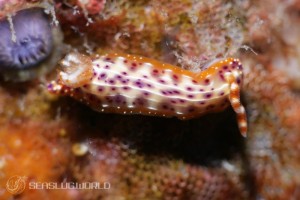
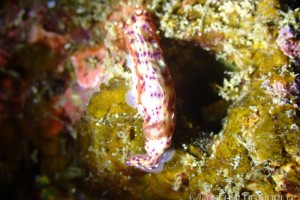
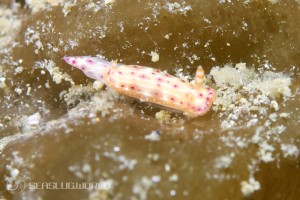
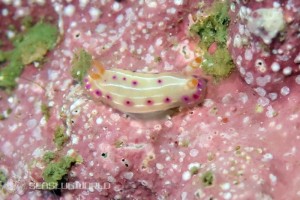
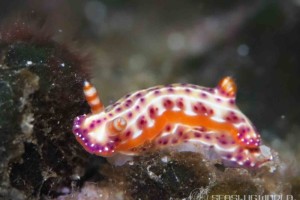
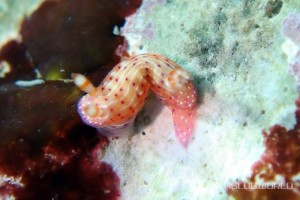
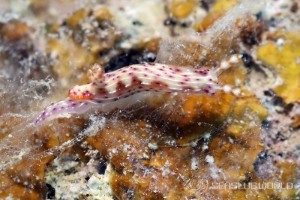
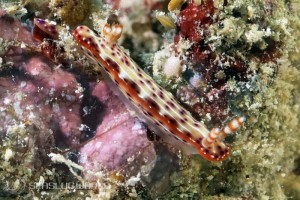
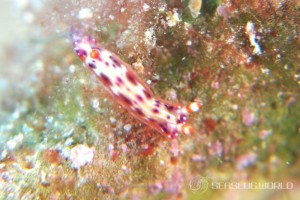
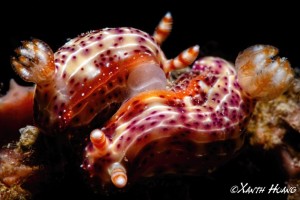
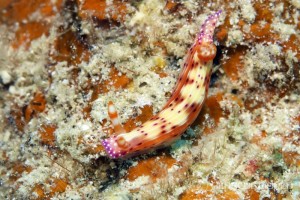
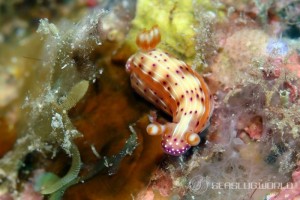
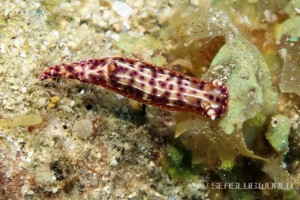
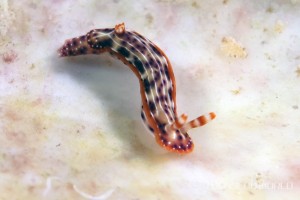
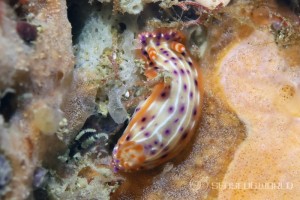
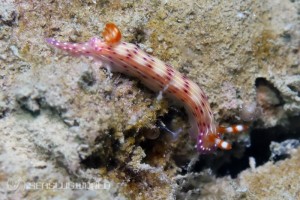
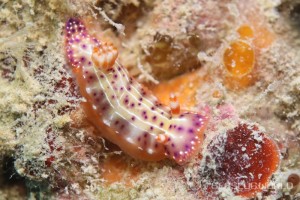
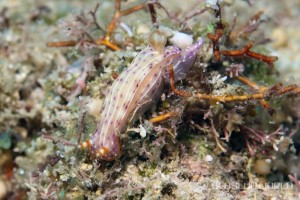
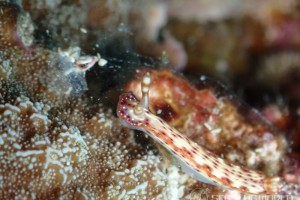
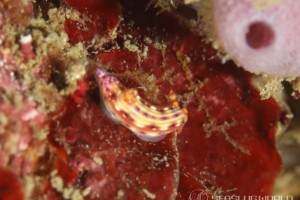
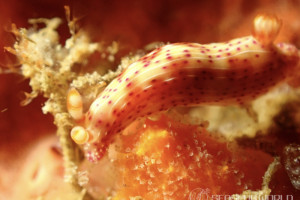
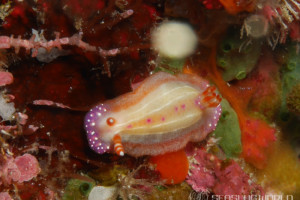
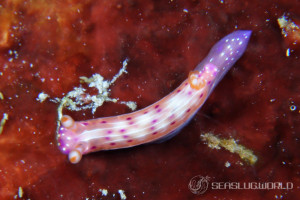
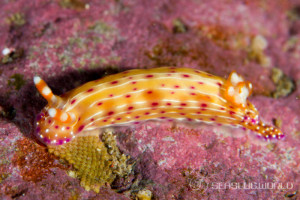
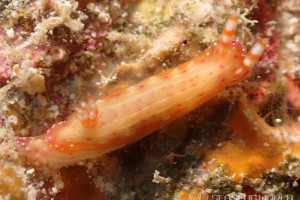
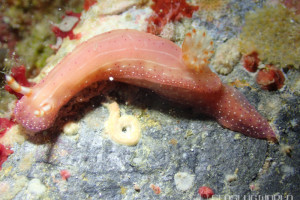
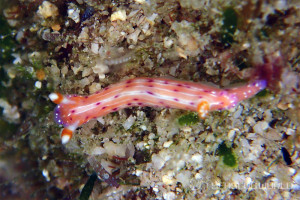
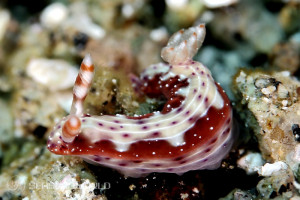
A small chromodorid with a narrow white body. Four thin opaque white longitudinal lines run along the dorsum (two on each side of the midline), beginning in front of the rhinophores and extending back to encircle the gills; the innermost pair are joined by transverse bars. Rows of purplish-red spots lie between the lines. The mantle margin is orange-brown, with a row of opaque white spots just inside it. The rhinophores are white with red rings on the club, usually two, though some individuals show three. The eight white gills each bear a purplish-red spot at the base and a vermilion mark at the tip. The foot is colorless, and the upper side of the tail carries purplish-red and opaque white spots along with the same white lines as the dorsum. The species reaches about 40 mm, though recorded specimens include small individuals around 10 mm.Distribution
Type locality Tahiti. Widespread across the Indo-Pacific; in Japan it is known from the Ryukyu Islands (Ishigaki and elsewhere).Etymology
The specific epithet maculosa is Latin for "spotted" or "speckled," after the dorsal markings.Remarks
Long confused with the similar Hypselodoris decorata, with which it was once treated as a single species. The two have been separated by the number of red rhinophore rings, three in H. decorata and two in this species, but some individuals of this species also show three rings, so they cannot be reliably told apart by appearance alone. Confident separation requires molecular data.References
- Chromodoris maculosa Pease n. sp., Pease W.H. (1871). Descriptions of new species of Nudibranchiate Mollusca inhabiting Polynesia. No. 2. American Journal of Conchology. 7(1): 11-19, pls. III-IX.
- Hypselodoris maculosa, Baba, K. (1994). Descriptions of four new, rare or unrecorded species of Hypselodoris (Nudibranchia: Chromodorididae) from Japan. Venus. 53(3): 175-187. page(s): 175
- Hypselodoris maculosa (Pease, 1871), Gosliner T.M. & Johnson R.F. (1999). Phylogeny of Hypselodoris (Nudibranchia: Chromodorididae) with a review of the monophyletic clade of Indo-Pacific species, including descriptions of twelve new species. Zoological Journal of the Linnean Society. 125: 1-114. https://doi.org/10.1111/j.1096-3642.1999.tb00585.x
- センテンイロウミウシ, 小野篤司. (1999). ウミウシガイドブック. TBSブリタニカ.
- センテンイロウミウシ, 鈴木敬宇. (2000). ウミウシガイドブック〈2〉. TBSブリタニカ.
- センテンイロウミウシ, 小野篤司. (2004). 沖縄のウミウシ. ラトルズ.
- センテンイロウミウシ, 中野理枝. (2004). 本州のウミウシ. ラトルズ.
- センテンイロウミウシ, 小野篤司 & 加藤昌一. (2009). ウミウシ. 誠文堂新光社.
- Hypselodoris maculosa, Terrence Gosliner, Ángel Valdés and David Behrens. (2015). Nudibranch and Sea Slug Identification Indo-Pacific. New World Pubns Inc.
- センテンイロウミウシ, シロウネイロウミウシ, 中野理枝. (2018). 日本のウミウシ. 文一総合出版.
- Hypselodoris maculosa, Epstein H.E., Hallas J.M., Johnson R.F., Lopez A. & Gosliner T.M. (2019). Reading between the lines: revealing cryptic species diversity and colour patterns in Hypselodoris nudibranchs (Mollusca: Heterobranchia: Chromodorididae). Zoological Journal of the Linnean Society. 186(1): 116-189. https://doi.org/10.1093/zoolinnean/zly048
- センテンイロウミウシ,ニヨリセンテンイロウミウシ,シロウネイロウミウシ, 今川郁. (2026). 沖縄のウミウシ: DNA解析による最新の分類図鑑1089種. 誠文堂新光社.
Featured in this book
Terrence Gosliner, Ángel Valdés and David Behrens. (2018). Nudibranch and Sea Slug Identification Indo-Pacific 2nd Edition. New World Pubns Inc.
New World Publications
This species, Hypselodoris maculosa, is included in the book.
View on Amazon PR (Amazon Associates)Seasonality
Shooting Locations
Loading shooting locations...
Photos of Hypselodoris maculosa
Tag:






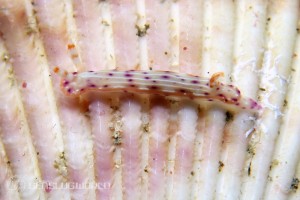
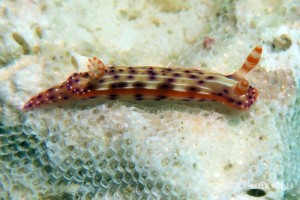
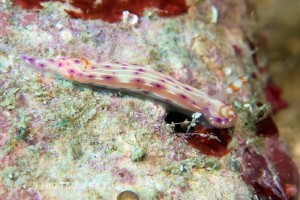
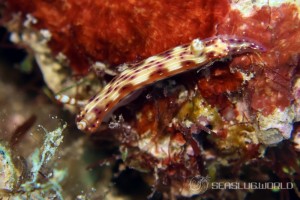





Same Genus Nudibranchs
Academic Database
Sea slug observation data is available in international marine biodiversity databases.