Showajidaia sagamiensis (Baba, 1937)
Description
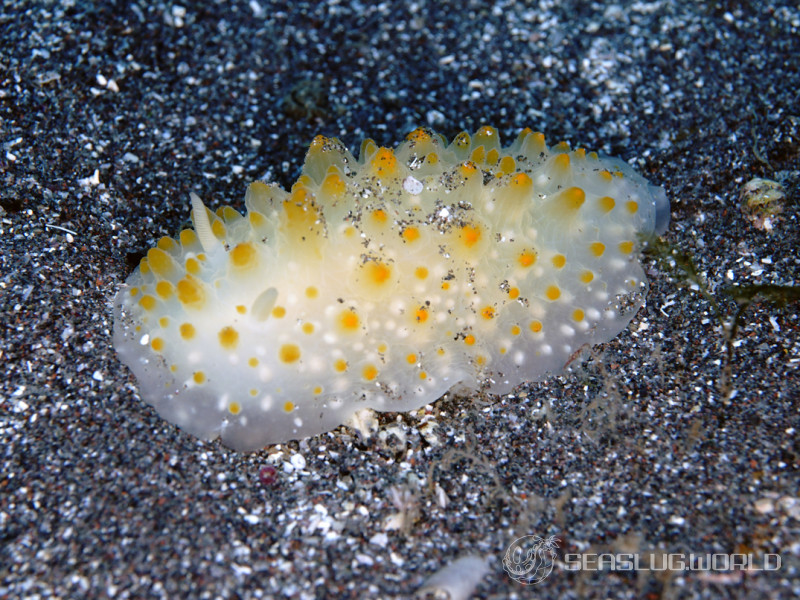
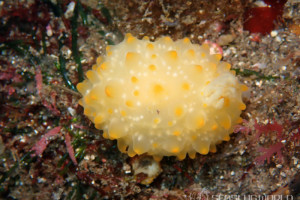
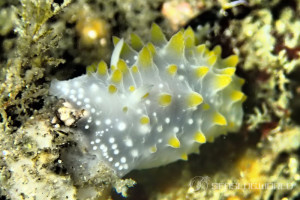
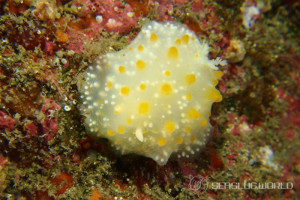
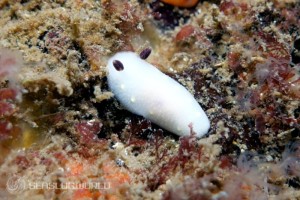
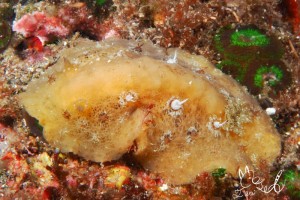
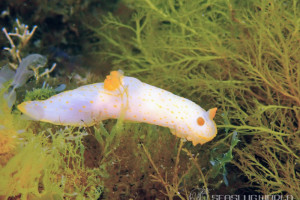
A doridiform nudibranch reaching 40-50 mm in length, oval in outline and almost equally rounded at both ends. The most striking feature is the dorsum, which is very sparsely covered with tubercles of various sizes: the smaller ones are granular and the larger ones rise as bluntly conical projections. The mantle is somewhat soft and projects well beyond the body all around, although during locomotion the tip of the foot may protrude slightly. The skin is well supplied with fine spicules. The rhinophores are stout, with a short cylindrical stalk bearing a perfoliate clavus, and are retractile into a sheath with an elevated, entire margin. There are 5 spreading branchial plumes arranged around the anal papilla; they are tripinnate and retractile within a low sheath whose margin is set with tubercles similar to those on the back. The head is small, the mouth a tiny slit-like opening, and the oral tentacles are short and triangular. The foot is abruptly rounded and bilabiate in front, with a notch in the middle of the upper lip, and ends in a bluntly pointed tail.The living animal is watery white with an orange tinge confined to the dorsal tubercles.
Distribution
Type locality: Amadaiba, Sagami Bay, Japan, at 50 fathoms; an additional type specimen was taken off Kameki in Sagami Bay at 40 fathoms. No reliable records are known from outside Japanese waters.Etymology
The specific epithet sagamiensis is a Latinised geographical adjective meaning "of Sagami (Bay)", referring to the type locality.Remarks
The species was originally described by Baba 1937 as a new species of Cadlina, together with Cadlina japonica from the same Sagami Bay material. Following the broader revision of dorid systematics by Korshunova et al. 2020, the species was transferred to the newly established genus Showajidaia, making Cadlina sagamiensis a former combination. The genus name Showajidaia is coined from the Japanese era name "Showa", paying tribute to Emperor Hirohito, who was himself a marine biologist.Baba separated this species from Cadlina japonica, described in the same paper, by the very sparse arrangement of dorsal tubercles, by labial hooks that are bifid at the distal end, and by a first lateral tooth bearing a large inner denticle and a series of smaller outer denticles. Externally the two species are easy to tell apart: Cadlina japonica has a dorsum densely covered with tubercles, whereas Showajidaia sagamiensis has a sparsely tuberculate back where bluntly conical projections stand out as orange-yellow accents on a watery, bluish-white ground.
References
- サガミウミウシ(新稱 ), Baba, K. 1937d. Two new species of the nudibranchiate genus Cadlina from Sagami Bay, Japan. Venus 7(2):75-80.
- サガミウミウシ, Baba K. (1949). Opisthobranchia of Sagami Bay collected by His Majesty the Emperor of Japan (相模湾産後鰓類図譜). Iwanami Shoten, Tokyo. 4+2+194+7 pp., pls. 1-50.
- Korshunova T., Fletcher K., Picton B., Lundin K., Kashio S., Sanamyan N., Sanamyan K., Padula V., Schrödl M. & Martynov A. (2020). The Emperor’s Cadlina, hidden diversity and gill cavity evolution: new insights for the taxonomy and phylogeny of dorid nudibranchs (Mollusca: Gastropoda). Zoological Journal of the Linnean Society. DOI: 10.1093/zoolinnean/zlz126/5741605.
A Kindle field guide by the site author

Kimoto N. (2026). Sea Slugs of Japan & the Indo-Pacific, 2nd Edition.
Kindle Edition
View on Amazon PR (Amazon Associates)Seasonality
Shooting Locations
Loading shooting locations...
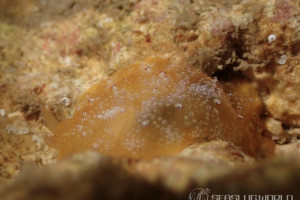
Photos of Showajidaia sagamiensis






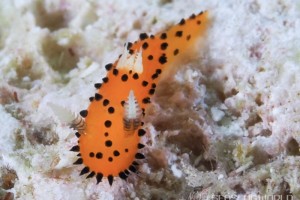
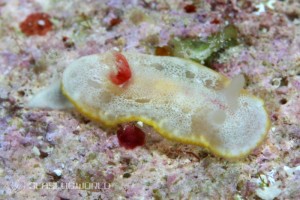
Similar Colors Nudibranchs
Academic Database
Sea slug observation data is available in international marine biodiversity databases.