Triopha maculata MacFarland, 1905
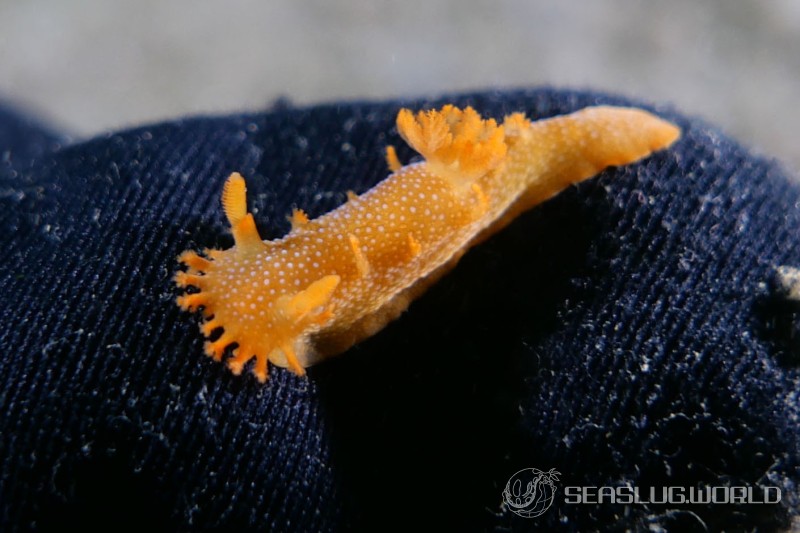
- Location
- Lifeguard Tower, San Diego, California, United States
- Date
- 2020/07/13
- Length
- ??mm
- Depth
- ??m
- Water temperature
- ??℃
What is the spotted triopha?
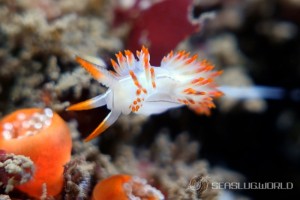
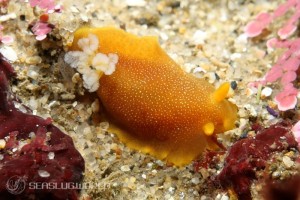
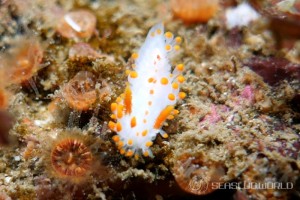
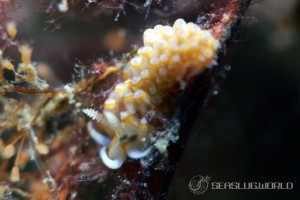
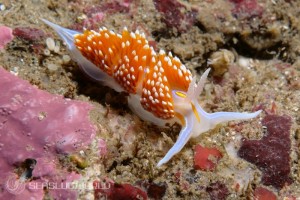
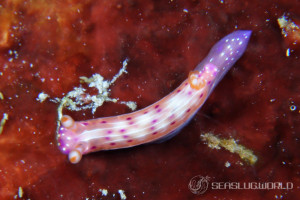
The spotted triopha (Triopha maculata) is a colourful orange-and-white nudibranch of the northeastern Pacific, with raised white spots scattered over a yellow-to-orange body and bushy, branched papillae along the edge of its oral veil.Description
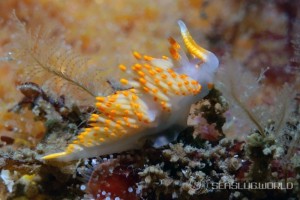
A polycerid nudibranch usually about 5 cm long, occasionally reaching 18 cm. The body colour varies widely, from pale translucent yellow through rich yellow, orange and red to dark brown. Its most distinctive feature is the scattering of raised, whitish spots over the body. The front edge of the head bears a row of bushy, branched papillae, and the tips of the dorsal appendages, rhinophores and gills are often orange.Distribution
Ranges in the northeastern Pacific from British Columbia, Canada, to Baja California, Mexico. It occurs from the intertidal into the shallow rocky subtidal.Etymology
The specific epithet maculata is Latin for "spotted", after the whitish spots scattered over the body.Remarks
It feeds on bryozoans. For many years it was treated as the same species as the widespread North Pacific Triopha catalinae, but a 2020 study separated the eastern Pacific populations as Triopha maculata. It differs from T. catalinae in having raised white spots on the body.References
- Triopha maculata n.sp., MacFarland F.M. (1905). A preliminary account of the Dorididae of Monterey Bay, California. Proceedings of the Biological Society of Washington. 18: 35-54.
- Triopha maculata, Jung D.-W., Gosliner T.M., Choi T.-J., Kil H.-J., Chichvarkhin A., Goddard J.H.R. & Valdés Á. (2020). The return of the clown: pseudocryptic speciation in the North Pacific clown nudibranch, Triopha catalinae (Cooper, 1863) sensu lato identified by integrative taxonomic approaches. Marine Biodiversity. 50(5): 84.
- Triopha maculata, Behrens D.W., Hermosillo A., Fletcher K. & Jensen G.C. (2022). Nudibranchs & Sea Slugs of the Eastern Pacific. Molamarine.
Featured in this book
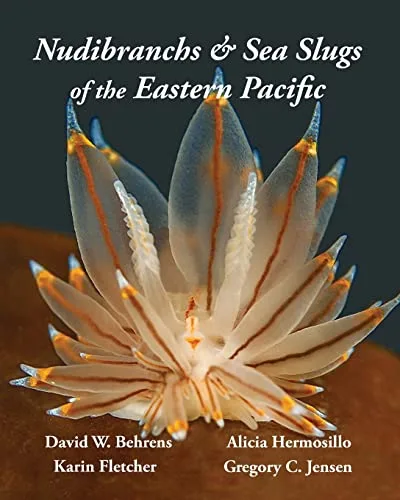
Behrens D.W., Hermosillo A., Fletcher K. & Jensen G.C. (2022). Nudibranchs & Sea Slugs of the Eastern Pacific. Molamarine.
Molamarine
This species, Triopha maculata, is included in the book.
View on Amazon PR (Amazon Associates)Seasonality
Shooting Locations
Loading shooting locations...
Photos of Triopha maculata

Same Genus Nudibranchs
Similar Colors Nudibranchs
Academic Database
Sea slug observation data is available in international marine biodiversity databases.