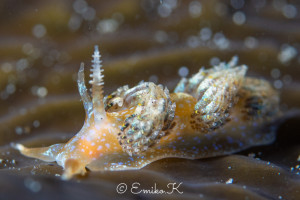
Dondice occidentalis (H. Engel, 1925)
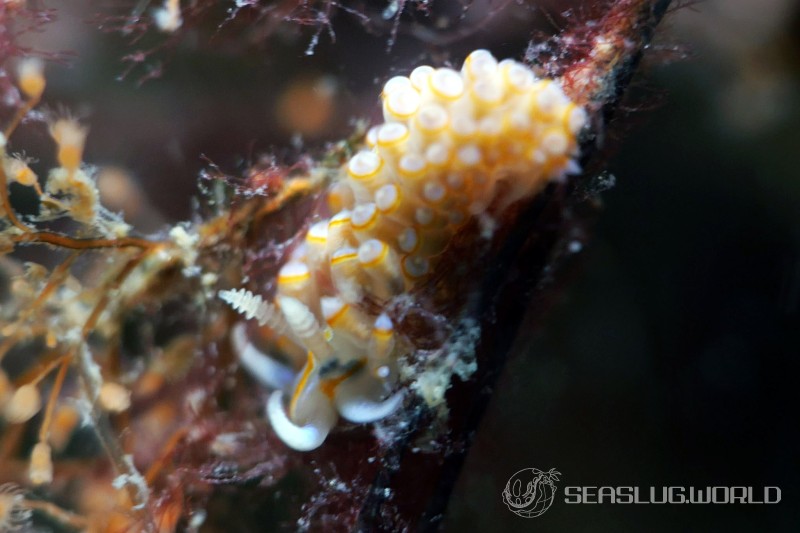
- Location
- Myrtle Beach, Bill Perry, South Carolina, United States
- Date
- 2021/08/04
- Length
- ??mm
- Depth
- ??m
- Water temperature
- ??℃
Description
A slender aeolid about 3 cm long. The translucent grey body bears a single yellow-to-orange (sometimes reddish) line running from the head to the tail, bordered on each side by a white band. The rhinophores are annulate (ringed), and the oral tentacles are longer than the rhinophores. Orange-tinged cerata are arranged in clusters along the back, and the animal may cast off its cerata when disturbed.Distribution
Widespread in the western Atlantic and Caribbean, from Florida, USA, and the Gulf of Mexico through the Caribbean islands and Central America to northern South America (as far as Brazil). It occurs from near the surface to about 26 m depth. The species was originally described from Jamaica.Etymology
The specific epithet occidentalis is Latin for “western,” after its distribution in the western Atlantic — the West Indies.Remarks
A hydroid feeder, preying on hydroids such as Eudendrium.References
- Caloria occidentalis n.sp., Engel H. (1925). Westindische opisthobranchiate Mollusken. Bijdragen tot de Dierkunde. 24: 33-80.
A Kindle field guide by the site author

Kimoto N. (2026). Sea Slugs of Japan & the Indo-Pacific, 2nd Edition.
Kindle Edition
View on Amazon PR (Amazon Associates)Seasonality
Shooting Locations
Loading shooting locations...
Photos of Dondice occidentalis

Similar Colors Nudibranchs

Academic Database
Sea slug observation data is available in international marine biodiversity databases.