For Kids Who Love Nudibranchs — Interview with Atsushi Ono, Part 1
We spoke with Atsushi Ono, the author of the field guide New Edition: Sea Slugs. If you come across any difficult words, try reading them with a grown-up!
—— When did you first see a nudibranch?
I came across them while working at Izu Ocean Park, diving to photograph fish and other marine life. But back then, there were still so many nudibranchs whose names were unknown. Even the field guides just listed them as "one species of sea slug."
—— What made you want to create a book about nudibranchs?
Researchers overseas were steadily identifying nudibranchs that scientists in Japan didn't yet know about. Here in Okinawa, where I live now, there's a university professor studying nudibranchs, so research was more advanced than on the main Japanese islands. That's when I thought it was time to make a book.
—— Was it fun making a nudibranch book?
Because nudibranch research is still young, there's this puzzle-like thrill to it: you almost understand something, and then as the pieces come together one by one, it starts to make sense. It was really fun.
—— Is nudibranch research in Japan still behind?
Detailed research only really began recently. Especially among the aeolid nudibranchs of mainland Japan, there are many whose genus and even family are still unknown. Someone reading this might be the very person who studies them someday. There's a lot to look forward to!
—— Could you tell us about a nudibranch you were especially glad to find?
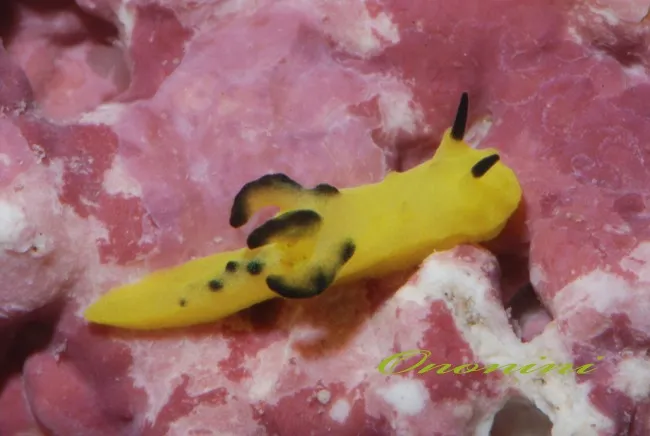
I was thrilled when I found a perfect specimen of the Bornella anguilla (tachi-aoi umiushi). It's a rare one — maybe just one individual shows up per year. I had found them a few times before, but always with damage to the appendages in front of the gills.
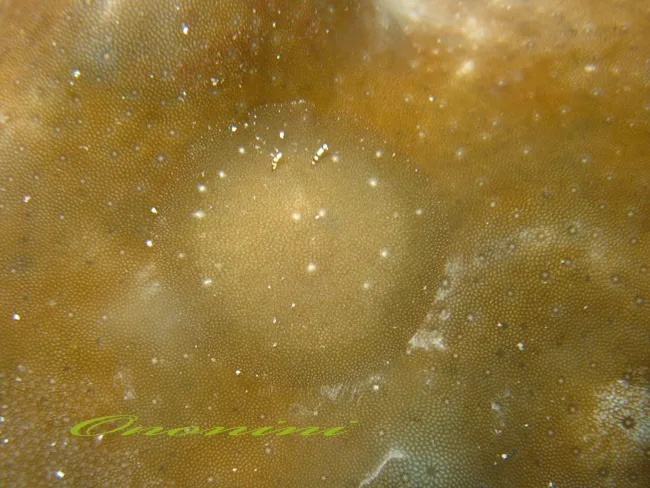
—— What's the smallest nudibranch you've ever seen?
About 1.5 mm, I think. But when someone else finds a really tiny one, it can be hard for me to see it — so I use a magnifying loupe.
—— Have you noticed any changes in Japan's nudibranchs?
Where nudibranchs can be found keeps shifting all the time. But honestly, I feel like their numbers have been declining over the past twenty years.
—— Are there any nudibranchs you'd like enthusiasts to take on as a challenge?
First, try looking up photos of the sentenro-umiushi (Hypselodoris placida) and niyori-sentenro-umiushi online, using my field guide as a reference, and see if you can tell them apart. These two were once grouped together as a single "sentenro-umiushi," but they turned out to be different species — and they look incredibly similar. When you grow up and start diving, try searching for them and taking your own photos!
Next, try the Gymnodoris group (kinuhada-no-nakama). There are SO many of them — it's really tough, but I promise it's fun.
Once you've learned even more about nudibranchs, try searching for cryptic species — species that haven't been classified yet. Just like the sentenro-umiushi example, there are still many nudibranchs that look similar but may actually be different species. And if you find a nudibranch that isn't in any field guide, it might even be a brand-new species no one has discovered yet!
—— How should we take photos to help identify a nudibranch in a field guide?
Take a look at the field guide first to see what features are used to tell species apart. And don't just shoot from the side — take photos from directly above, from the front, from behind, from lots of different angles.
—— What did you focus on when making New Edition: Sea Slugs?
When I was a kid, I grew up reading lots of field guides. So I really tried to put myself in the shoes of the reader — thinking hard about what would be easy to use, and how to help people find what they want to know.
Since this field guide covers nudibranchs found in Japan, I avoided using photos taken overseas. I chose photos of adult specimens with as little damage as possible, and used the standard Japanese common names throughout.
—— Who do you hope will read the book?
Adults, of course — but there are also many elementary-school nudibranch fans, so I really hope anyone interested will pick it up.
I've had kids send me photos and videos of nudibranchs they caught and kept in their own aquariums, and some have even brought me handmade nudibranch crafts. A few came to meet me with their parents. Some I still haven't been able to meet, because our schedules didn't line up. I often wonder how they're all doing.
I hope this book can give them something to dream about.
—— Could you share one final message?
People often say "let's protect biodiversity" — but have you ever wondered why there are so many different kinds of nudibranchs in the world? Will this amazing diversity continue forever? What about climate change, typhoons, and coastal development — could they make life harder for nudibranchs? Some species might disappear. But life always finds a way. That's the strength and resilience of living things — I hope you'll take the time to see it.
Enjoyed this post? You can tip the author directly —
Tip this post