Bornella anguilla S. Johnson, 1984
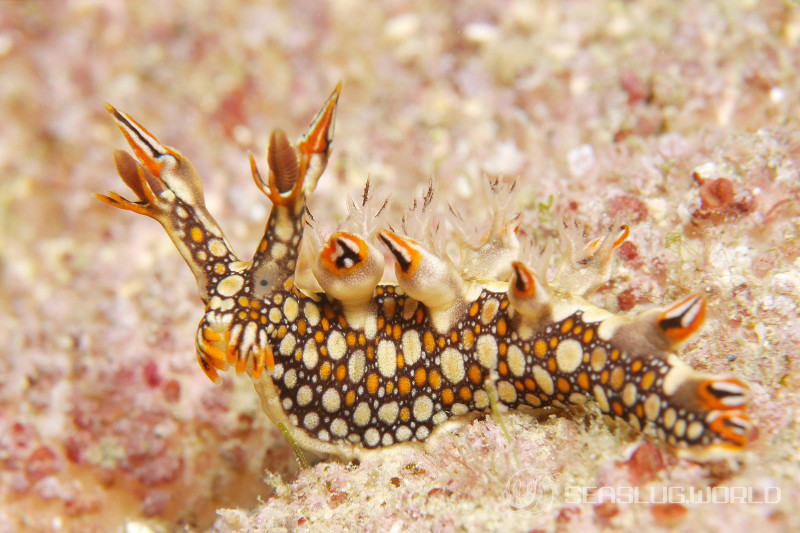
- Location
- Sunabe Water Treatment Plants, Okinawa Island (Chatan and Southern area), Okinawa, Japan
- Date
- 2017/04/04
- Length
- 30mm
- Depth
- 8.0m
- Water temperature
- 21.0℃
Description
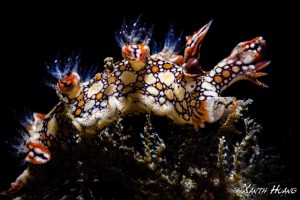
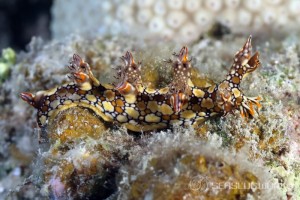
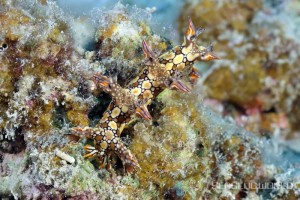
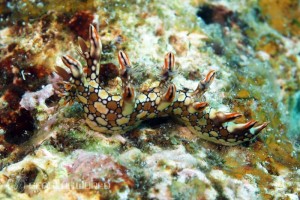
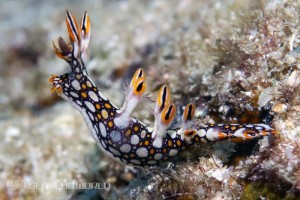
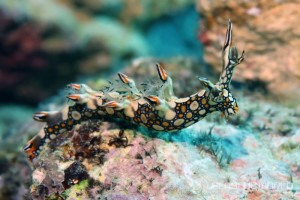
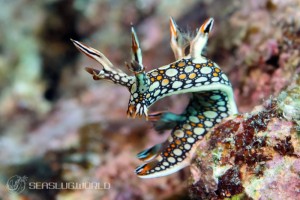
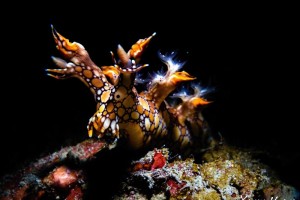
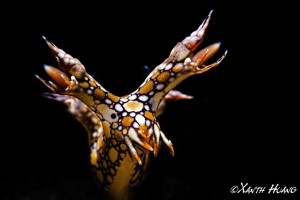
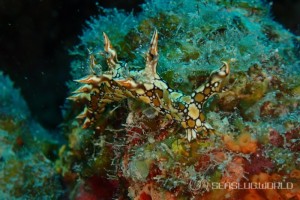
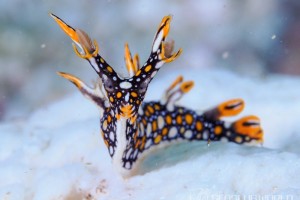
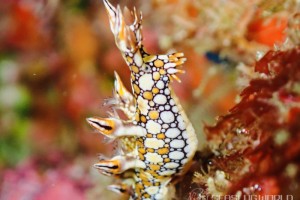
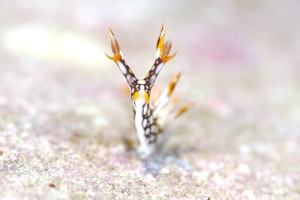
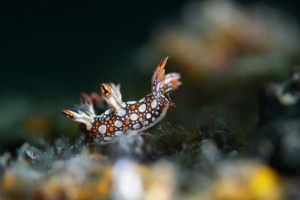
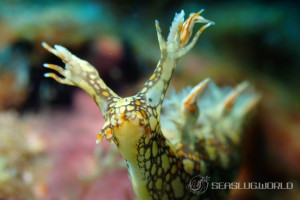
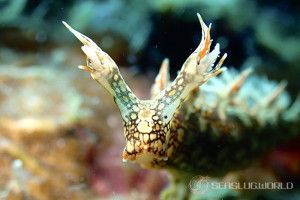
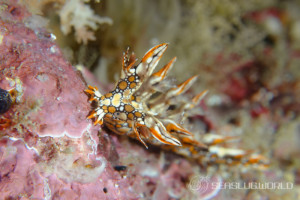
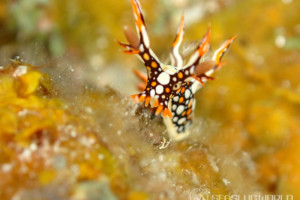
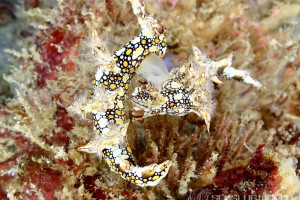
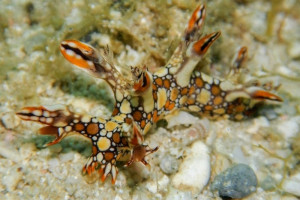
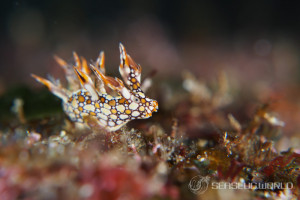
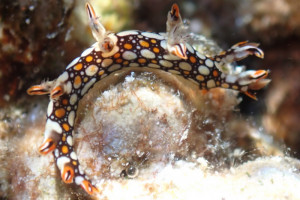
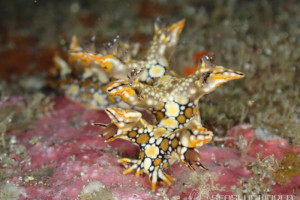
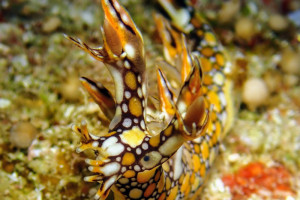
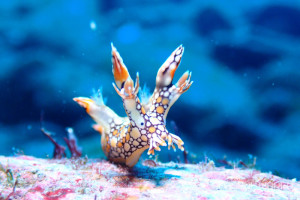
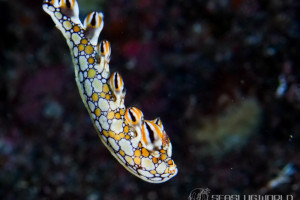
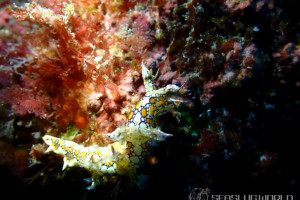
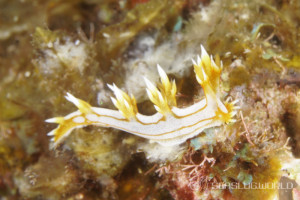
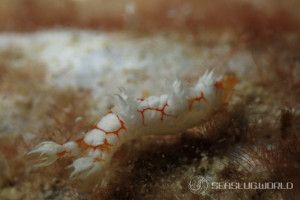
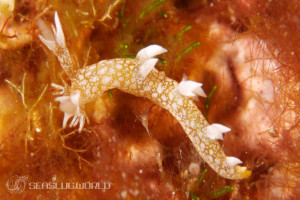
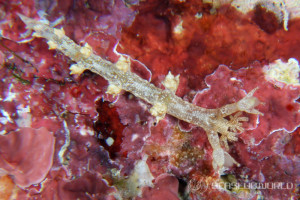
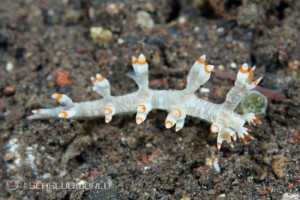
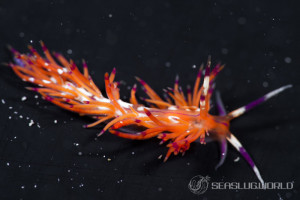
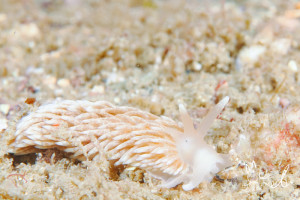
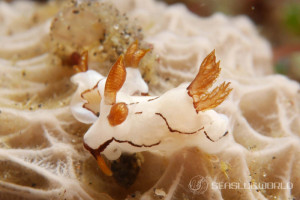
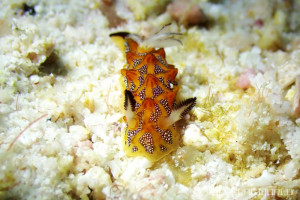
The body is elongate and limaciform, with a long tapering posterior foot. Living animals are usually 40–50 mm long, but reach up to 120 mm in exceptional specimens.The body bears a characteristic mosaic-like colour pattern. A dark-coloured network encloses variably sized patches of white-cream, yellow, orange or light brown ground colour. Scattered opaque white granules dot the dorsum. The papillae of the oral tentacles and the upper edge of the rhinophore sheaths are orange with white tips. The posterior sail-like papilla of the rhinophore sheaths is bordered on each side with an orange line and shows a central, vertical, dark brown stripe down each side. The upper paddle-like flap of each dorsolateral process matches the rhinophore sail in colour, while their cream-yellow bases carry a light brown to purple vertical band on each side.
On either side of the mouth a flattened lobe-like oral tentacle bears up to six elongate papillae along its margin. The rhinophores are perfoliate with 15 to 25 lamellae and are light peach in colour. Each rhinophore sheath bears three long narrow anterior and anterolateral papillae and a taller, strongly laterally compressed, unbranched posterior sail. Behind the rhinophores there are three pairs of dorsolateral processes followed by three unpaired dorsal processes along the dorsal midline. Each dorsolateral process is topped by a paddle-like flap matching the rhinophore sail, with three tripinnate white gills on the inner surface.
The radula bears seven to eleven denticles on either side of the median cusp, and the outer laterals are strikingly blade-like with long basal portions. The posterior chamber of the stomach carries about 30 longitudinal rows of brown chitinous spines. The penial sac contains a fleshy disc-like structure, the penial papilla, bearing an irregular ring of chitinous hooks around its inner edge.
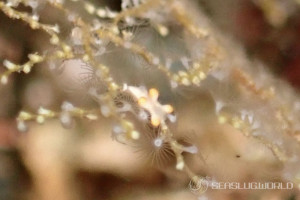
This species feeds on hydroids of the genus Plumularia. While most species of Bornella swim by lateral flexion of the body, B. anguilla swims with an eel-like muscular wave running down the body — the trait reflected in its specific epithet.
Distribution
Widely distributed across the Indo-West Pacific. The type locality is the Marshall Islands. Recorded from South Africa, Madagascar, Réunion, Mauritius, India, Myanmar, Thailand, Vietnam, China, Taiwan, the Philippines, Indonesia, Malaysia, Papua New Guinea, Australia, Vanuatu, Fiji, New Zealand, Hawaii, the Pitcairn Islands region, and Japan.Etymology
The specific epithet anguilla is Latin for "eel", referring to the species's distinctive eel-like swimming, in which a muscular wave travels along the body.Remarks
This is the largest species in the genus. Although it was originally reported as strictly nocturnal in the Marshall Islands, it is sometimes seen out in the open in broad daylight elsewhere.Bornella anguilla is readily distinguished from Bornella stellifera and Bornella hermanni by its mosaic-like colour pattern, the paddle-like flaps on the posterior of the rhinophore sheath and on each dorsolateral process, and the broad, semicircular arrangement of penial spines.
References
- アングイラ, 小野篤司. (1999). ウミウシガイドブック. TBSブリタニカ.
- ゴシキユビウミウシ, 奥谷喬司. (2000). 日本近海産貝類図鑑. 東海大学出版会.
- ブルネラ・アングイラ, 殿塚孝昌. (2003). ウミウシガイドブック〈3〉. TBSブリタニカ.
- ヒオドシユビウミウシ, 小野篤司. (2004). 沖縄のウミウシ. ラトルズ.
- ヒオドシユビウミウシ, 中野理枝. (2004). 本州のウミウシ. ラトルズ.
- ヒオドシユビウミウシ, 小野篤司 & 加藤昌一. (2009). ウミウシ. 誠文堂新光社.
- Bornella anguilla Johnson, 1984, Pola M., Rudman W.B. & Gosliner T.M. (2009). Systematics and preliminary phylogeny of Bornellidae (Mollusca: Nudibranchia: Dendronotina) based on morphological characters with description of four new species. Zootaxa. 1975(1): 1-57. https://doi.org/10.11646/zootaxa.1975.1.1
- Bornella anguilla, Terrence Gosliner, Ángel Valdés and David Behrens. (2015). Nudibranch and Sea Slug Identification Indo-Pacific. New World Pubns Inc.
Featured in this book
Terrence Gosliner, Ángel Valdés and David Behrens. (2018). Nudibranch and Sea Slug Identification Indo-Pacific 2nd Edition. New World Pubns Inc.
New World Publications
This species, Bornella anguilla, is included in the book.
View on Amazon PR (Amazon Associates)Seasonality
Shooting Locations
Loading shooting locations...
Photos of Bornella anguilla
Tag:

















Same Genus Nudibranchs

Similar Colors Nudibranchs

Academic Database
Sea slug observation data is available in international marine biodiversity databases.