Halgerda indotessellata Tibiriçá, Pola & Cervera, 2018
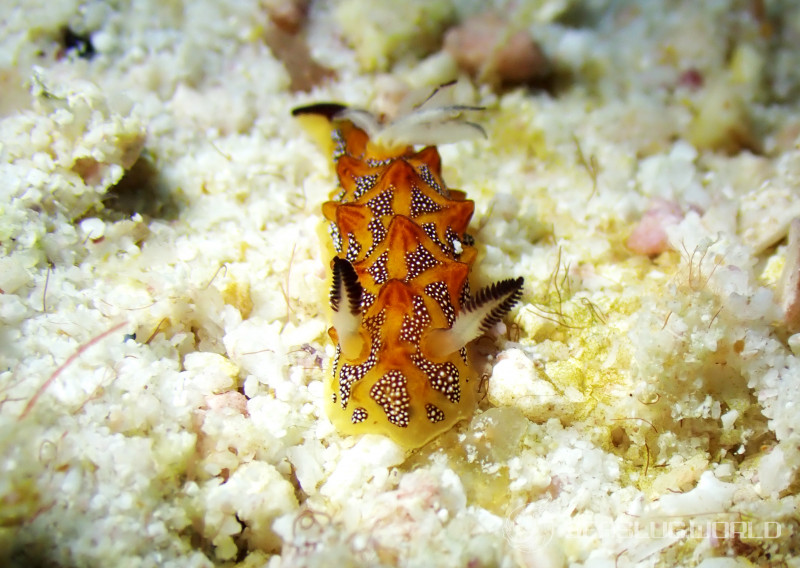
- Location
- Seychelles
- Date
- Length
- 15mm
- Depth
- 14.0m
- Water temperature
- 26.0℃
Description
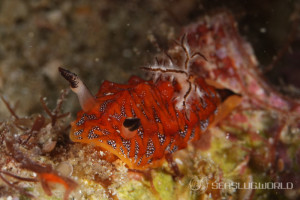
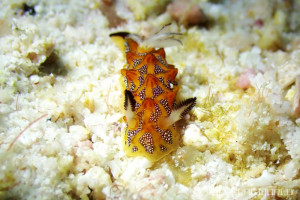
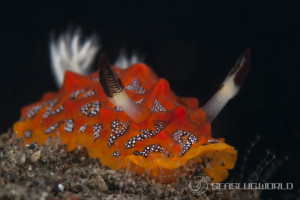
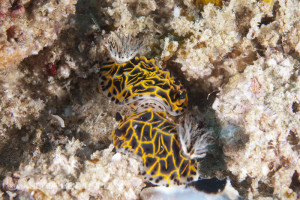
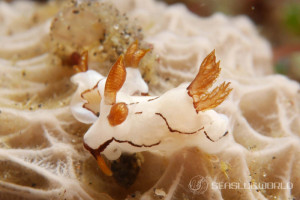
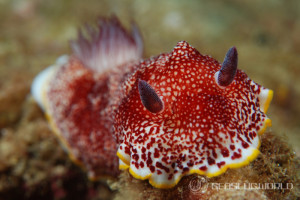
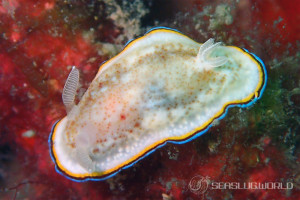
A medium-sized halgerdid with a body very similar in external appearance to its sister species Halgerda tessellata. The body is semi-firm and gelatinous, with sharp net-like yellow ridges crossing the dorsum that meet at slightly raised, angular intersections. The ridges and the mantle margin are bright yellow, while the depressions between them are brownish with scattered fine white dots. A dark brown longitudinal stripe runs along the dorsal midline from the head, past the gill pocket, toward the tail. The rhinophores and gills are white with longitudinal dark brown lines or speckling. As in other members of the genus, the rhinophoral and branchial sheaths are low and smooth, and the dorsum lacks caryophyllidia.Live specimens of Halgerda indotessellata are nearly indistinguishable in the field from the Pacific H. tessellata. The two species are clearly separated by COI sequence divergence and by subtle differences in the reproductive system.
Distribution
Type locality: Paindane, Mozambique (20–25 m depth). Reported mainly from the western Indian Ocean — Mozambique, Tanzania (Zanzibar), Kenya (Diani), Mayotte Island, and South Africa. The molecular phylogeny of a 2023 study also assigns specimens from the Philippines (Maricaban Island and Verde Island) to this species, indicating that its range extends into the western Pacific. Many records from the Indian Ocean previously identified as Halgerda tessellata are now referable to H. indotessellata.Etymology
The specific epithet indotessellata is a compound of the prefix indo- ("of the Indian Ocean") and the existing species name Halgerda tessellata, marking this species as the long-overlooked Indian Ocean lineage of the tessellata complex.Remarks
Described by Tibiriçá, Pola & Cervera in their systematic revision of Mozambican Halgerda (Invertebrate Systematics 32, 2018) as one of six new species. H. indotessellata is effectively a pseudocryptic species of H. tessellata: nearly identical externally but consistently separated by molecular markers and by geographic distribution. In the molecular phylogeny of a 2023 study it forms a well-supported clade together with H. tessellata, Halgerda mozambiquensis, and Halgerda maaikeae, representing the western Indian Ocean to western Pacific lineage of the group.References
- Halgerda indotessellata Tibiriçá, Pola & Cervera, 2018, Tibiriçá Y., Pola M. & Cervera J.L. (2018). Astonishing diversity revisited: an annotated and illustrated catalogue of nudibranch and sea slug species occurring in southern Mozambique (Indo-West Pacific). Zootaxa. 4378(4): 451-503. https://doi.org/10.11646/zootaxa.4378.4.1
- Halgerda sp. 6, Terrence Gosliner, Ángel Valdés and David Behrens. (2018). Nudibranch and Sea Slug Identification Indo-Pacific 2nd Edition. New World Pubns Inc.
- Halgerda indotessellata sp. nov., Tibiriçá Y., Pola M. & Cervera J.L. (2018). Systematics of the genus Halgerda Bergh, 1880 (Heterobranchia: Nudibranchia) of Mozambique with descriptions of six new species. Invertebrate Systematics. 32(6): 1388-1421. https://doi.org/10.1071/IS17095
- Halgerda indotessellata Tibiriçá, Pola & Cervera, 2018, Donohoo S.A., Villalobos S.G., Hallas J.M. & Gosliner T.M. (2023). Hyperdiversity of the genus Halgerda Bergh, 1880 (Nudibranchia: Discodorididae) with descriptions of fourteen new species. Marine Biodiversity. 53(3): 42. https://doi.org/10.1007/s12526-022-01334-9
Featured in this book
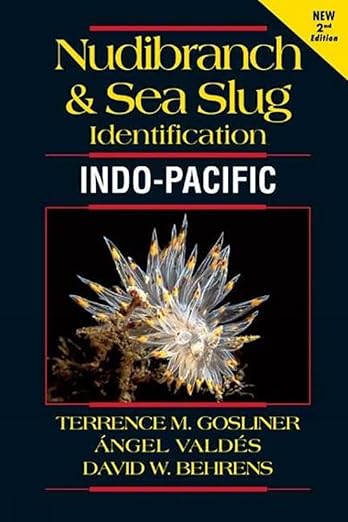
Terrence Gosliner, Ángel Valdés and David Behrens. (2018). Nudibranch and Sea Slug Identification Indo-Pacific 2nd Edition. New World Pubns Inc.
New World Publications
This species, Halgerda indotessellata, is included in the book.
View on Amazon PR (Amazon Associates)Seasonality
Shooting Locations
Loading shooting locations...
Photos of Halgerda indotessellata




Same Genus Nudibranchs
Similar Colors Nudibranchs

Academic Database
Sea slug observation data is available in international marine biodiversity databases.