Halgerda willeyi Eliot, 1904
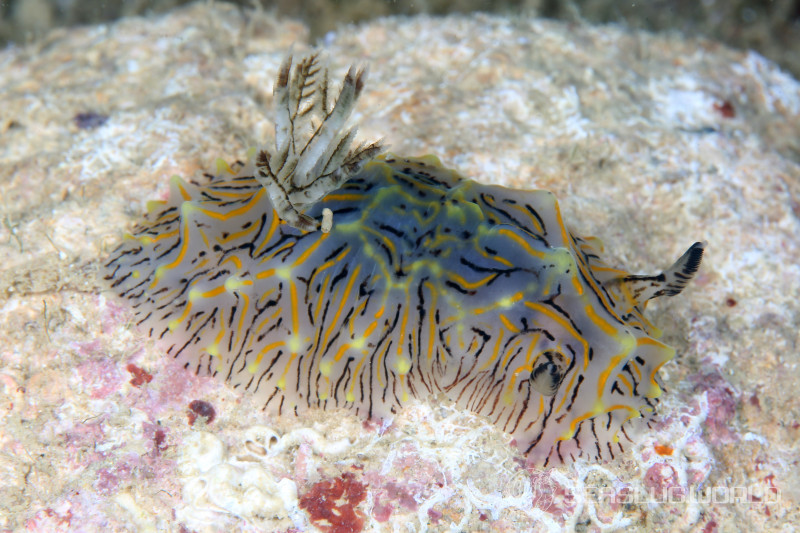
- Location
- Tengan(Kombu), Okinawa Island (East coast), Okinawa, Japan
- Date
- 2015/06/25
- Length
- 30mm
- Depth
- 5.0m
- Water temperature
- 28.0℃
Description
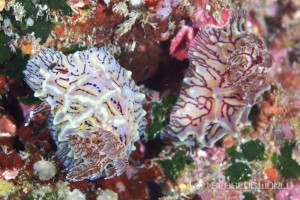
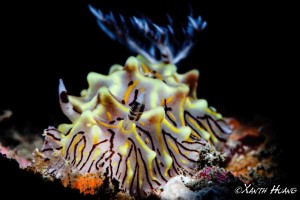
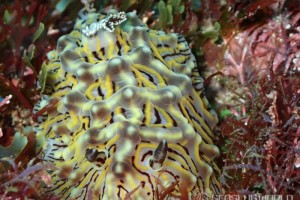
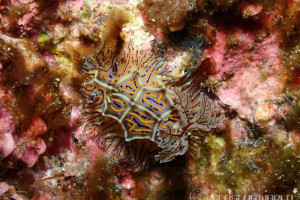
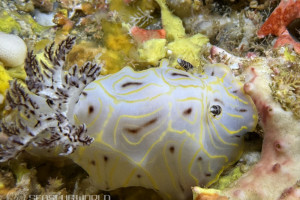
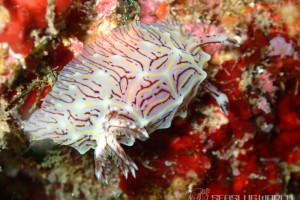
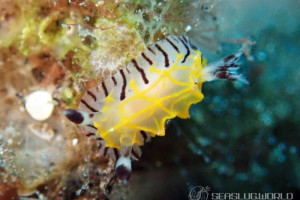
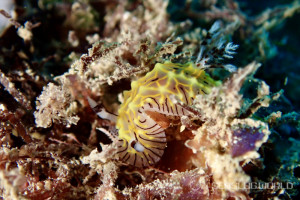
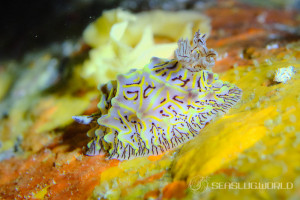
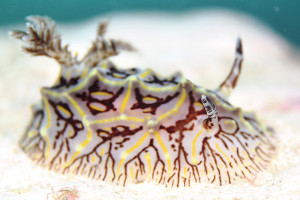
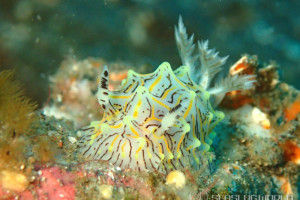
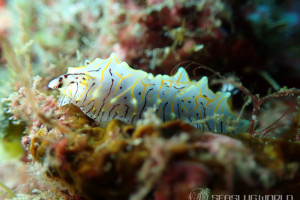
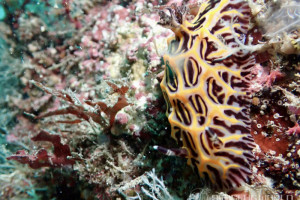
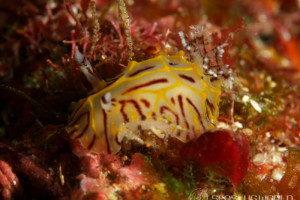
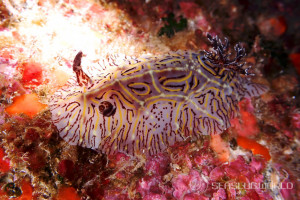
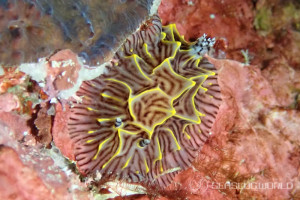
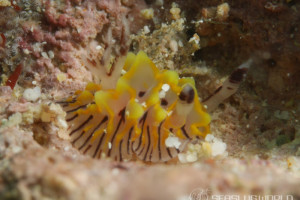
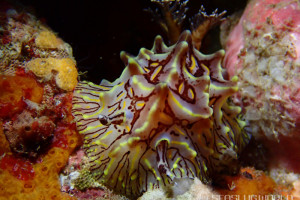
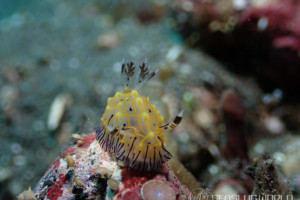
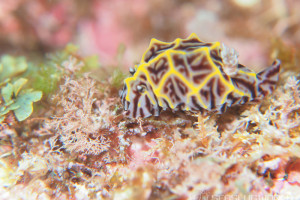
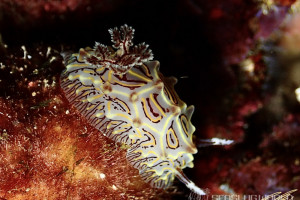
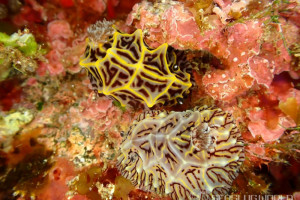
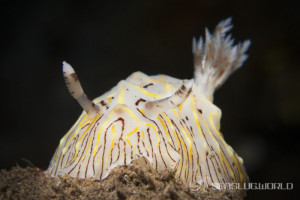
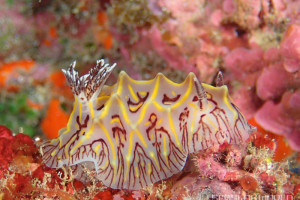
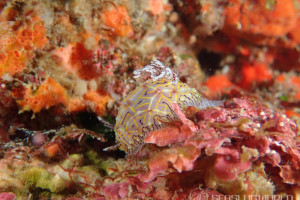
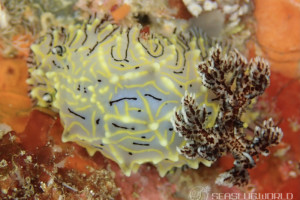
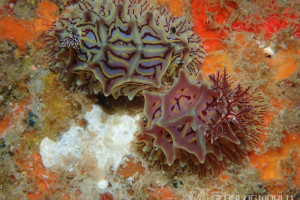
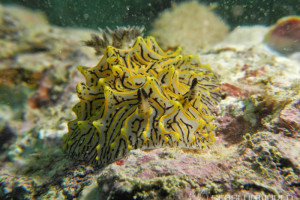
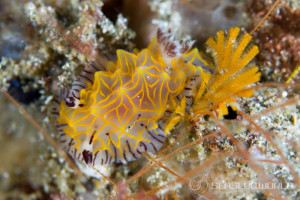
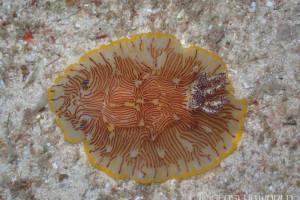
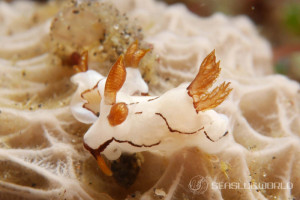
A translucent white dorid with a series of low, irregular yellow to orange ridges on the dorsum and prominent yellow to orange tubercles at the ridge junctions. The valleys between ridges bear thick dark-brown to black lines, and short perpendicular black lines radiate along the mantle edge. The central tubercles are often ringed with a diffuse brown pigment. Rhinophores are translucent white with a posterior dark-brown stripe; lamellae carry numerous lateral black spots. The gill consists of two branchial plumes, each splitting into three large mostly bipinnate branches, translucent white with brown stripes along the dorsal and lateral surfaces of the rachis. Adult specimens typically measure 15–35 mm in preserved length, reaching about 50 mm at maximum.Distribution
Type locality: Lifu (Lifou), Loyalty Islands, New Caledonia. Widely distributed across the western Pacific and adjacent waters, with records from the Ryukyu Islands (Japan), the Philippines, Indonesia, Papua New Guinea, Australia, Vanuatu, the Marshall Islands, and the Khuriya Muriya Islands off Oman.Etymology
Named in honour of the British zoologist Arthur Willey.Remarks
A 2023 study, based on integrative molecular and morphological revision, synonymized Halgerda elegans Bergh, 1905 — long treated as a separate species — with Halgerda willeyi, regarding it as a juvenile color form of the latter. The same study showed that Red Sea and Gulf of Tadjoura specimens previously identified as H. willeyi represent a distinct species, Halgerda paulayi Donohoo & Gosliner, 2023. The animal is encountered crawling in the open or under rocks on shallow tropical reefs, feeding on sponges.References
- Halgerda willeyi n.sp., Eliot C.N.E. (1904). On some nudibranchs from East Africa and Zanzibar. Part III. Dorididae Cryptobranchiatae. I. Proceedings of the Zoological Society of London. 1903(2): 354-385, plates XXXII-XXXIII.
- パイナップルウミウシ (新称: pineapple海牛), Fukuda H., 1994. Marine Gastropoda (Mollusca) of the Ogasawara Islands (Bonin) Islands. Part 2 : Neogastropoda, Heterobranchia and fossil species, with faunal accounts. Ogasawara Research 20, 1-126
- メイズウミウシ(仮称), 益田一. (1999). 海洋生物ガイドブック. 東海大学出版会.
- ハルゲルダ属の一種, 殿塚孝昌. (2003). ウミウシガイドブック〈3〉. TBSブリタニカ.
- パイナップルウミウシ, 中野理枝. (2004). 本州のウミウシ. ラトルズ.
- パイナップルウミウシ, 中野理枝. (2018). 日本のウミウシ. 文一総合出版.
- Halgerda willeyi, Terrence Gosliner, Ángel Valdés and David Behrens. (2018). Nudibranch and Sea Slug Identification Indo-Pacific 2nd Edition. New World Pubns Inc.
- Halgerda willeyi Eliot, 1904, Donohoo S.A., Villalobos S.G., Hallas J.M. & Gosliner T.M. (2023). Hyperdiversity of the genus Halgerda Bergh, 1880 (Nudibranchia: Discodorididae) with descriptions of fourteen new species. Marine Biodiversity. 53(3): 42. https://doi.org/10.1007/s12526-022-01334-9
Featured in this book
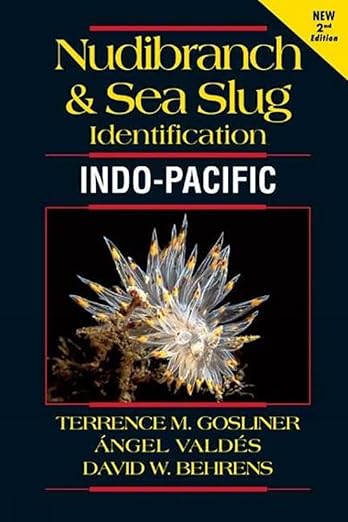
Terrence Gosliner, Ángel Valdés and David Behrens. (2018). Nudibranch and Sea Slug Identification Indo-Pacific 2nd Edition. New World Pubns Inc.
New World Publications
This species, Halgerda willeyi, is included in the book.
View on Amazon PR (Amazon Associates)Seasonality
Shooting Locations
Loading shooting locations...
Photos of Halgerda willeyi
Tag:

























Same Genus Nudibranchs
Similar Colors Nudibranchs
Academic Database
Sea slug observation data is available in international marine biodiversity databases.