Halgerda elegans Bergh, 1905
Description
The Latin diagnosis of the genus Halgerda from the original description reads:Corpus subdepressum, subrigidum, cancellatum dorso. Branchia paucifoliata, foliis tripinnatis. Tentacula parva, conica. Armatura labialis nulla. Lingua rhachide angusta nuda, pleuris multiserialis et multidentatis, dentibus hamatis, externis interdum serrulatis. Prostata magna, penis inermis.— body somewhat depressed and rather firm, the dorsum cancellate (with a network of ridges); gill of few tripinnate leaves; rhinophores small and conical; jaws unarmed; radula with a narrow naked rachis and broad pleurae bearing many series of many teeth, the teeth hooked, the outer ones sometimes finely serrate; prostate large; penis unarmed.
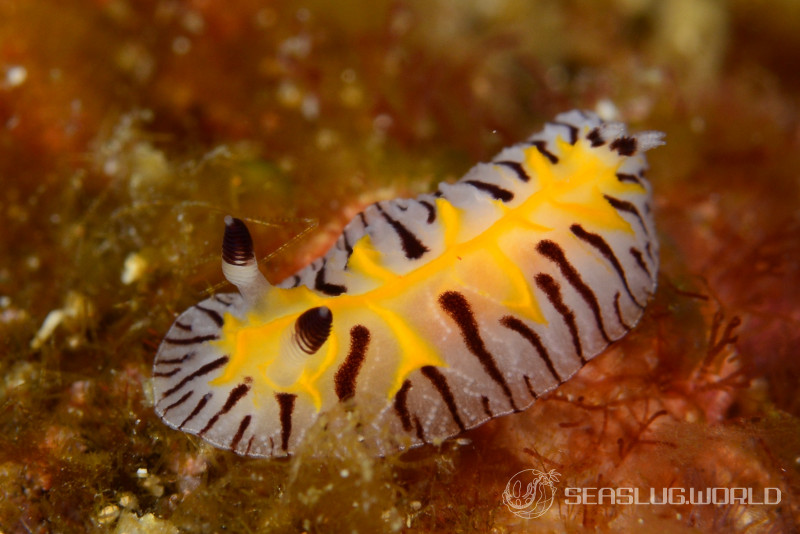
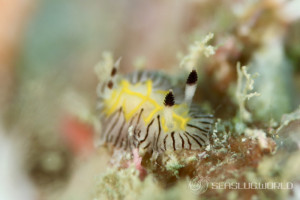
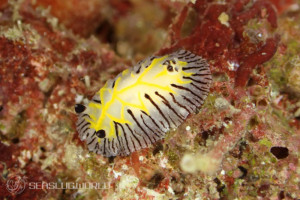
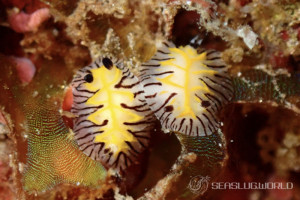
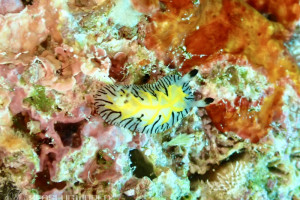
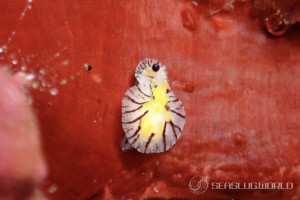
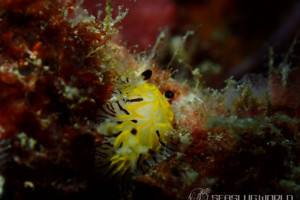
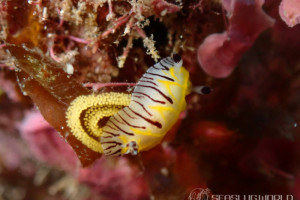
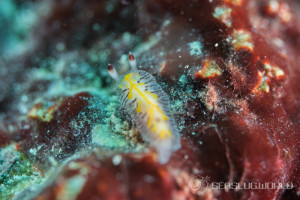
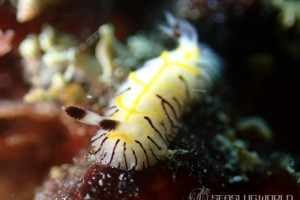
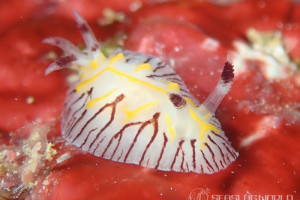
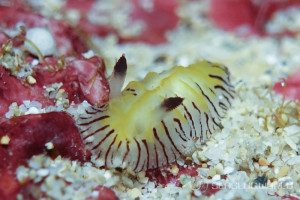
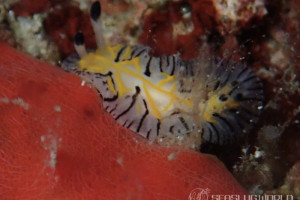
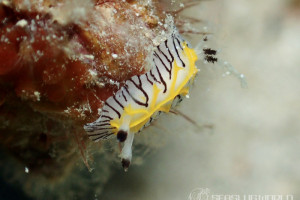
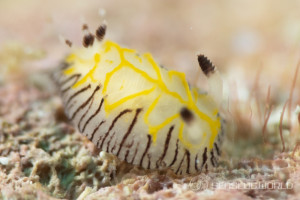
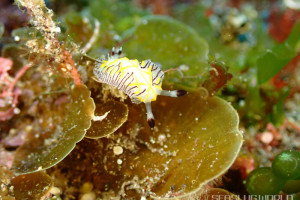
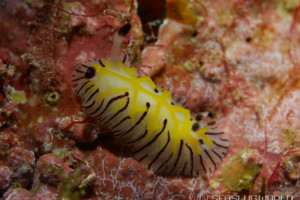
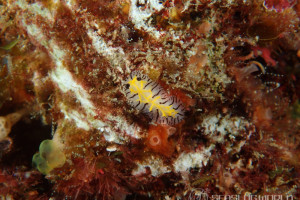
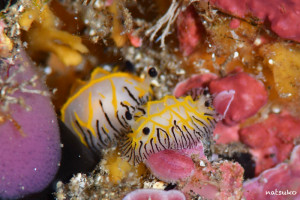
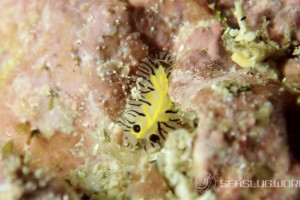
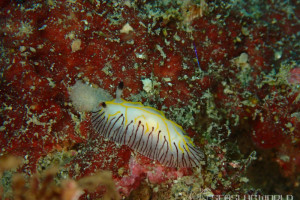
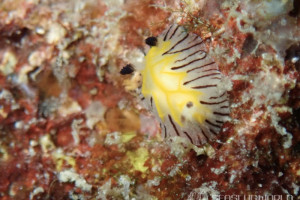
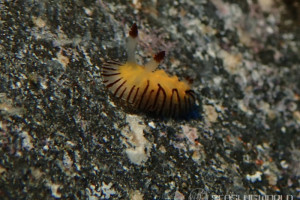
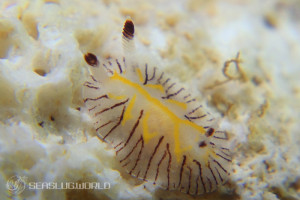
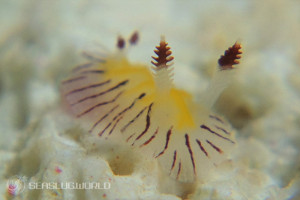
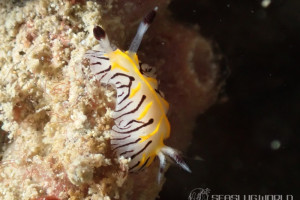
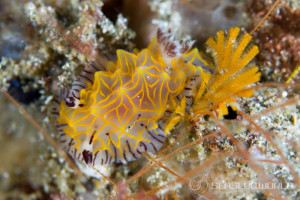
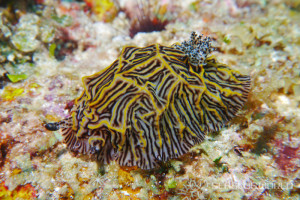
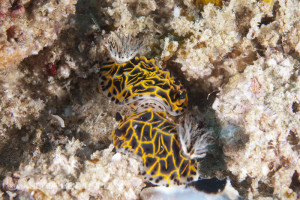
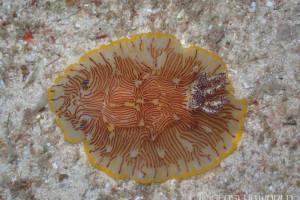
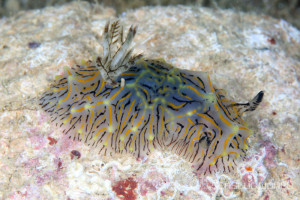
The original description is based on a single specimen collected on 12 February 1899 about 2.5 nautical miles off Gunong-Api (an active volcanic island in the Banda Sea), Siboga Expedition station 310, drawn from life and preserved in formalin. Bergh's field notes: in life the animal measured 13 mm long and 6 mm wide; the dorsal ground colour was pale greenish grey, the longitudinal ridges crossing the dorsum were yellow, the proper dorsum carried fine black transverse stripes, and small similar black spots scattered onto the mantle border. The rhinophores and gill were blackish.
The alcohol-preserved specimen measured 13 mm long, 8 mm wide, 6 mm high, with a 2 mm gill opening and a 2 mm foot width. The ground colour is milky white, with sparsely scattered short stripes and spots on the dorsum; the rhachides of the rhinophores and gill are black, and blackish spots also occur on the underside of the mantle border, especially along the body sides. Bergh writes:
Am Rücken fanden sich 3 Reihen von gerundeten Knoten, eine mediane und jederseits eine laterale, am Gebräm noch einige kleinere, vor den klaftenden runden Rhinophoröffnungen ein medianer Knoten und hinter der (ähnlichen) Kiemenöffnung 2 laterale. Die Knoten durch niedrige Leisten verbunden, und der Rücken dadurch undeutlich gefeldert.— three rows of rounded nodes occur on the dorsum, a median one and a lateral one on each side, with a few smaller ones on the mantle border, a median node in front of the rhinophore openings and two lateral ones behind the gill opening; the nodes are connected by low ridges, faintly dividing the dorsum into fields. The rim of the gill opening is smooth; the gill consists of six leaves; the anal papilla is rather stout and white.
The oral tube measures 2 mm long. The pharyngeal bulb together with the strongly projecting radular sheath is 5 mm long. The radula has 20 rows (plus 22 in the sheath, of which the two hindmost are immature), totalling 42 rows. The rachis is very narrow; up to 65 teeth occur on each side. The teeth are colourless; the outermost five measure 0.013-0.02-0.03-0.045-0.08 mm in height, the largest near the middle of the inner radula reach 0.28 mm, then drop again to 0.035 mm. Their shape is the usual hooked form (Fig. 36-40); the outermost three or four are upright with finely serrate edges (Fig. 40).
Co-occurring variety
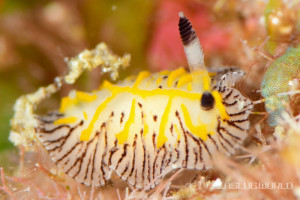
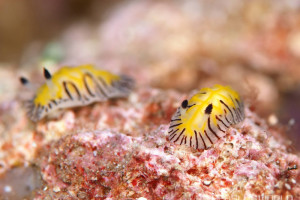
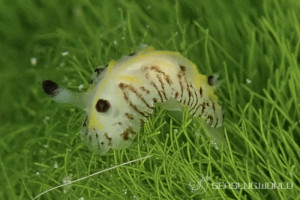
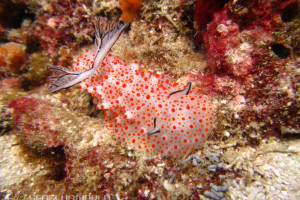
The original account (p.126) also describes a variety (var.) from the same locality off Gunong-Api (station 310), reported as a separate individual. In life it was slightly shorter and broader, with the same greenish-grey ground colour but, in place of the yellow ridge network, with rather large yellow blotches accompanied by short black stripes; the rhinophores and gill again appeared black. After preservation the ground colour became milky white with scattered spots and short stripes; the rhinophores and gill remained black.Distribution
Type locality: about 2.5 nautical miles off Gunong-Api (an active volcanic island in the Banda Sea), Indonesia (Siboga Expedition station 310, collected 12 February). The species ranges across the tropical Indo-West Pacific.Etymology
The specific epithet elegans is the Latin adjective meaning "elegant, refined", in reference to the striking geometric pattern of yellow ridges on a pale greenish ground.Remarks
Described as a new species, and the current combination has remained stable. Of his own genus Bergh wrote that "ihre Stellung dieser Gattung im System der cryptobranchialen Doriden ist sehr zweifelhaft" — its position within the cryptobranchiate dorids was very doubtful — and listed five species then known to him: H. formosa Bgh., H. elegans Bgh. n. sp., H. rubra Bgh. n. sp., H. Willeyi Eliot and H. Wasinensis Eliot.References
- Halgerda elegans Bgh. n. sp., Bergh R. (1905). Die Opisthobranchiata der Siboga-expedition. https://doi.org/10.5962/bhl.title.11223
- ハルゲルダ・アルボクリスタタ, 殿塚孝昌. (2003). ウミウシガイドブック〈3〉. TBSブリタニカ.
A Kindle field guide by the site author
Kimoto N. (2026). Sea Slugs of Japan & the Indo-Pacific, 2nd Edition.
Kindle Edition
View on Amazon PR (Amazon Associates)Seasonality
Shooting Locations
Loading shooting locations...
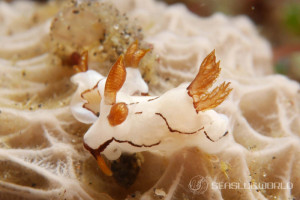
Photos of Halgerda elegans
Tag:

























Same Genus Nudibranchs
Similar Colors Nudibranchs
Academic Database
Sea slug observation data is available in international marine biodiversity databases.