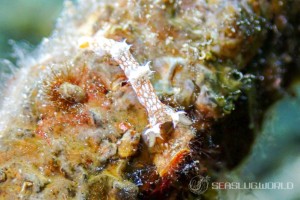
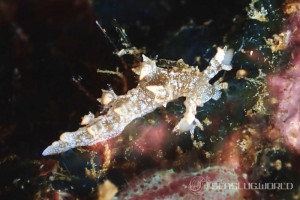
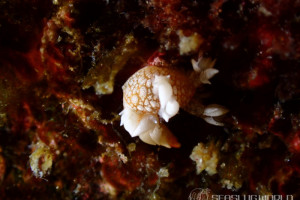
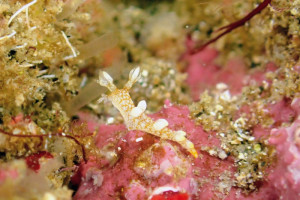
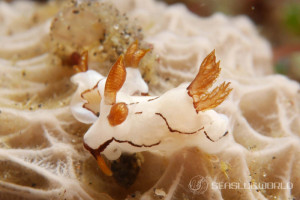
Bornella hermanni Angas, 1864
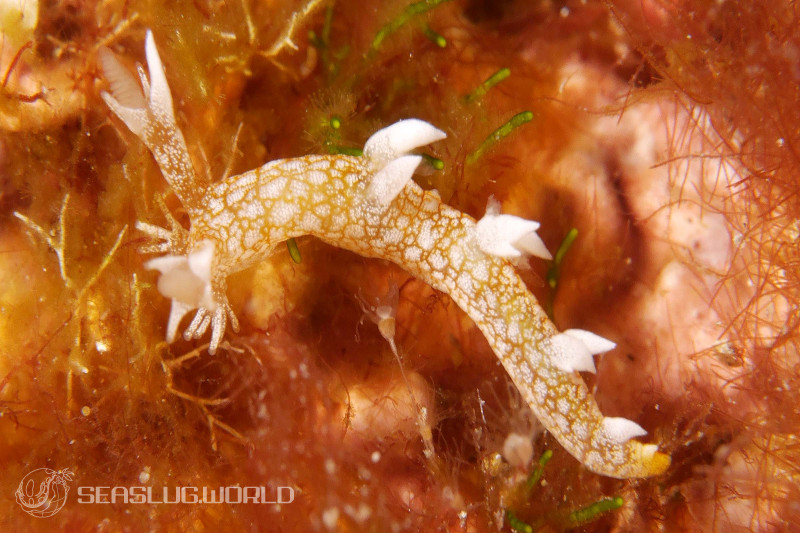
- Location
- Taredo, Hachijo Island, Tokyo, Japan
- Date
- 2016/09/10
- Length
- 10mm
- Depth
- 7.0m
- Water temperature
- 27.0℃
Description
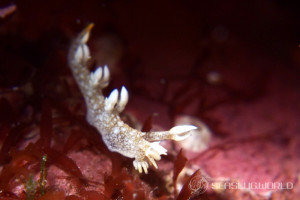
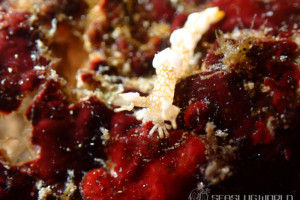
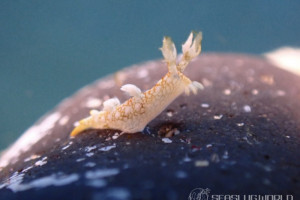
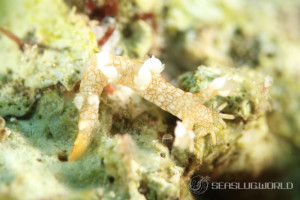
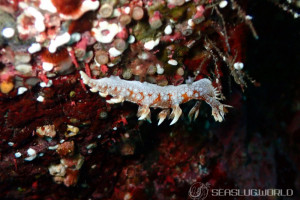
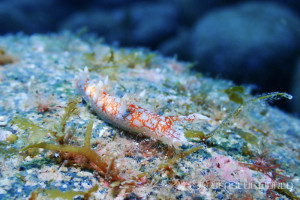
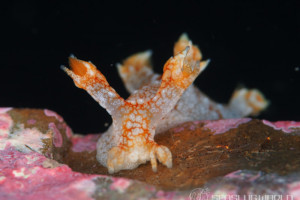
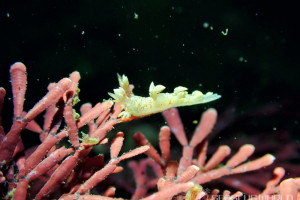
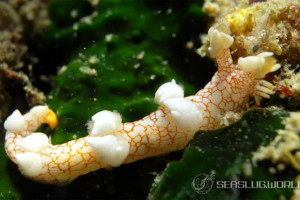
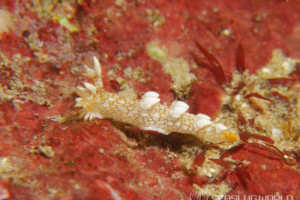
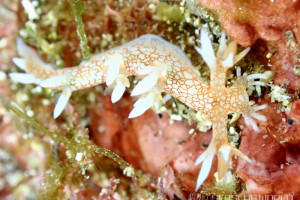
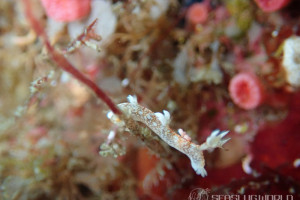
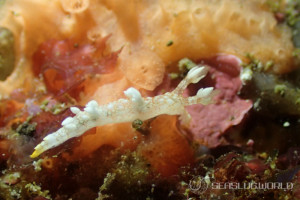
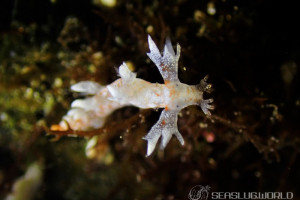
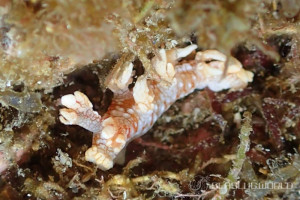
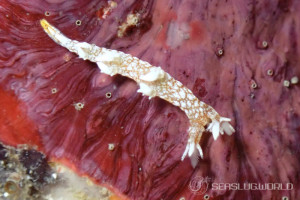
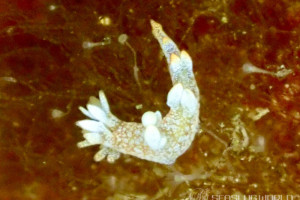
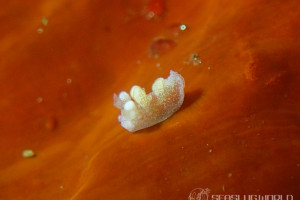
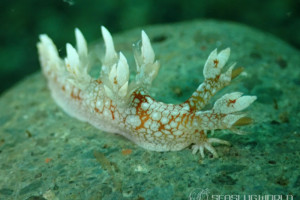
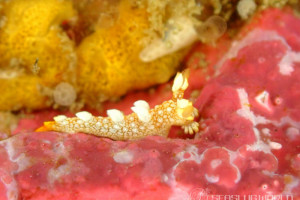
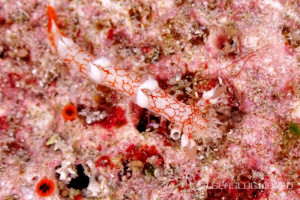
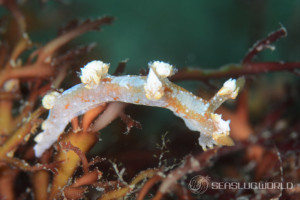
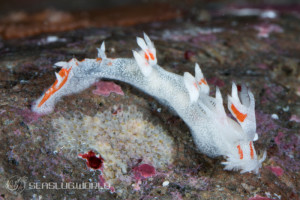
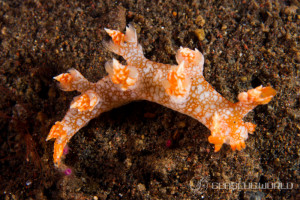
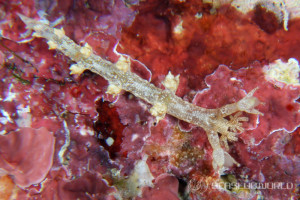
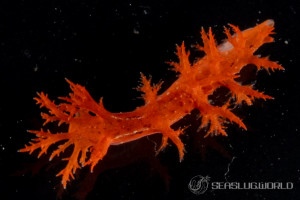
The body is elongate and limaciform, up to 50 mm in length. The ground colour is translucent cream-white with a network of broken red-orange lines and scattered subepidermal opaque white granules on the back and both sides; this colour pattern can extend to the stalk of the rhinophore sheaths and the dorsolateral processes. Each lobe-like oral tentacle bears 13–14 finger-like papillae of unequal length arranged in three rows; smaller specimens usually carry 9 to 12 papillae. The rhinophore sheath stalk is tall, with 15 to 20 lamellae on the rhinophore at its tip. At the upper edge of each sheath are three long, narrow anterior and anterolateral papillae and a taller, sail-like posterior papilla bearing two or three secondary papillae. Behind the rhinophores there are three pairs of dorsolateral processes, followed by two unpaired processes along the dorsal midline. The first and second pairs of dorsolateral processes have three or four branches; the third pair usually has three branches. In paired processes with four branches, three tripinnate translucent gills sit at the junction of each lateral papilla and the central one.The radula generally bears about eight to ten denticles on either side of a median cusp. The posterior chamber of the stomach is armed with about 20 to 30 longitudinal rows of brown chitinous spines that are straight, cylindrical and spatuliform at the tip. The penial bulb is large and contains a fleshy, irregularly lobed structure armed with a single circular row of chitinous hooked spines.
Distribution
Distributed across the Indo-West Pacific, with the type locality in Sydney Harbour, eastern Australia. The Japanese populations previously reported as B. japonica are referable to this species. Also recorded from the Marshall Islands, Malaysia, Korea and the Indian Ocean (Christmas Island and elsewhere).Etymology
The specific epithet hermanni is the genitive of the personal name Hermann; the original description by Angas 1864 does not state the dedicatee explicitly.Remarks
Pola, Rudman & Gosliner 2009 treated Bornella japonica Baba, 1949, originally described from Japan, as a new junior synonym of Bornella hermanni. Baba had separated B. japonica from Bornella stellifera on the basis of four supra-marginal papillae on the rhinophore sheaths (the hindmost subdivided into two or three smaller papillae) and three pairs of dorsolateral processes, but Angas's B. hermanni from eastern Australia shows exactly the same features.This species has often been misidentified as Bornella stellifera in field guides. It differs from B. stellifera in always having branched posterior papillae on the rhinophore sheaths, in lacking the orange subapical rings on the papillae (which are cream-white instead), in having more numerous and spatuliform stomach spines, and in having the penial spines arranged in a single ring around a large fleshy lobe rather than in several rows.
References
- ヤマトユビウミウシ(新稱), Baba K. (1949). Opisthobranchia of Sagami Bay collected by His Majesty the Emperor of Japan (相模湾産後鰓類図譜). Iwanami Shoten, Tokyo. 4+2+194+7 pp., pls. 1-50.
- ユビウミウシ, 益田一. (1999). 海洋生物ガイドブック. 東海大学出版会.
- ユビウミウシ, 益田一. (1999). 海洋生物ガイドブック. 第2刷. 東海大学出版会.
- ユビウミウシ, 中野理枝. (2004). 本州のウミウシ. ラトルズ.
- ユビウミウシ, 小野篤司. (2004). 沖縄のウミウシ. ラトルズ.
- Bornella hermanni Angas, 1864 (= Bornella japonica Baba, 1949 syn. nov.), Pola M., Rudman W.B. & Gosliner T.M. (2009). Systematics and preliminary phylogeny of Bornellidae (Mollusca: Nudibranchia: Dendronotina) based on morphological characters with description of four new species. Zootaxa. 1975(1): 1-57. https://doi.org/10.11646/zootaxa.1975.1.1
- Bornella hermanni, Terrence Gosliner, Ángel Valdés and David Behrens. (2015). Nudibranch and Sea Slug Identification Indo-Pacific. New World Pubns Inc.
Featured in this book

Terrence Gosliner, Ángel Valdés and David Behrens. (2018). Nudibranch and Sea Slug Identification Indo-Pacific 2nd Edition. New World Pubns Inc.
New World Publications
This species, Bornella hermanni, is included in the book.
View on Amazon PR (Amazon Associates)Seasonality
Shooting Locations
Loading shooting locations...
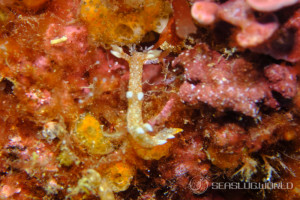
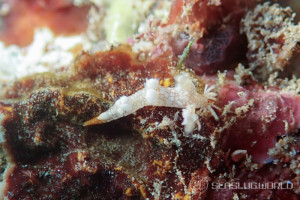
Photos of Bornella hermanni



























Same Genus Nudibranchs

Similar Colors Nudibranchs
Academic Database
Sea slug observation data is available in international marine biodiversity databases.