Japanese Shell Names Decoded — Three Old Names Edo-Period Naturalists Gave to Sea Slugs
Last time we looked at the viral nicknames — Sea Bunny, Blue Dragon, Pikachu. Whatever else they are, they all start from a recognizable animal. Rabbit. Dragon. Rodent. Easy targets.
This time the Japanese names go somewhere English mostly can't follow. Three old shell names, all predating Linnaean taxonomy, that reach not for animals or cartoons but for imperial palace furnishings and court textiles. Names that describe a shell by way of the bamboo blind a Heian princess sat behind, or the indigo dye a craftsman pulled out of the vat after six baths.
Two words to get out of the way up front:
Shibori (絞り) — traditional Japanese resist-dyeing. You bind, fold, or stitch a piece of fabric, drop it in an indigo vat, and the tied parts come back out white. The result is that distinctive pattern of speckled dots and soft-edged bands on a dark ground. "Japanese tie-dye" gets you close, but shibori is older and much more disciplined.
Misu (御簾) — the fine-woven bamboo blind hung in imperial palaces and shrines. Horizontal ribs, vertical silk bindings at regular intervals. If you've seen a Heian court scene in any painting, you've seen misu.
Once you know what shibori and misu look like, the three names below stop being mysterious and start being obvious. Each one is literally named after an object: a dyed cloth, a dyed cloth, a palace blind.
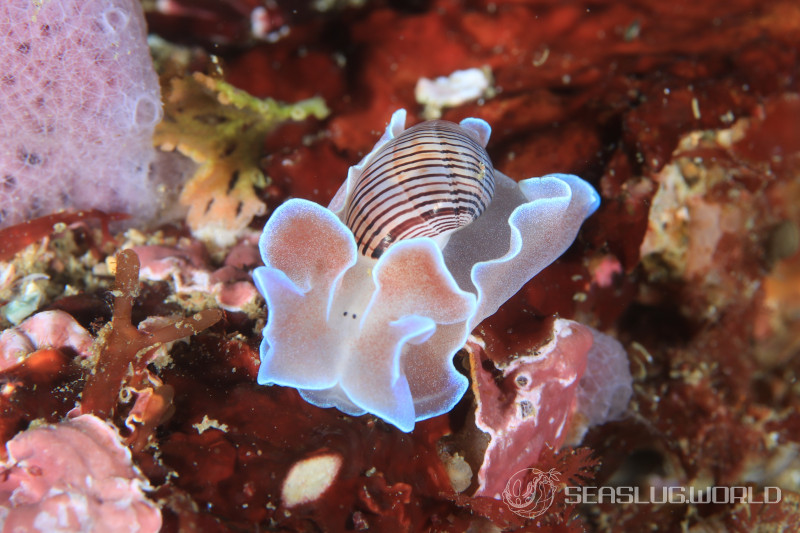
1. The court blind — Misugai
- Japanese: Misugai (御簾貝) — "court-blind shell"
- English (common): Brown-lined Paper Bubble
- Scientific: Hydatina physis (Linnaeus, 1758)
The thin brown horizontal bands wrapping the globular shell really do look like the ribs of a misu screen. That's the whole name. English went for "paper bubble" — descriptive, practical, about the material. Japanese went for a specific piece of imperial interior design.
Biological aside: Hydatina is in the family Aplustridae — a shelled heterobranch, sometimes called a "bubble snail," with a thin external shell and a body too big to retract into it. Not what most English speakers picture when they hear "sea slug," but firmly in the umbrella group.
2. The crimson tie-dye — Benishibori & Ōbenishibori
- Japanese: Benishibori (紅絞り, "crimson shibori"), Ōbenishibori ("great crimson shibori")
- Scientific: Bullina lineata (J. E. Gray, 1825); Bullina nobilis Habe, 1950
The shell of Bullina lineata is cream-white with rose-pink spiraling lines — the exact palette of red-dyed shibori on undyed silk. It is, in every sense, a tiny wearable garment for a snail. Ōbenishibori is the same idea with a bigger shell.
The name is old. Musashi Sekijū's 1843 shell manual Mokuhachi-fu already lists this species as beni-ko-shibori (紅粉絞) — which means Japanese naturalists had been calling it a piece of tie-dyed fabric for at least two centuries before anyone put on a dive mask. This isn't a modern fancy. It's what the shell actually looked like to someone handling textile dyes every day.
→ Bullina lineata | → Bullina nobilis
3. The indigo tie-dye — Konshibori-gai
- Japanese: Konshibori-gai (紺絞り貝) — "indigo-shibori shell"
- Scientific: Micromelo guamensis (Quoy & Gaimard, 1825)
Kon isn't generic blue. It's the specific deep indigo a dyer gets after several baths in the vat — the colour where the fabric stops getting bluer. The shell is that colour. Someone who'd spent time around an indigo dyer named this animal.
The Japanese name was in circulation well before the scientific side settled down. Yōichirō Hirase coined Konshibori-gai in 1914, and it appears in the 1928 Catalogue of Molluscs of Amami-ōshima as "Konshibori (Hirase)." Meanwhile the scientific name has bounced around — the species was long considered synonymous with the Atlantic Micromelo undatus (Bruguière, 1792) until a 2021 molecular revision (Feliciano et al.) resurrected M. guamensis, originally described by Quoy & Gaimard from Guam in 1825, as the distinct western-Pacific species. The Japanese name stayed stable throughout.
What these three names have in common
Three things worth noticing.
They aren't "looks like" metaphors. "Sea bunny" is a comparison — this looks like that. Benishibori is a classification — this is a kind of textile. The difference is the word as versus the word like. Japanese is naming the shell as though it were already patterned cloth, not as though it resembled some cloth somewhere.
The references are all pre-industrial and very specific. Not "a dye" but indigo after several baths. Not "a blind" but the bamboo screen a princess sat behind. Not "dyed cloth" but benizome shibori specifically. These come from an era when the named objects were daily life, not boutique crafts. A shibori-patterned shell in 1820 would have looked, instantly, like a dyer's sample left on the beach.
They're old. Benishibori is documented in 1843. Konshibori was in print by 1914 and almost certainly older. These aren't new coinages — they predate the Linnaean assignments they're now paired with. Japanese naturalists were classifying these shells into a cultural-material vocabulary before Western science had fully worked out the genus-level taxonomy.
A small closing note
Western shell naming has its own long tradition, and it's equally ancient. Aristotle named the sea hare two thousand years ago. Linnaeus's Systema Naturae in 1758 formalised what 17th-century Dutch and English collectors had been cataloguing for decades. But the metaphor vocabulary is different. Western vernacular shell names reach for the angel (Angel Wings, Cyrtopleura), the pagan deity (Venus shells), the religious office (Turk's Cap, Bishop's Mitre), or the animal (Paper Nautilus, Sea Hare). Japanese reached for the textile pattern and the palace blind.
Same activity — smart people looking at shells and reaching for a reference word — very different cultural shelves to reach onto. It makes you wonder what the next thing is. What sea slug, fifty years from now, will some kid name after whatever object is part of her daily life that we haven't thought of yet.
Read this next
Part 1: Sea Bunny, Blue Dragon, Pikachu — What Those Viral Sea Slug Nicknames Really Mean
Enjoyed this post? You can tip the author directly —
Tip this post