Sea Bunny = Jorunna, Blue Dragon = Glaucus: Real Names Behind Viral Sea Slugs
You've seen the photo. The fluffy little white thing with what look like tiny ears, captioned "sea bunny." Someone asks "what even is that?" and you confidently say, "it's a sea slug!" Fine. But what sea slug, exactly?
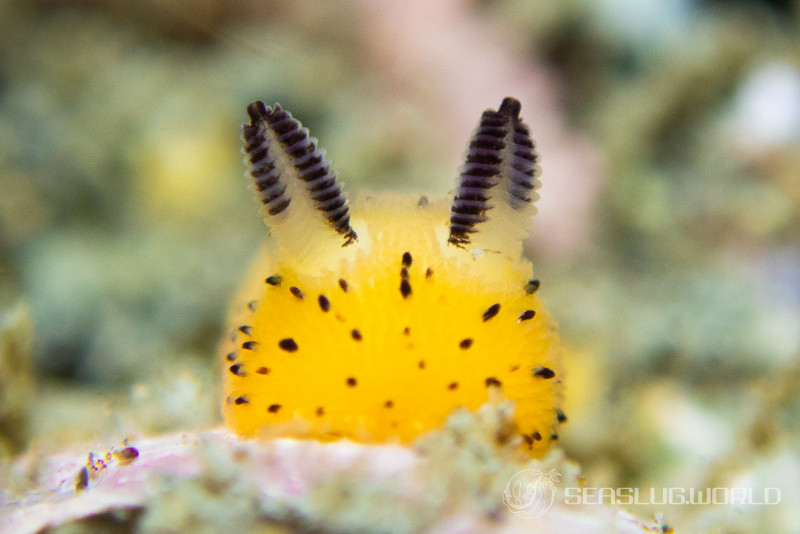
The answer is Jorunna parva. In Japan, it's been called goma-fu birōdo umiushi — "spotted-velvet sea slug" — since long before anyone pointed a phone camera at one. The name "sea bunny" is a nickname that went viral on Tumblr around 2015, and it stuck because the photos were irresistible. But strictly speaking, it isn't really a name. It's a meme that won.
Almost every famous sea slug you've seen shared online has a story like this: a social-media nickname, a different name that locals have used for ages, and a scientific name that quietly stays the same while everyone else argues about labels. Here are six of the big ones.
A quick note on the word "umiushi." The Japanese word for nudibranch is umiushi, written with kanji (海牛) that literally mean "sea cow." In English, "sea cow" refers to manatees and dugongs — a completely unrelated group of mammals — so throughout this article I'll gloss umiushi as "sea slug" instead. But just know: every time a Japanese name ends in -umiushi, the literal kanji meaning is "...sea cow." Apparently rhinophores reminded someone of horns, a long time ago.
1. Sea Bunny
- Viral nickname: Sea Bunny
- Formal English (WoRMS): Peppercorn Velvet Dorid
- Japanese name: Goma-fu birōdo umiushi (spotted-velvet sea slug)
- Scientific: Jorunna parva (Baba, 1938)
The "ears" are rhinophores, chemosensory organs that most nudibranchs have. The velvety texture isn't fluff — it's rows of tiny defensive structures called caryophyllidia. So biologically, the sea bunny is less "cute mammal" and more "bristled chemical-warfare unit." But the photos keep going viral anyway.
Worth noting: the Japanese name and the formal English name line up almost word-for-word. "Peppercorn" = goma-fu (sesame-speckled), "velvet" = birōdo, "Dorid" ≈ umiushi (sea slug — or literally "sea cow," as mentioned above). Two languages independently looked at this animal and went, "spotted, velvety, small." Only the English side later picked up a second name, courtesy of the internet.
And here's the thing: even among English-speaking divers, nobody actually says "Peppercorn Velvet Dorid." Try it out loud. It doesn't survive a dive boat. "Sea bunny" won because it's easier to say.
2. Sea Hare (or, the Rain Tiger)
- English: Sea Hare
- Japanese: Amefurashi — which, written in kanji, means rain tiger (雨虎)
- Scientific: Aplysia kurodai Baba, 1937 and relatives
The English name is ancient. Aristotle wrote about λαγωός θαλάσσιος — "sea hare" — over two thousand years ago, because the rhinophores look like a rabbit's ears. Fair enough.
Now, technically, rabbits and hares aren't the same animal. Rabbits (Leporidae) and hares (genus Lepus) diverge at the family level, and any biologist will correct you if you mix them up. But it's worth noticing that English reached for a long-eared mammal twice in this article already — "sea bunny" for Jorunna parva, "sea hare" for Aplysia. Two different sea slugs, two different rabbity metaphors, from a language that's otherwise pretty careful about keeping rabbits and hares apart.
In Japanese? Both would translate to usagi — one word covers the whole long-eared category, so the English distinction between rabbits and hares evaporates. And to be fair, Japanese does use usagi in sea slug names: there's a Costasiella usagi whose scientific name literally borrows the Japanese word, plus several species called shiro-usagi-umiushi (white-rabbit), yuki-usagi-umiushi (snow-rabbit), and so on. But for these particular two — sea bunny and sea hare — Japanese reached elsewhere entirely.
The Japanese name goes somewhere completely different. Amefurashi literally means "the one that brings rain" — folklore said that when these animals appeared in numbers, it would soon pour. Written in kanji, the same word becomes rain tiger. The creature that English-speakers have called a rabbit for two millennia, Japanese-speakers have been calling a weather-summoning tiger. Same animal. No overlap whatsoever.
3. Blue Dragon (which one, though?)
"Blue Dragon" is probably the single most-misattributed nickname in the sea slug world, because it doesn't refer to one species. It's applied, casually and confidently, to two completely unrelated animals.
The pelagic Blue Dragon — Glaucus atlanticus
This is the one in most viral photos. It drifts at the surface of the open ocean, feeds on Portuguese man o' war (yes, really), and looks like something out of a fantasy novel. The Japanese name is aomino-umiushi — "blue straw-raincoat sea slug." A mino is a woven straw cape that Edo-period peasants and fishermen wore. So where English went full mythological, Japanese went full pre-industrial workwear. The visual is the same; the cultural reference is about as far apart as it gets.
The reef Blue Dragon — Pteraeolidia spp.
Plenty of dive photos labeled "Blue Dragon" on Instagram are actually Pteraeolidia, an aeolid genus that lives on coral reefs, especially across the Indo-Pacific. Long body, rows of bluish-purple cerata down the back, very photogenic in a wafting-scarf kind of way. The Japanese name here is mukade-mino-umiushi — "centipede straw-raincoat sea slug," because the cerata line up like insect legs.
So when someone posts a "Blue Dragon" photo, you actually have to look at it to figure out which animal they mean. And it's worse than it sounds, because Pteraeolidia was recently split into multiple species of its own. The nickname is vague at two different levels simultaneously.
→ Glaucus atlanticus | → Pteraeolidia semperi
4. Leaf Sheep / Shaun the Sheep
- English: Leaf Sheep, Shaun the Sheep nudibranch
- Japanese: Hohobeni-mo-umiushi — "rosy-cheeked seaweed sea slug"
- Scientific: Costasiella sp. 3 (still undescribed)
Small, absurdly cute, and famous for doing something genuinely weird: it eats algae and keeps the chloroplasts alive inside its own body, running partial photosynthesis (a process called kleptoplasty). A sea slug that also sort of functions as a plant.
One catch worth knowing: a near-identical sibling species, Costasiella kuroshimae (known in Japan as tengu-mo-umiushi), gets confused with the "real" Shaun the Sheep constantly. Both species appear in dive photos and neither is reliably labeled. The actual "Leaf Sheep" / "Shaun the Sheep" of the viral posts is Costasiella sp. 3 — you can tell it apart by the pink blush on its cheeks, which is exactly what the Japanese name hohobeni (cheek rouge) picks up on. The other one is much less pink.
→ Costasiella sp. 3 (cf. Costasiella kuroshimae)
5. Pikachu — and the twist you probably didn't see coming
This is where it gets properly strange.
- Viral nickname: "Pikachu nudibranch"
- What Japanese divers have called "Pikachu": Thecacera pacifica — locally known as ude-furi-tsuno-zaya-umiushi
- What everyone else was calling "Pikachu": a different Thecacera, uncommon in Japan
- In 2026: that other species was formally described as Thecacera pikachu — yes, the scientific name is literally "pikachu"
A yellow body, black-tipped horns, plausibly a tiny electric mouse. The nickname took off globally. Even in Japan, divers use "Pikachu" more often than the ten-syllable local name. So far, so good.
But here's the twist: Japanese divers and non-Japanese divers were pointing at different animals the whole time.
- In Japan, the common species is Thecacera pacifica. When a Japanese diver said "Pikachu," that's what they meant.
- Outside Japan, T. pacifica is uncommon. The species most divers were photographing and labeling "Pikachu" was a different, as-yet-undescribed Thecacera.
- In 2026, that other species was formally described. The authors named it Thecacera pikachu, taking the internet nickname directly into the scientific name. It got a new Japanese name in the process: kanna-tsuno-zaya-umiushi.
So for years, everyone was using the same nickname for animals that now have different scientific names, different Japanese names, and different typical locations. It's a rare case of a viral nickname being promoted into binomial nomenclature — but the side effect is that "Pikachu" turned out to be two species wearing one costume the whole time.
→ Thecacera pikachu (kanna-tsuno-zaya) | → Thecacera pacifica (ude-furi-tsuno-zaya)
6. Spanish Dancer
- English: Spanish Dancer
- Japanese: Mikado-umiushi — "emperor sea slug"
- Scientific: Hexabranchus lacer (Cuvier, 1804)
A large, reddish dorid that swims with flowing undulations of its mantle. English-speaking divers saw flamenco; Japanese speakers saw imperial regalia. Different ceremonies, same idea — both cultures converged on "elegant and unmistakably red." That convergence is rare.
One technical note: for a long time, pretty much every Spanish Dancer got labeled Hexabranchus sanguineus. Recent molecular work has split the genus, and the "Mikado-umiushi" that Japanese divers know is now considered H. lacer, a separate species. So the name has stayed put in two languages while the animal quietly got reassigned underneath it.
So what's actually going on?
Line these up and one thing stands out: the only name that stays put across languages, cultures, and decades of taxonomy is the scientific name. Jorunna parva is Jorunna parva in Tokyo, in Sydney, and in a 1938 journal article. Nothing else in the naming system is that stable.
But scientific names don't really work in conversation. Nobody on a dive boat says "I saw a Hexabranchus lacer on the last dive." You say "Spanish Dancer" or Mikado-umiushi depending on who you're talking to. People default to whatever name is easiest to say in their own language. That's not a bug in naming — that's just how names are used.
Japanese has something English mostly doesn't: a long, pre-existing stock of vernacular sea slug names, built up over generations of naturalists and field guides, full of specific descriptive elements (mino, birōdo, tsuno-zaya, hohobeni) that slot neatly onto new species. Those names were already doing the job, so there was never a vacuum for a viral "sea bunny"-style nickname to fill.
English had the opposite situation. The formal vernacular names (Peppercorn Velvet Dorid, etc.) mostly exist on paper and nowhere else. The seat was open, and social media sat in it. Sea Bunny, Blue Dragon, Pikachu, Shaun the Sheep — all born on platforms, not in field guides.
Neither of those naming systems is particularly precise. Blue Dragon spans two genera. Pikachu spans two species. Shaun the Sheep routinely gets pointed at the wrong Costasiella. When you actually need to know what animal you're looking at, only the scientific name holds up.
And the imaginative leaps each language takes are just entertaining on their own. English keeps reaching for rabbits — even when it knows perfectly well rabbits aren't hares — and for dragons, and for fantasy creatures in general. Japanese, at the species level, reaches all over the place: rabbits (usagi), straw-raincoats (mino), centipedes (mukade), emperors (mikado), rain-tigers (amefurashi). But they're all umiushi at the category level, and umiushi literally means "sea cow." So every one of those straw-raincoats and tigers and rabbits is, technically, a breed of sea cow. Same animals, very different eyes.
Which is probably the point. Nicknames are for saying out loud. Scientific names are for being sure. A good sea slug photo usually needs both.
One more thing
Next time you're on a dive boat and someone says "I got a Blue Dragon shot!" — ask to see it. Check whether it's the pelagic one drifting in the open ocean or the reef-dwelling Pteraeolidia on the coral. If it's Pikachu, ask where they were diving: Japan or everywhere else. The answer changes the species.
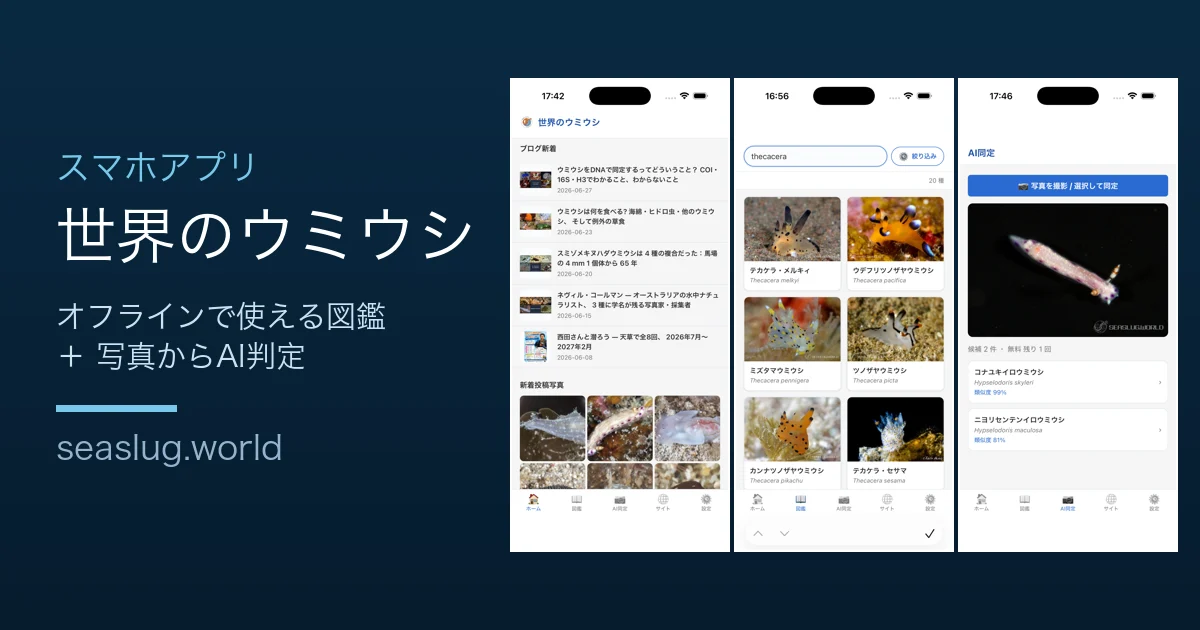
If you want to poke around more, SEASLUG.WORLD has species pages for everything mentioned above, with photos, distribution, and the messy tangle of synonyms each one has collected over the years.
Enjoyed this post? You can tip the author directly —
Tip this post