Aplysia kurodai (Baba, 1937)
Description
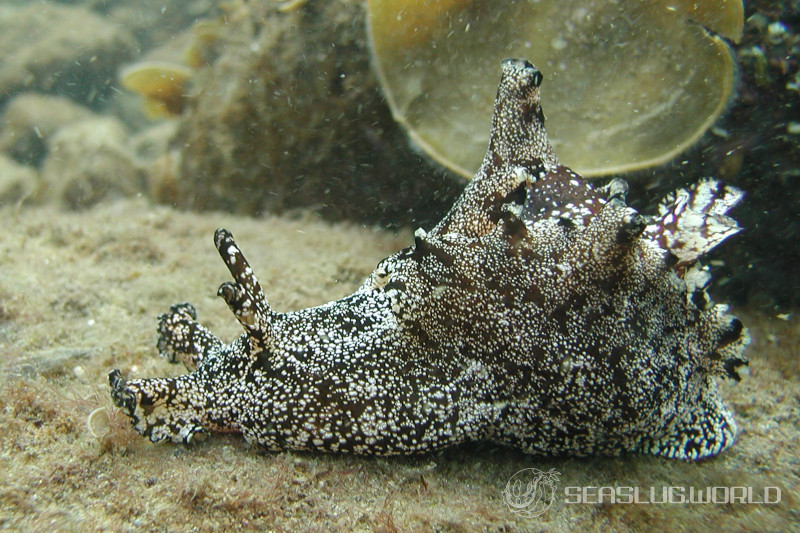
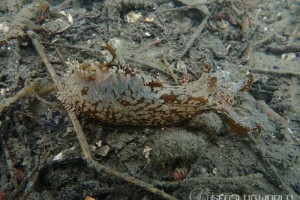
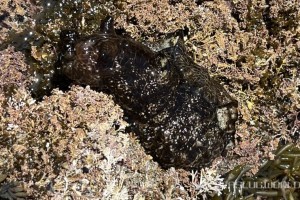
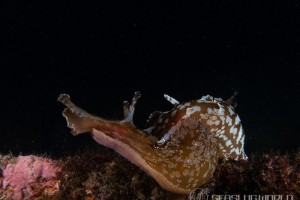
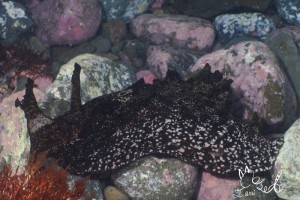
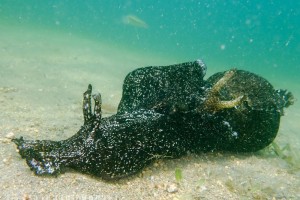
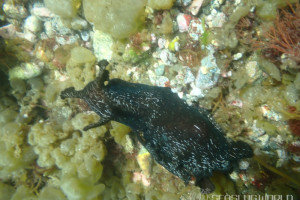
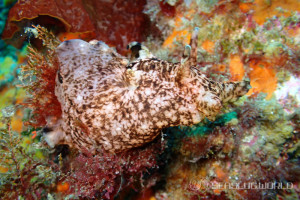
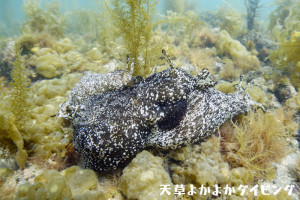
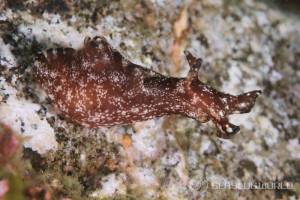
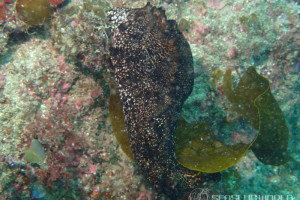
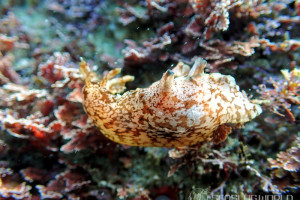
The most common large sea hare in Japanese coastal waters. Body reaches 350–400 mm in length, swollen behind and narrowing in front, with a long neck and head. At the anterior end of the head is a vertical slit-like mouth flanked by a pair of large folded anterior tentacles. The rhinophores are cylindrical with an upper outward-facing slit. The parapodial lobes, arising postero-laterally, are ample and free throughout, separated both in front and behind. The mantle is oval with a median foramen communicating with the shell cavity; this foramen is very small in young individuals and may take the form of a minute papilla in adults. Posteriorly, the mantle is produced into a short rolled anal siphon. A purple gland develops along the right margin of the mantle. The dorsal skin is soft and smooth. The opaline gland exudes a milky-white fluid through multiple pores. The genital groove begins at the common genital orifice in front of the ctenidium and runs forward to the penial orifice at the outer base of the right anterior tentacle. The foot is large, truncate in front and tapering to a blunt tail behind.Coloration
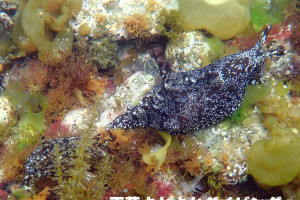
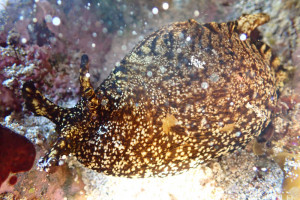
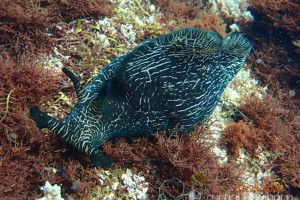
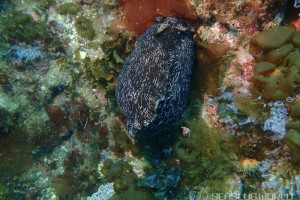
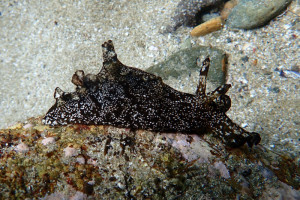
The upper surface is brownish or purplish-black, densely covered with small, oval, or irregular grayish mottles, which in some individuals are so large and abundant that they obscure the ground colour. The sole is uniformly dark. The ctenidium is yellow; the opaline gland yellowish-white.Distribution
Type locality: Formosa (Takahasi, 1934), with additional records from Tomioka (Amakusa), Misaki, and Tateyama, Japan (Baba, January–June 1936; very common).Etymology
The original description (Baba, 1937) states: "It is here named T. kurodai in honour of the malacologist, Mr. Tokubei Kuroda." Tokubei Kuroda (1886–1987) was a pioneering Japanese malacologist; Baba acknowledges him in Part I as one of the colleagues who provided access to the literature.Remarks
Originally described in the genus Tethys (later replaced by Aplysia because Tethys was preoccupied by a coelenterate genus). In the family Aplysiidae (Anaspidea). Externally and anatomically similar to the Atlantic and Mediterranean Tethys punctata (Cuvier) but distinguished by the parapodial lobes being separated behind, a slightly larger radular formula, a smaller mantle foramen, and a different shell shape.References
- Tethys kurodai nov. sp., Baba K. (1937). Opisthobranchia Of Japan (I). Journal of the Faculty of Agriculture, Kyushu University. 5(4): 195-236. https://doi.org/10.5109/22583
- アメフラシ, Baba K. (1949). Opisthobranchia of Sagami Bay collected by His Majesty the Emperor of Japan (相模湾産後鰓類図譜). Iwanami Shoten, Tokyo. 4+2+194+7 pp., pls. 1-50.
- Aplysia kurodai (Baba) Amefurashi, Baba, K. 1957. A revised list of the species of Opisthobranchia from the northern part of Japan, with some additional descriptions. J. Fac. Sci., Hokkaido Univ.,ser. 6, Zool. 13(1-4):8-14.
- アメフラシ, 高岡高等学校生物研究会(編). (1964). 富山湾産後鰓類図譜.
- 高岡生物研究会. (2002). 日本海のウミウシ. 第2版.
A Kindle field guide by the site author

Kimoto N. (2026). Sea Slugs of Japan & the Indo-Pacific, 2nd Edition.
Kindle Edition
View on Amazon PR (Amazon Associates)Seasonality
Shooting Locations
Loading shooting locations...
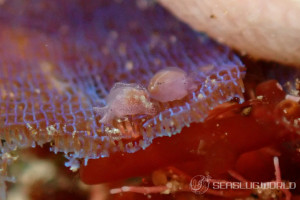
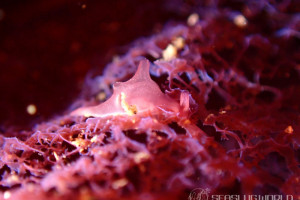
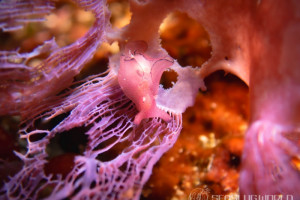
Photos of Aplysia kurodai
Tag:























Same Genus Nudibranchs
Similar Colors Nudibranchs
Academic Database
Sea slug observation data is available in international marine biodiversity databases.