Aplysia californica (J. G. Cooper, 1863)
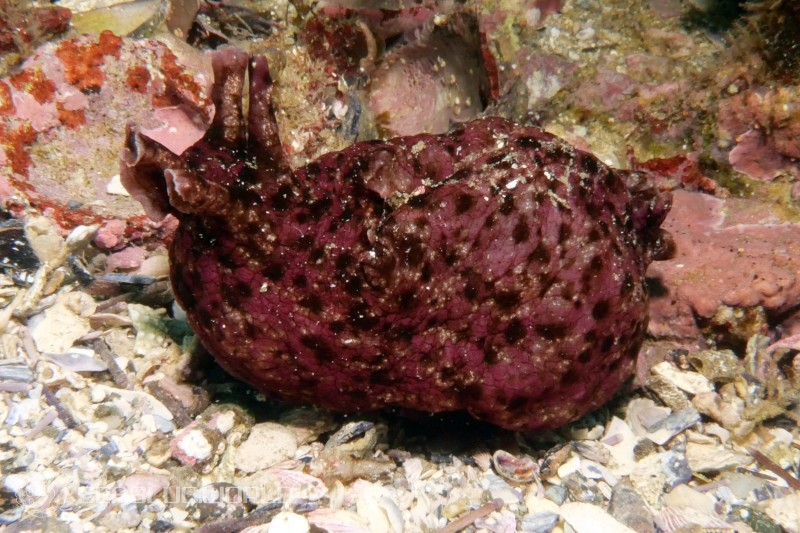
- Location
- Lobster Shack, Coronado Islands, Baja California, Mexico
- Date
- 2019/10/25
- Length
- ??mm
- Depth
- ??m
- Water temperature
- ??℃
Description
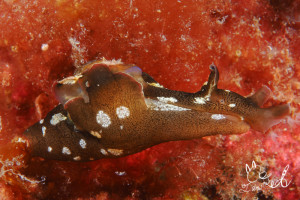
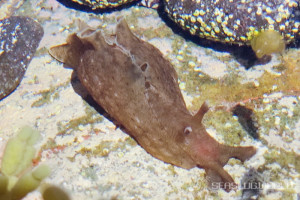
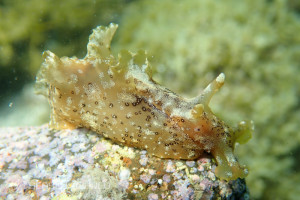
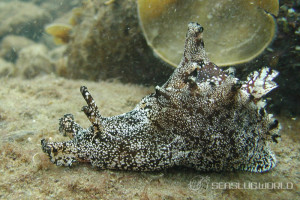
A very large sea hare that can reach about 75 cm in length when crawling and weigh up to 7 kg, making it one of the largest sea slugs. The soft body ranges from greyish-green to reddish-brown, mottled with white specks and brown lines. There are two pairs of tentacles on the head, and large wing-like parapodial folds along the sides of the back; a thin shell is retained internally. When disturbed, it releases purple ink and a whitish secretion in defence.Distribution
Northeastern Pacific, from Oregon, USA, south to northwestern Mexico and the Gulf of California. It lives in the intertidal zone and shallow rocky reefs and algal beds. The species was originally described from California.Etymology
The specific epithet californica means “of California,” after the region where it was found.Remarks
A herbivore that feeds on red algae such as Laurencia, its body colour being influenced by the algae it eats. With a simple nervous system of relatively few, unusually large neurons, it has long been a classic model organism in the neuroscience of learning and memory, famously in the work of Nobel laureate Eric Kandel.References
- Aplysia californica n.sp., Cooper J.G. (1863). On new or rare Mollusca inhabiting the coast of California — No. II. Proceedings of the California Academy of Natural Sciences. Series 1, 3: 56-60.
- Aplysia californica, Behrens D.W., Hermosillo A., Fletcher K. & Jensen G.C. (2022). Nudibranchs & Sea Slugs of the Eastern Pacific. Molamarine.
Featured in this book
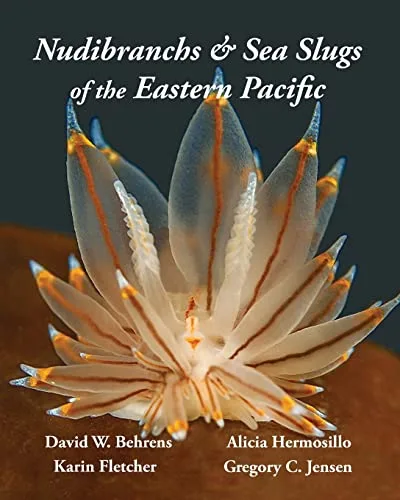
Behrens D.W., Hermosillo A., Fletcher K. & Jensen G.C. (2022). Nudibranchs & Sea Slugs of the Eastern Pacific. Molamarine.
Molamarine
This species, Aplysia californica, is included in the book.
View on Amazon PR (Amazon Associates)Seasonality
Shooting Locations
Loading shooting locations...
Photos of Aplysia californica

Same Genus Nudibranchs
Similar Colors Nudibranchs

Academic Database
Sea slug observation data is available in international marine biodiversity databases.